The science behind non-stick pans: How they really work
TL;DR:
- PTFE (Teflon) has the lowest coefficient of friction and creates non-stick surfaces.
- Surface energy differences determine whether food sticks or releases from cookware.
- Alternatives like ceramic, carbon steel, and cast iron offer PFAS-free options with varying durability.
The slipperiest solid on earth is almost certainly sitting in your kitchen cupboard right now. Polytetrafluoroethylene, better known as PTFE or Teflon, holds the record for one of the lowest coefficients of friction of any known material, and it is the reason a fried egg can glide across a pan with barely a drop of oil. Yet most home cooks treat all non-stick pans as interchangeable, choosing by price or colour rather than by what is actually happening at the molecular level. PTFE gives non-stick pans their unique properties, but the story goes far deeper than a single coating. Understanding the science will change how you shop, cook, and care for every pan you own.
Table of Contents
- The science behind non-stick surfaces
- How non-stick coatings are applied to pans
- The strengths and weaknesses of non-stick technology
- Alternatives to PTFE: Ceramic, carbon steel, and more
- A closer look: What most non-stick guides won’t tell you
- Find your perfect pan for healthier everyday cooking
- Frequently asked questions
Key Takeaways
| Point | Details |
|---|---|
| PTFE creates non-stick | PTFE coatings repel food due to low surface energy and strong chemical bonds. |
| Heat and care matter | Using non-stick pans correctly prevents coating damage and prolongs their life. |
| Alternatives exist | Ceramic, carbon steel, and cast iron suit different needs and health priorities. |
| Regulations influence choices | Health and environmental rules are shifting European pan markets toward PFAS-free options. |
The science behind non-stick surfaces
To understand why food sticks to metal, you first need to think about surface energy. Every material has a surface energy, which is essentially a measure of how eagerly its molecules want to bond with whatever touches them. Bare stainless steel and aluminium have high surface energy, which means food proteins and sugars form covalent bonds and van der Waals interactions with the pan almost instantly when heat is applied. That is why a cold chicken breast dropped onto a dry, uncoated steel pan welds itself to the surface within seconds.
PTFE works by doing the opposite. Its carbon-fluorine bonds are extraordinarily strong and stable, but they are also deeply unreactive. The fluorine atoms essentially shield the carbon backbone from interacting with anything outside the molecule. The result is extremely low surface energy that leaves food with almost nothing to grip. Water beads on it. Oil spreads in a microscopically thin layer. Proteins cannot form meaningful bonds.
Here is a quick summary of what drives sticking and what prevents it:
- High surface energy metals (steel, aluminium, cast iron without seasoning) attract food molecules aggressively.
- Microscopic roughness on bare metal creates tiny pockets where food can physically lock in place.
- PTFE’s fluorine shield repels food molecules before bonds can form.
- Seasoned surfaces (carbon steel, cast iron) fill those microscopic pockets with polymerised oil, lowering surface energy naturally.
The difference between a pan that sticks and one that does not often comes down to a layer thinner than a human hair. Surface energy, not slipperiness in the everyday sense, is the real deciding factor.
For a direct comparison of how these principles play out in practice, the carbon steel vs nonstick guide on our site breaks down the real-world cooking differences in useful detail.
How non-stick coatings are applied to pans
Knowing what PTFE does is one thing. Understanding how it gets onto a pan explains why some non-stick surfaces last five years and others start peeling after five months.
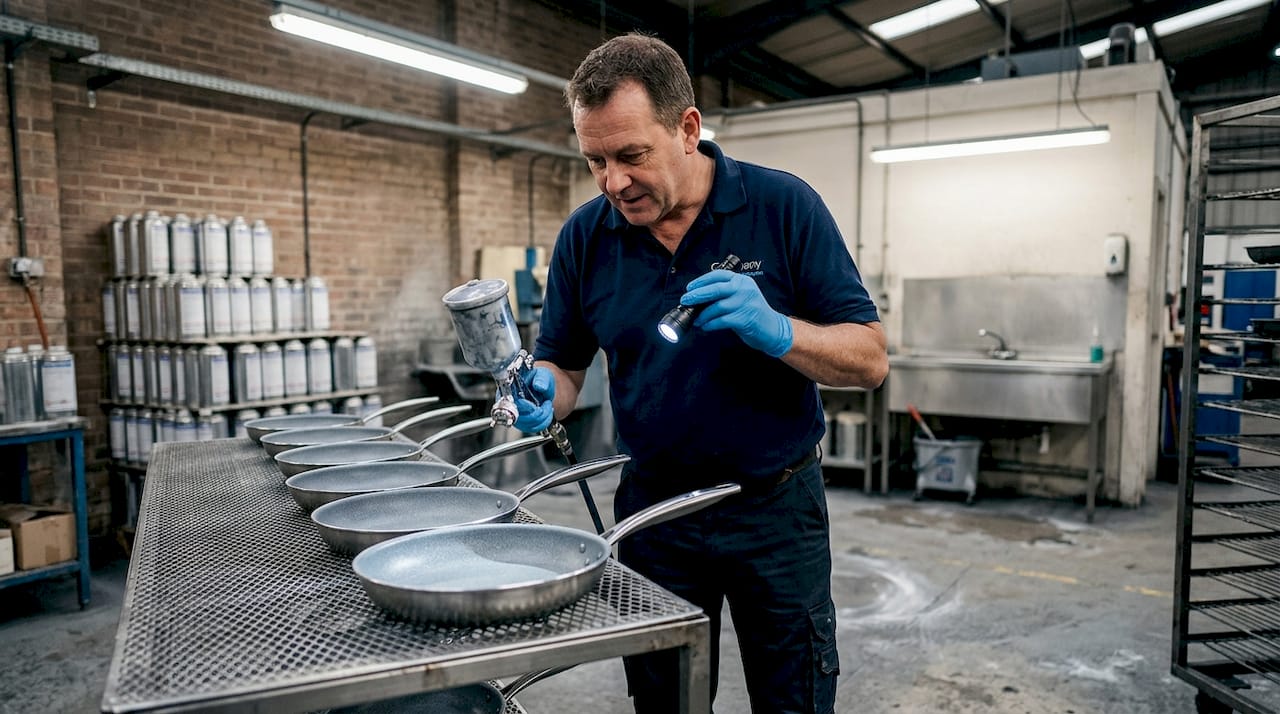
The process begins before a single drop of coating is applied. Manufacturers use abrasive blasting or chemical etching to roughen the metal substrate. This sounds counterintuitive given that we just established roughness causes sticking, but at this stage the goal is adhesion for the coating itself, not for food. The roughened surface gives the PTFE something to grip.
Here is how the coating process typically unfolds:
- The metal pan is cleaned and degreased thoroughly.
- The surface is roughened by sandblasting or acid etching.
- A primer layer is applied to improve adhesion between metal and PTFE.
- PTFE is sprayed or rolled onto the surface in successive layers.
- The pan is cured in a high-temperature oven to bond the coating.
- Quality checks assess thickness, adhesion, and surface uniformity.
PTFE is applied in 1 to 7 layers on the roughened metal, filling microscopic crevices to create a smooth, inert shell. The number of layers matters enormously for durability.
| Number of PTFE layers | Typical durability | Common use case |
|---|---|---|
| 1 to 2 layers | 6 to 18 months | Budget pans |
| 3 to 4 layers | 2 to 4 years | Mid-range cookware |
| 5 to 7 layers | 4 to 7 years | Professional grade pans |
Manufacturing consistency is where quality diverges sharply. Uneven spraying leaves thin spots that degrade first. Inadequate curing temperatures mean the coating never fully bonds. These are not problems you can spot in a shop, which is why brand reputation and independent reviews matter more than the label on the box.
Pro Tip: If you want a non-stick surface that never chips or peels, consider a seasoned carbon steel pan instead. Proper rust prevention methods keep the surface performing without any applied coating at all. You can also explore ceramic vs nonstick manufacturing for a broader view of how different surfaces are made.
The strengths and weaknesses of non-stick technology
PTFE non-stick pans are genuinely excellent tools for specific tasks. Scrambled eggs, crêpes, delicate fish fillets, and low-fat cooking all benefit from a surface that releases food without fuss. At low to medium heat, PTFE performs consistently and requires minimal fat, which suits health-conscious everyday cooking well.
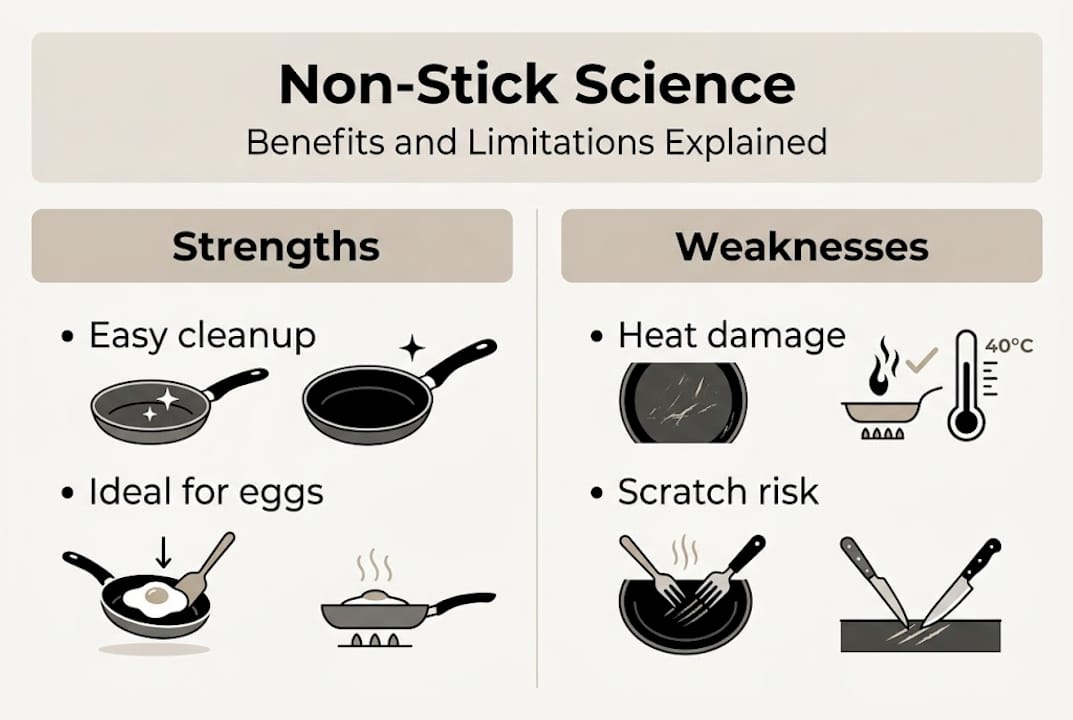
The problems begin when heat rises. PTFE degrades above 260°C, losing its non-stick properties and releasing fumes that are harmful to birds and, at very high concentrations, uncomfortable for humans. An empty non-stick pan on a high gas flame can reach 260°C in under two minutes. That is not a theoretical risk; it is a routine kitchen scenario.
| Scenario | Risk level | Recommendation |
|---|---|---|
| Empty pan on high heat | High | Never preheat empty |
| Metal utensils on coating | Medium | Use silicone or wood only |
| Dishwasher cleaning | Medium | Hand wash only |
| Cooking at medium heat | Low | Safe everyday use |
| Oven use above 200°C | Medium to high | Check manufacturer limit |
Beyond heat, physical damage is the other major threat. Metal spatulas, sharp utensils, and abrasive sponges all scratch through PTFE layers. Once the coating is compromised, food sticks in those spots, the damage spreads, and the pan’s useful life ends. Dishwashers accelerate this process through both the mechanical action and harsh detergents.
Pro Tip: If you want to sear a steak or cook at high heat regularly, a cast iron vs nonstick comparison will show you why PTFE is simply the wrong tool for that job. Similarly, a stainless steel vs non-stick guide can help clarify which surface suits which cooking style.
The practical upshot is that non-stick pans work brilliantly within a narrow performance band. Push them outside it, and the technology fails quickly.
Alternatives to PTFE: Ceramic, carbon steel, and more
Health and environmental concerns have driven genuine innovation in the non-stick category. Ceramic is PFAS-free and handles higher heat than PTFE, but its non-stick effect typically fades faster, often within one to two years of regular use. The sol-gel coating used in ceramic pans is harder than PTFE but more brittle, and once the surface degrades, it cannot be restored.
Carbon steel and cast iron take a fundamentally different approach. Instead of applying a coating, you build one. Repeated seasoning with high-smoke-point oils creates a layer of polymerised carbon that fills the surface’s microscopic pores and lowers its surface energy. The result is a natural non-stick surface that actually improves with use rather than degrading. You can explore alternatives to Teflon and specifically Teflon-free carbon steel options if this approach appeals to you.
Here is how the main alternatives compare on key priorities:
- Ceramic: PFAS-free, higher heat tolerance, shorter non-stick lifespan, cannot be re-seasoned. Good for medium-heat cooking.
- Carbon steel: PTFE-free, improves over time, handles high heat, requires initial seasoning effort. Excellent all-round performer.
- Cast iron: Similar to carbon steel but heavier. Outstanding heat retention, very long lifespan, suits slow cooking and searing.
- Stainless steel: No non-stick properties without fat, but extremely durable and dishwasher-safe. Best for browning and braising.
For those concerned about avoiding PFAS in everyday products, carbon steel and ceramic represent the most practical kitchen alternatives available today. A ceramic vs Teflon comparison can help you decide which direction suits your cooking habits best.
Pro Tip: Seasoning a carbon steel pan is not difficult, but the first three sessions matter most. Use a very thin coat of grapeseed or avocado oil each time, and bake the pan upside down at 250°C for 30 minutes. Thin layers build a stronger, more even patina than thick ones.
A closer look: What most non-stick guides won’t tell you
Most buying guides present the non-stick decision as a straightforward technical question: which coating lasts longest, which handles the most heat, which is easiest to clean. We think that framing misses the point entirely.
The industry defends PTFE as stable and inert, while environmental bodies emphasise potential PFAS risks and microplastics, and EU regulations are already tightening in ways that will reshape the market. Neither side is being dishonest. The science genuinely supports both positions depending on which variables you prioritise.
What we find more useful is asking a different set of questions. How do you actually cook? Do you cook at high heat daily, or mostly at medium? Are you cooking for one or for a family? How much time are you willing to invest in maintenance? A health, performance, and value comparison will give you a clearer picture than any single metric.
The pan that is right for you is the one that fits your real kitchen habits, not the one with the most impressive marketing claim on the box.
Find your perfect pan for healthier everyday cooking
If this article has made you curious about cooking without PTFE coatings, you are not alone. More European home cooks are moving towards surfaces they can trust at high heat, maintain for decades, and pass on rather than replace every few years.
At Brass & Steel, our carbon steel pans are forged from a single sheet of steel with no rivets, no welds, and no applied coatings of any kind. The non-stick surface is one you build yourself through seasoning, and it only gets better with time. If you want to explore what that looks like in practice, our guide to the best Teflon-free pans is a practical starting point for making the switch with confidence.
Frequently asked questions
Is PTFE (Teflon) safe to cook with?
PTFE is inert and safe below 260°C and has been PFOA-free since around 2015, but you should always avoid overheating an empty pan, as PTFE degrades above 260°C and can release unpleasant fumes.
Why does food still stick on some non-stick pans?
PTFE coatings lose effectiveness when overheated or scratched, and sticking can also occur if the pan is used completely dry at high heat or if the coating has simply worn thin through regular use.
What is the main difference between ceramic and PTFE non-stick pans?
Ceramic is PFAS-free and tolerates higher temperatures than PTFE, but its non-stick surface wears out faster and cannot be restored once it degrades, unlike seasoned alternatives.
Are there eco-friendly non-stick pan options?
Yes. Ceramic and seasoned carbon steel are both PFAS-free alternatives, and EU regulations are tightening on PFAS, which is likely to make these options even more widely available in the coming years.