Non-stick pans explained: types, safety, and alternatives
TL;DR:
- Non-stick cookware includes PTFE, ceramic, and natural seasoning, each with different mechanisms.
- Properly seasoned carbon steel or cast iron pans are durable, chemical-free, and improve with use.
- PTFE is safe when used correctly but concerns over PFAS are driving interest toward natural non-stick options.
Most home cooks assume non-stick means one thing: a dark, slippery Teflon coating that makes fried eggs glide across the pan. That assumption leaves out a whole world of cookware. Cast iron, carbon steel, and even ceramic pans can all become genuinely non-stick, each through a different mechanism. Understanding what separates these surfaces matters more than ever, especially as European cooks increasingly question synthetic coatings and look for cleaner, longer-lasting alternatives. This guide covers how each type works, what the safety evidence actually says, and how to choose and use a natural non-stick pan with real confidence.
Table of Contents
- What does ‘non-stick pan’ really mean?
- Understanding non-stick: Materials and how they work
- Safety, health and sustainability considerations
- Choosing and using natural non-stick pans
- Our perspective: Why natural non-stick is the pro’s choice
- Discover natural non-stick cooking with Brass & Steel
- Frequently asked questions
Key Takeaways
| Point | Details |
|---|---|
| Non-stick isn’t just Teflon | Both synthetic coatings and naturally seasoned pans can achieve non-stick results. |
| Natural non-stick lasts decades | With correct seasoning and care, carbon steel and cast iron pans are a sustainable, chemical-free option. |
| Safety comes down to use | Modern PTFE is safe if not overheated or scratched, but natural alternatives avoid PFAS entirely. |
| Care and technique matter | Proper seasoning and gentle cleaning are key to non-stick performance and pan longevity. |
What does ‘non-stick pan’ really mean?
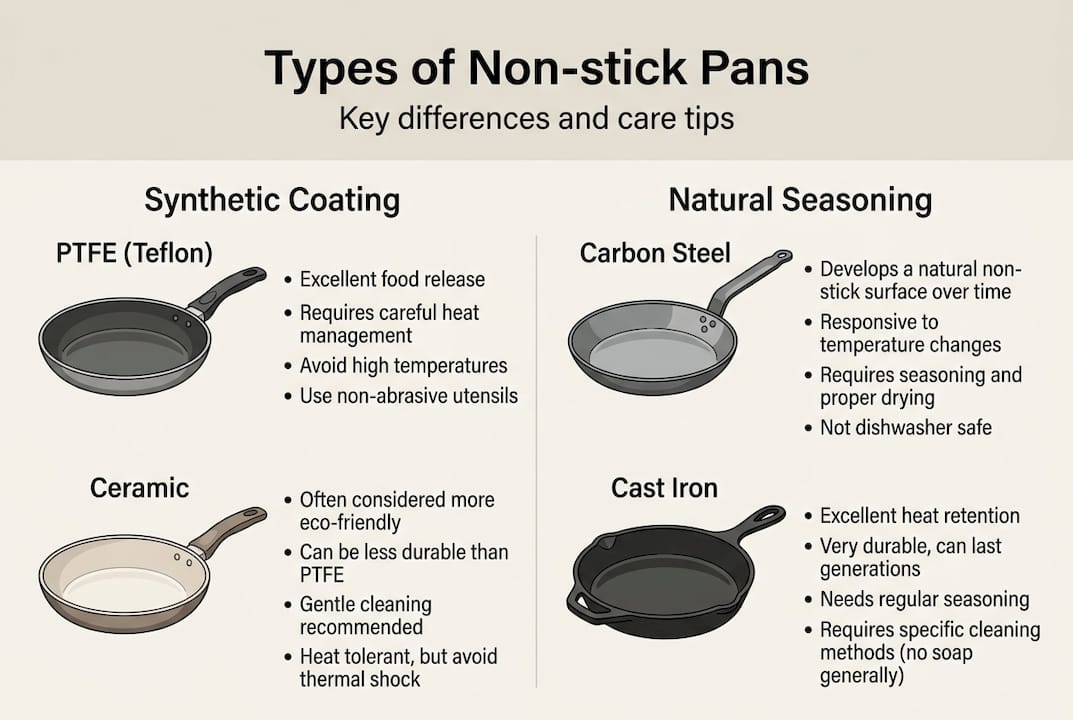
The term gets used loosely, and that causes a lot of confusion in the kitchen. Technically, a non-stick pan is cookware with a surface engineered to minimise food adhesion, achieved via synthetic coatings like PTFE, ceramic alternatives, or natural seasoning on materials like carbon steel. The surface itself is only part of the story. What matters is why food sticks in the first place.
Food sticks to pans because proteins and sugars bond chemically with hot metal surfaces. A non-stick surface interrupts that bond. It does this either by being physically smooth, chemically inert, or by carrying a thin layer of polymerised oil that acts as a barrier between the food and the metal.
“The key is surface energy. Low surface energy means food molecules have nothing to grip onto, which is exactly why PTFE works so well as a coating.”
PTFE works by creating a low-surface-energy, smooth coating that food simply cannot adhere to. Ceramic coatings work on a similar principle but use a silica-based layer instead. Natural seasoning on carbon steel or cast iron works differently: repeated heating of thin oil layers builds a natural nonstick patina that bonds permanently to the metal.
Here are the three main categories of non-stick surface:
- PTFE (Teflon): A synthetic fluoropolymer coating applied to aluminium or stainless steel. Highly effective from day one, but degrades over time and raises questions around PFAS chemicals.
- Ceramic: A sol-gel coating marketed as more natural. Smoother release initially, but wears out faster than PTFE in most real-world tests.
- Natural seasoning: Built up through cooking on carbon steel or cast iron. Requires technique and patience, but improves with every use rather than degrading.
One of the biggest misconceptions is that non-stick pans require no oil. Even the best PTFE pan benefits from a small amount of fat for flavour and heat distribution. The difference is that you need far less oil, and food release is much more forgiving. Another common myth is that non-stick surfaces are all equally fragile. Seasoned carbon steel, for instance, is nearly indestructible if cared for correctly.
Understanding these distinctions helps you make smarter choices at the hob, not just at the shop.
Understanding non-stick: Materials and how they work
Each material performs very differently depending on the cooking task. Knowing those differences changes how you cook, not just what you buy.
PTFE (Teflon) pioneered the non-stick category and remains the benchmark for effortless food release. It excels with delicate foods like eggs, fish, and pancakes. The drawback is its association with PFAS chemicals, a group of synthetic compounds that persist in the environment and have raised health concerns in recent years. Modern PTFE pans are PFOA-free, but the broader PFAS conversation continues.
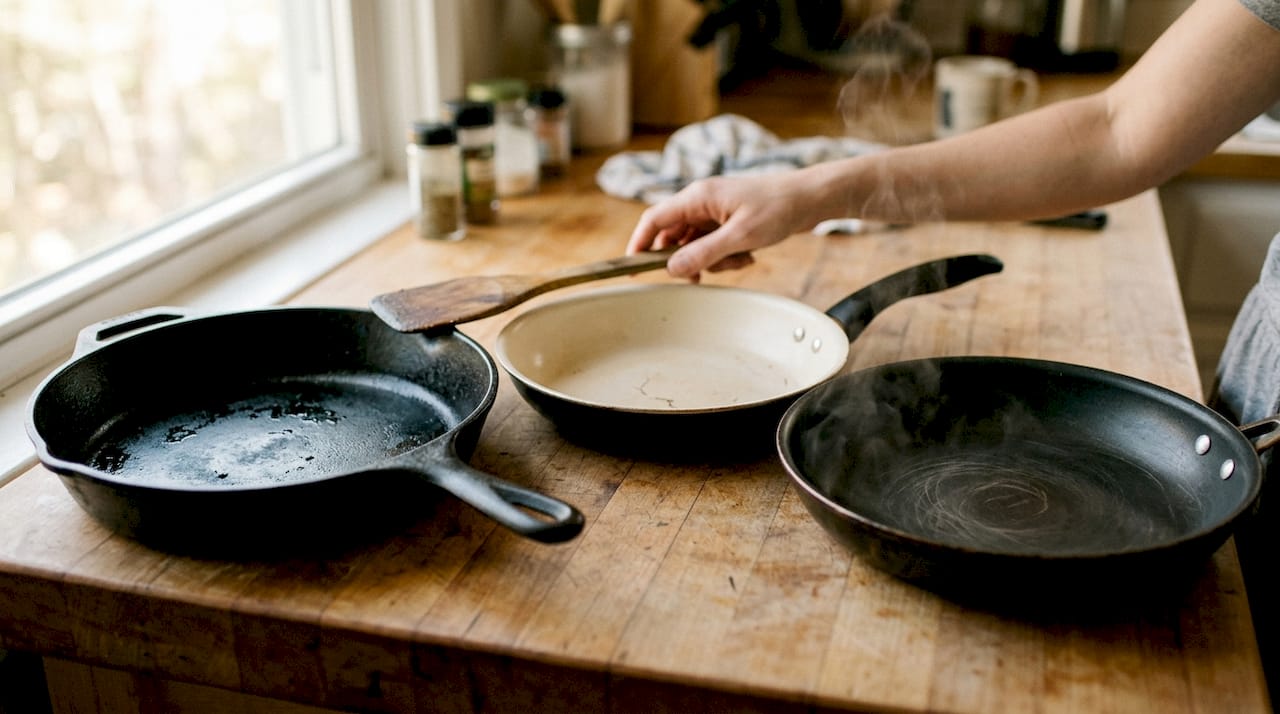
Ceramic coatings are often marketed as the clean, eco-friendly option. They do contain fewer synthetic chemicals, and they handle higher initial temperatures reasonably well. The problem is durability. PTFE benchmarks show excellent egg release long-term, while ceramic drops to 30 to 40% of its original performance, and natural seasoning excels at high-heat searing. Ceramic simply wears faster.
Natural seasoning on carbon steel or cast iron is the oldest non-stick method and arguably the most rewarding. Oil polymerises into a hard, slick patina through repeated heating, and carbon steel seasoning produces a durable, chemical-free surface that improves with every meal you cook. For a practical walkthrough, our guide on seasoning a carbon steel pan covers the full process step by step.
| Material | Durability | Ease of care | Best use | Chemical-free? |
|---|---|---|---|---|
| PTFE (Teflon) | Medium (3 to 5 years) | Very easy | Eggs, fish, low heat | No |
| Ceramic | Low (1 to 3 years) | Easy | Light sautéing | Mostly |
| Carbon steel | Very high (20+ years) | Moderate | Searing, all-round | Yes |
| Cast iron | Very high (lifetime) | Moderate | Slow cooking, searing | Yes |
For a deeper comparison of ceramic versus PTFE in real kitchen conditions, nonstick vs. ceramic skillets offers a thorough breakdown worth reading.
Pro Tip: Before your first cook on a new carbon steel pan, run through the carbon steel seasoning checklist to build a solid base layer. Skipping this step is the most common reason seasoning fails early on.
Safety, health and sustainability considerations
This is the question most European home cooks are asking right now, and the answer is more nuanced than headlines suggest.
PTFE itself is considered inert and safe when used correctly. EU BfR and FDA guidance confirms no health effects from proper PTFE use, with PFOA now phased out across the EU and US. The concern has shifted to PFAS as a broader class of chemicals, many of which are persistent in the environment and in human tissue. That persistence is driving a genuine shift in consumer preference across Europe.
The practical safety rules for PTFE are straightforward. PTFE is safe below 260 to 360°C when the pan is filled with food, but an empty pan can overheat rapidly and release fumes. Ceramic handles higher temperatures more tolerantly but chips more easily, and a chipped ceramic surface should be replaced.
Here is a simple checklist for safe non-stick cooking at home:
- Never heat an empty non-stick pan on high. Always add oil or food before the temperature climbs.
- Avoid metal utensils on coated surfaces. Use wood, silicone, or nylon to prevent scratching.
- Replace coated pans when the surface shows visible damage, peeling, or deep scratches.
Natural seasoning on carbon steel or cast iron carries none of these chemical concerns. The surface is pure polymerised oil bonded to metal. No synthetic compounds, no coatings to scratch or degrade. For guidance on keeping that surface in good condition, our carbon steel surface care guide covers everything from daily cleaning to long-term maintenance.
For a broader view of the safest cookware options currently available, best nontoxic cookware provides a useful independent summary.
Pro Tip: If you cook for children or are simply cautious about chemical exposure, a seasoned carbon steel pan removes the uncertainty entirely. There is nothing synthetic in the surface at all.
Choosing and using natural non-stick pans
Once you decide to move towards natural non-stick cookware, the practical questions begin. Carbon steel, cast iron, and ceramic each suit different kitchens and cooking styles.
Carbon steel is lighter than cast iron, heats up faster, and responds quickly to temperature changes. It is the professional kitchen standard across Europe for a reason. Cast iron holds heat longer and suits slow braises and oven work particularly well, but its weight makes it impractical for daily sautéing. Ceramic (uncoated, not the sol-gel coating discussed earlier) is naturally non-reactive and easy to clean, but it does not build a seasoned patina the way steel or iron does.
For most home cooks who want a natural non-stick pan they can use every day, carbon steel is the most versatile choice. Carbon steel and cast iron can last 20 or more years with proper care, improving in performance rather than declining.
| Pan type | Weight | Seasoning needed | Longevity | Best for |
|---|---|---|---|---|
| Carbon steel | Light to medium | Yes | 20+ years | Searing, sautéing, eggs |
| Cast iron | Heavy | Yes | Lifetime | Braises, oven cooking |
| Uncoated ceramic | Light | No | 5 to 10 years | Gentle cooking |
To get started with a carbon steel pan, follow these steps:
- Wash the new pan with warm soapy water and dry it completely.
- Heat the pan in an oven at 250°C for 10 minutes to ensure it is bone dry.
- Apply a very thin coat of high-smoke-point oil such as grapeseed or sunflower.
- Wipe off the excess so the pan looks almost dry, not wet.
- Bake upside down for 30 minutes, then repeat two to three times.
For ongoing performance, our carbon steel pan seasoning guide and seasoned steel surface guide cover the full routine. If rust appears, do not panic. Our guide on avoiding rust on pans explains exactly what to do, and if the seasoning breaks down, the repair seasoning guide will get it back to peak condition quickly.
Our perspective: Why natural non-stick is the pro’s choice
Most guides treat natural non-stick as the harder option, something you graduate to after mastering Teflon. We think that framing is backwards.
The reality, as Serious Eats confirms, is that PTFE offers superior initial and long-term non-stick performance, ceramic’s natural marketing often overstates its benefits, and seasoning needs practice but yields genuinely professional results. The key word there is practice. That practice is not a burden. It is cooking. Every meal you prepare on a seasoned carbon steel pan makes it better. That is the opposite of every coated pan you have ever owned.
European cooks are rediscovering this. There is a growing recognition that the best tools in the kitchen are not the most convenient ones out of the box, but the ones that reward attention and technique. A well-seasoned pan is a record of your cooking. It carries flavour history, it responds to heat precisely, and it will outlast any coated pan by decades.
The myth that natural non-stick is difficult persists because people skip the seasoning steps or use too much oil. Get those basics right, and the results speak for themselves. Explore more about natural nonstick pan materials to understand why this approach suits serious home cooks so well.
Discover natural non-stick cooking with Brass & Steel
If this guide has made you curious about making the switch, we have everything you need to take the next step with confidence.
At Brass & Steel, we craft single-piece carbon steel sauté pans forged without rivets or welds, designed to build a natural non-stick surface that improves with every use. Our pans are free from PTFE, PFOA, and synthetic coatings, and they work on all cooktops including induction. Alongside our pans, we publish practical guides on seasoning, surface care, and troubleshooting so you are never left guessing. Whether you are choosing your first carbon steel pan or refining your technique, our natural nonstick pan materials guide is the ideal place to start.
Frequently asked questions
What is the difference between PTFE and ceramic non-stick pans?
PTFE (Teflon) delivers strong, long-lasting non-stick performance but involves PFAS chemicals, while ceramic coatings are more natural but lose performance faster, dropping to around 30 to 40% of their original release ability over time.
How do you build a natural non-stick surface at home?
Apply a very thin layer of high-smoke-point oil to a clean carbon steel or cast iron pan, heat it until the oil polymerises, and repeat two to three times. This builds a patina that grows more effective with every use.
Is non-stick cookware safe now in Europe?
PTFE pans are considered safe when used correctly and not overheated, as PFOA has been phased out across the EU. However, PFAS persistence concerns are driving many European cooks towards PTFE-free and naturally seasoned alternatives.
How long does a natural non-stick pan last?
A properly seasoned carbon steel or cast iron pan lasts over 20 years and actually improves with use, making it far more durable than any synthetic-coated alternative on the market.
Recommended
- Nonstick Alternatives Explained: Understanding Safe Options – Brass & Steel
- Defining Nonstick Alternatives: Safer Choices for Cooks – Brass & Steel
- Ceramic Nonstick Cookware Safety – What Every Cook Needs – Brass & Steel
- 7 Top Examples of Non-Toxic Pans for Pro Cooks – Brass & Steel
- Why Upgrade Outdoor Cookware: Family Camping Benefits