Why pan thickness matters: a guide for home cooks

TL;DR:
- Pan thickness determines heat distribution and retention, impacting cooking evenness and control. Thicker pans in the 2.5 to 3.5mm range balance heat performance with manageable weight, making them ideal for home cooking. Excessive thickness adds weight without significant performance gains and can hinder maneuverability during cooking.
Pan thickness is defined as the measurement of a pan’s wall and base depth, and it directly controls how evenly heat spreads across the cooking surface and how well the pan holds temperature under load. Most home cooks focus on material or brand, but thickness is the variable that separates a pan that scorches one side of your steak from one that cooks it evenly edge to edge. The ideal thickness for home cookware in tri-ply construction sits between 2.5mm and 3.5mm, balancing heat performance with a weight you can actually manage. Understanding why pan thickness matters gives you a real framework for buying and using cookware, not just a list of specs to memorise.
How does pan thickness affect heat distribution during cooking?
Thickness shapes how heat moves from the burner flame to your food. A thin pan transfers heat quickly at the point of contact but struggles to spread it sideways. The result is hot spots, and hot spots mean burnt patches on your omelette or uneven browning on a chicken breast.
The physics behind this is called thermal diffusivity, which measures how fast a material conducts and spreads heat relative to its mass. Temperature differentials on thin pans can reach 25–30°C across the cooking surface on a gas burner. A thick tri-ply pan with an aluminium core reduces that differential to under 8°C. That gap is the difference between a béchamel sauce that scorches in the centre and one that thickens evenly.
The burner flame itself is part of the problem. Gas flames concentrate heat in a ring or central point. Only a pan with enough thickness and a conductive core can absorb that uneven energy and redistribute it across the base. Thin pans simply pass the flame’s pattern straight onto your food.
Here is what thickness actually does for heat distribution:
- Absorbs uneven burner energy before it reaches the cooking surface, smoothing out hot spots from gas rings or electric coils.
- Slows the rate of heat transfer so the pan surface temperature rises more gradually and evenly.
- Works with the core material to spread heat laterally. An aluminium core in a tri-ply pan conducts heat sideways far better than stainless steel alone.
- Reduces temperature spikes when you turn the heat up quickly, giving you more control over delicate tasks like making a pan sauce.
Pro Tip: If you are cooking on gas and notice one side of your food browning faster, the pan is probably too thin for your burner size. Try a thicker base or reduce the flame to match the pan’s diameter.
What impact does pan thickness have on heat retention?
Thermal mass is the term for how much heat a pan can store and hold. Thickness builds thermal mass. A thicker pan holds more heat energy in its walls and base, which means it loses less temperature when you add cold food to it.
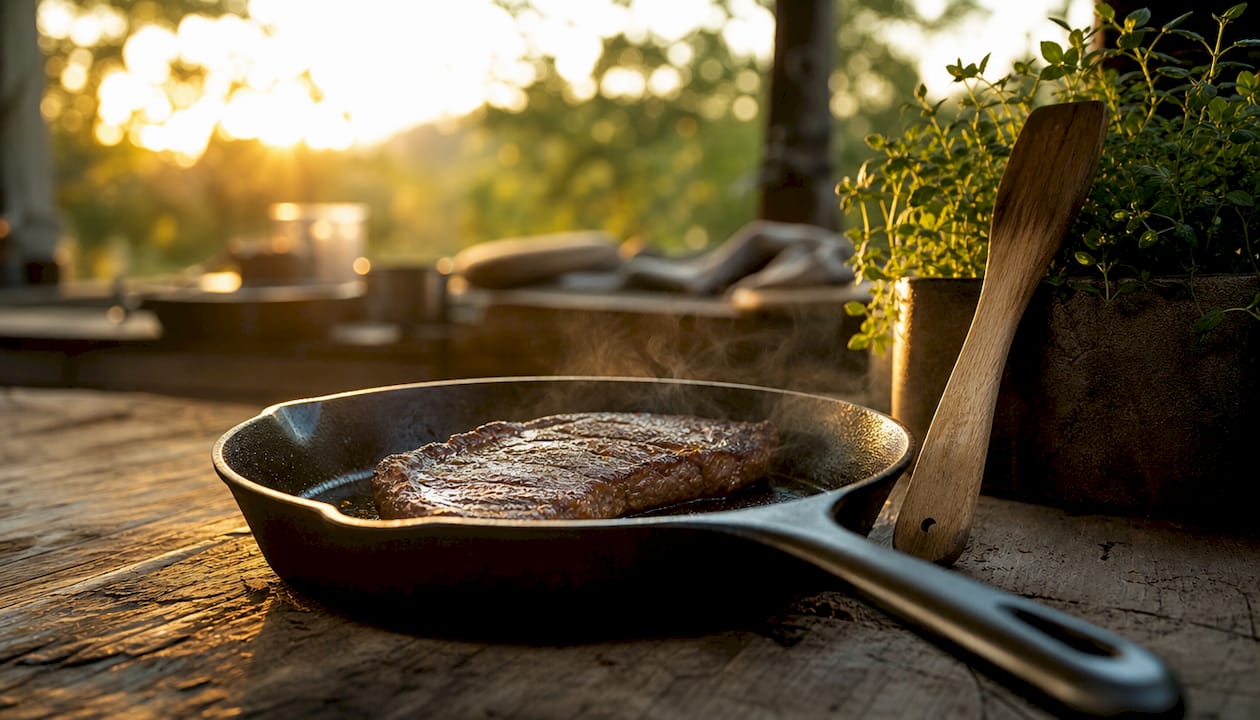
This matters most when searing. A 4mm thick skillet maintains temperature far better than a thinner pan when you place a room-temperature steak on it. That sustained heat is what drives the Maillard reaction, the chemical process that creates the brown, flavourful crust on seared meat. Drop that temperature too fast and you get grey, steamed meat instead.
Carbon steel sits in an interesting position here. Carbon steel’s thermal diffusivity is 14.1 mm²/s, compared to cast iron’s 18.8 mm²/s. Cast iron conducts heat more efficiently through its cross-section, but a carbon steel pan at 2–3mm thickness heats up and responds to temperature changes in 20–30 seconds, versus several minutes for a thick cast iron skillet. That responsiveness is a genuine advantage when you need to turn the heat down fast.
The trade-off works like this:
- Thicker pans preheat more slowly because there is more material to heat through before the surface reaches cooking temperature.
- Thicker pans recover faster after you add cold ingredients, because they have more stored heat to draw on.
- Thinner pans heat quickly but lose temperature sharply when cold food hits the surface, which can stall the cooking process.
- Carbon steel at 3–4mm hits a practical sweet spot: enough thermal mass for solid heat retention, with enough responsiveness to adjust quickly when needed.
The heat retention guide for carbon steel pans from Brass-steel covers this trade-off in detail, including how seasoning affects surface temperature behaviour over time.
Are there downsides to excessively thick pans for home cooking?
Thicker is not always better. Past a certain point, extra thickness adds weight without meaningfully improving cooking performance. Lateral heat flow depends more on core material conductivity than on thickness beyond 3–4mm. Doubling the thickness of a stainless steel pan, for example, only marginally improves heat distribution. The material’s conductivity is the limiting factor, not the depth of metal.
Weight is the practical consequence. A very thick pan can weigh over 5 lbs (roughly 2.3 kg) before food is added. Cookware testers consistently note that lighter pans with balanced thickness often outperform heavier ones in real kitchen use, because the cook can manoeuvre them confidently. A pan you cannot toss or tilt easily is a pan that limits your technique.
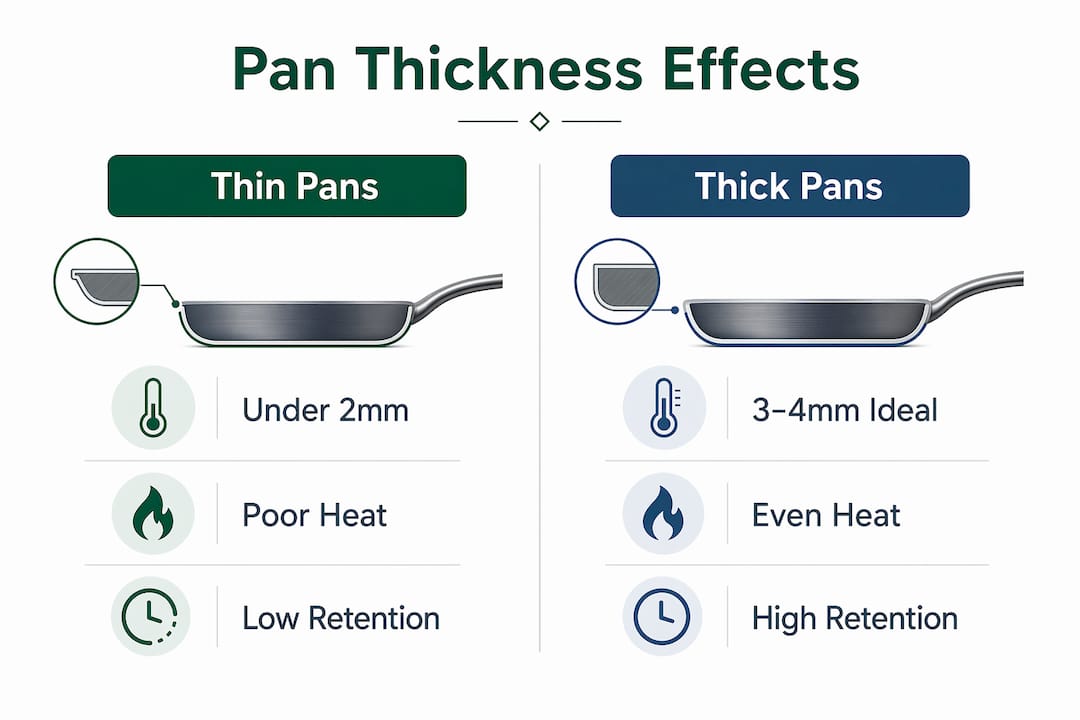
| Thickness range | Heat distribution | Heat retention | Practical weight |
|---|---|---|---|
| Under 2mm | Poor, significant hot spots | Low, loses heat quickly | Very light |
| 2.5–3.5mm (tri-ply) | Good, minimal hot spots | Solid, recovers well | Manageable |
| 4–5mm (carbon steel) | Good, stable surface | Excellent, high thermal mass | Heavier but usable |
| Over 5mm | Marginal improvement | Very high, slow to adjust | Heavy, tiring to use |
Pro Tip: Pick up a pan before you buy it. If it feels unwieldy empty, it will feel worse with food in it and a sauce reducing on the hob. Weight balance matters as much as thickness.
Thickness also acts as a thermal buffer, but it cannot fix poor pan geometry or a warped base that sits unevenly on the burner. A thick pan with a bowed base still heats unevenly. Thickness is one variable in a system, not a cure-all.
How to choose the right pan thickness for different cooking needs
The right thickness depends on what you cook most often. Home cooks should match thickness to cooking style: thicker for tasks that need stable, sustained heat; thinner for tasks that need quick temperature changes.
Here is a practical breakdown:
- Searing steaks and chops: Go for 3mm or more. You need the thermal mass to maintain surface temperature when the cold meat hits the pan. A 4mm carbon steel pan, like the Brass-steel 30 cm Carbon Steel Sauté Pan, holds heat well enough to produce a proper crust without the pan cooling mid-cook.
- Sautéing vegetables and eggs: A 3mm pan works well here. You want some responsiveness so you can turn the heat down quickly without the pan staying scorching hot for another minute.
- Making sauces and reductions: Thickness matters enormously. A thin pan scorches the base of a sauce while the edges stay cool. A tri-ply or thick carbon steel pan keeps the whole surface at a consistent temperature, which is what even sauce cooking requires.
- Pancakes and crêpes: Thinner pans (2–2.5mm) can work here because you want fast, even browning and quick release. But a well-seasoned 3mm carbon steel pan performs just as well once it is properly preheated.
- Family-sized meals: Larger pans need more thickness to maintain even heat across a wider surface. A 30 cm pan at 4mm distributes heat more evenly than the same diameter at 2mm.
Material and thickness work together. Carbon steel at 3mm behaves differently from stainless steel at 3mm because the materials conduct heat at different rates. Carbon steel heats and cools faster than cast iron at the same thickness, which gives you more control on the hob. For most home cooks, a carbon steel pan in the 3–4mm range covers the widest range of cooking tasks without becoming a burden to lift.
Longevity is also tied to thickness. Thicker pans resist warping better under high heat, particularly on induction hobs where the magnetic field heats the base rapidly. A pan that warps loses flat contact with the burner and develops the very hot spots that thickness was meant to prevent. The ergonomic design guide from Brass-steel covers how thickness, weight, and handle design interact for everyday comfort.
Key takeaways
Pan thickness governs heat distribution and retention, and choosing the right thickness for your cooking style is the single most effective way to improve consistency in the kitchen.
| Point | Details |
|---|---|
| Thickness controls heat evenness | Thicker pans reduce surface temperature differentials from 30°C to under 8°C on gas burners. |
| Thermal mass aids searing | A 4mm pan holds heat when cold food is added, sustaining the Maillard reaction for a proper crust. |
| Past 3–4mm, returns diminish | Beyond this range, extra thickness adds weight without meaningfully improving lateral heat distribution. |
| Match thickness to cooking task | Use 3–4mm for searing and sauces; thinner pans suit quick, delicate tasks like eggs. |
| Material and thickness work together | Carbon steel at 3mm responds faster than cast iron at the same thickness, giving you more control. |
Thickness through the lens of real cooking
I have cooked on pans ranging from 1.5mm pressed steel to 6mm cast iron, and the lesson I keep coming back to is this: the “thicker is better” rule is only half true. The other half is that a pan you cannot handle confidently will cost you more in ruined meals than a slightly thinner one you can actually control.
The shift that changed how I cook was thinking of pans as thermal systems, not just vessels. A 3mm carbon steel pan is not just a piece of metal. It is a system with a specific heat-up rate, a specific recovery time after adding food, and a specific window where it performs at its best. Once you understand that, you stop fighting the pan and start working with it.
The practical insight most home cooks miss is that preheat time is not a chore. It is the pan building its thermal reserve. A 4mm pan needs a longer preheat than a 2mm pan, but it rewards you with a cooking surface that stays stable for the entire cook. Rushing that preheat is where most searing mistakes happen, not in the seasoning or the oil choice.
My honest preference sits at 3–4mm carbon steel for everyday cooking. It is thick enough to hold heat through a family-sized batch of vegetables, responsive enough to adjust when I need to drop the temperature for a sauce, and light enough that I am not dreading the washing up. That balance is harder to find than it sounds, and it is worth taking seriously when you choose a pan.
— Davide
Brass-steel pans: thickness built for real cooking
Brass-steel designs its carbon steel pans around the 3–4mm range precisely because that is where performance and usability meet. The 27 cm Carbon Steel Sauté Pan at 3mm weighs around 2 kg, which is light enough to manoeuvre on the hob but thick enough to hold a proper sear. The 30 cm version steps up to 4mm and roughly 3 kg, built for larger meals and family cooking where heat recovery matters most.
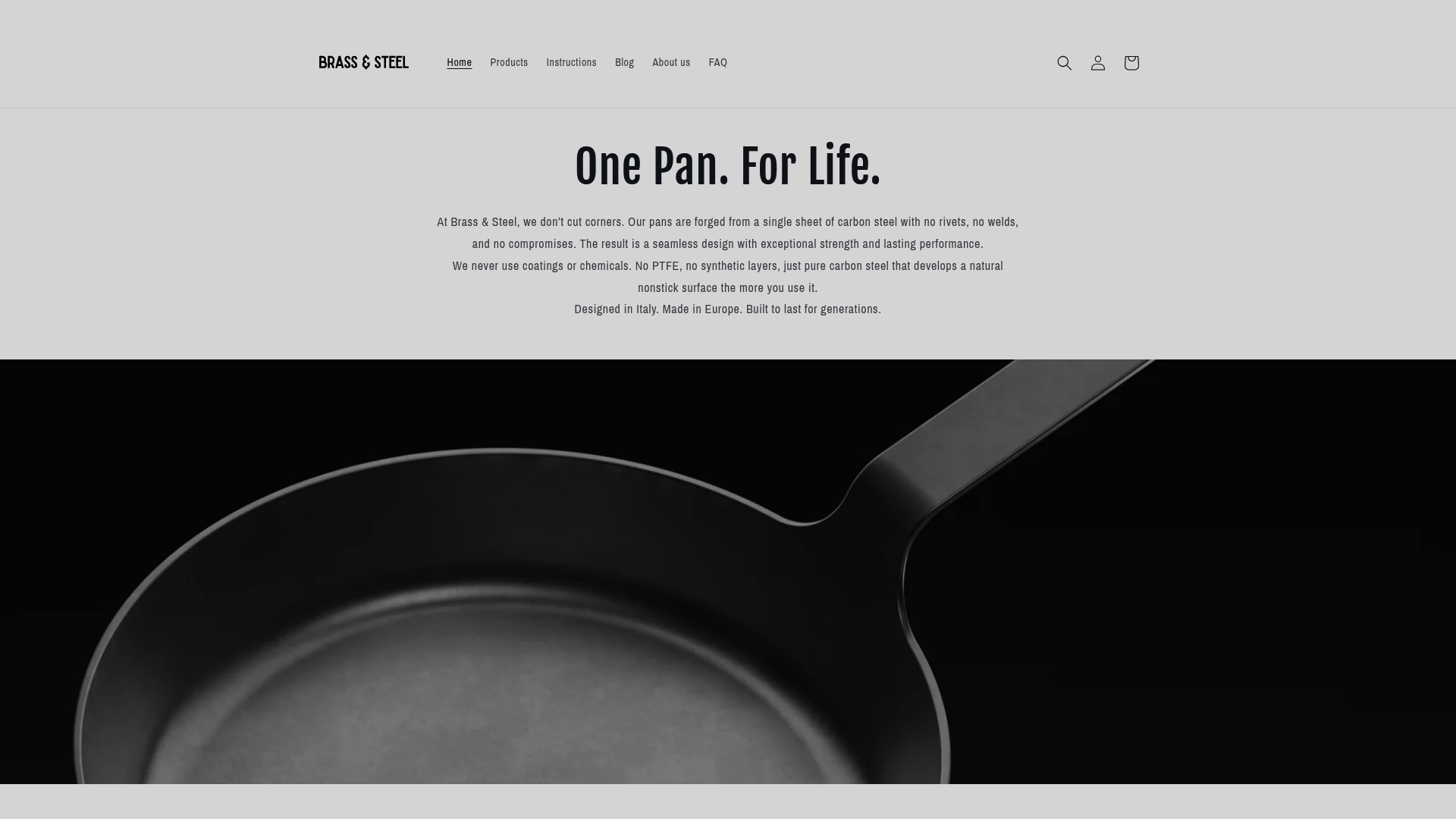
Both pans are forged from a single piece of carbon steel, with no rivets or welds to trap food or weaken the structure over time. They are free from PTFE and PFOA, work on every hob including induction, and build a natural nonstick patina with use. If you want a pan that performs the way this guide describes, Brass-steel’s carbon steel range is worth a close look.
FAQ
What is the ideal pan thickness for home cooking?
The ideal thickness for home cookware in tri-ply construction is 2.5–3.5mm. Carbon steel pans at 3–4mm also perform well, offering strong heat retention with manageable weight.
Does a thicker pan always cook better?
Not always. Lateral heat distribution depends more on core material conductivity than thickness beyond 3–4mm. Past that point, extra thickness mainly adds weight without improving cooking performance.
How does pan thickness affect searing?
A thicker pan holds more thermal mass, so it loses less temperature when cold food is added. That sustained heat drives the Maillard reaction, which creates the brown crust on seared meat.
Is carbon steel thicker than cast iron?
Carbon steel pans are typically thinner than cast iron, usually 2–4mm versus 5mm or more for cast iron. Despite this, carbon steel heats and responds to temperature changes faster, making it more practical for everyday hob cooking.
How do I know if my pan is too thin?
If you see one area browning much faster than another, or if the pan loses heat sharply the moment you add food, the base is likely too thin for the task. A pan that maintains even surface temperature across the cooking surface is thick enough for consistent results.