Non-coated cookware explained: healthier kitchen choices
TL;DR:
- Non-coated cookware includes bare metal materials like carbon steel, stainless steel, and cast iron, which develop natural nonstick surfaces through seasoning and use. Unlike coated pans, these require proper care and patience to build their nonstick patina, offering greater durability and safety from chemical degradation. Focusing on understanding your material and consistent maintenance ensures better cooking results and long-term performance.
Most home cooks assume that any pan without a shiny nonstick surface is essentially the same. Strip away the coating, and you’re left with plain metal, right? Not quite. The reality is that non-coated cookware spans several very different materials, each with distinct health implications, cooking behaviours, and care requirements. Choosing the wrong type, or simply not understanding what you’re working with, can mean frustrating results in the kitchen and unnecessary worry about what’s leaching into your food. This guide cuts through the confusion to give you a clear, practical picture.
Table of Contents
- What is non-coated cookware?
- How non-coated and coated cookware differ
- Common types of non-coated cookware
- Caring for non-coated cookware: what every home cook should know
- Nuances and edge cases: enamel and ceramic “coated” but not nonstick
- Why most cooks overcomplicate non-coated cookware
- Explore your non-coated cookware options
- Frequently asked questions
Key Takeaways
| Point | Details |
|---|---|
| No chemical coatings | Non-coated cookware lacks factory-applied nonstick surfaces and relies on material and seasoning for food release. |
| Material matters most | Choosing between carbon steel, stainless steel, or cast iron affects your cooking, maintenance, and food safety. |
| Seasoning prevents sticking | A natural oil layer develops nonstick qualities for carbon steel and cast iron with ongoing use and care. |
| Proper care needed | Non-coated pans last decades if properly cleaned, dried, and occasionally re-seasoned. |
What is non-coated cookware?
The term “non-coated” sounds straightforward, but it’s one of the most misused phrases in cookware marketing. At its core, non-coated cookware is cookware without a factory-applied chemical nonstick coating, such as PTFE, PFAS compounds, or ceramic nonstick layers. The pan reaches you as bare metal, without any synthetic surface treatment designed to make food slide off effortlessly.
This definition matters because it separates the pan’s material from its surface treatment. A pan can be made from stainless steel but still carry a nonstick coating. Conversely, a carbon steel pan is inherently free of coatings, relying instead on seasoning and cooking technique for food release. Understanding this distinction is the foundation of making smarter cookware choices.
Here’s what typically falls under the non-coated umbrella:
- Carbon steel: Bare metal that develops a natural nonstick patina through seasoning and use.
- Stainless steel: A chromium-nickel alloy with no reactive coating; food release depends on technique and heat management.
- Cast iron (bare): Heavy, porous metal that also benefits from seasoning, similar to carbon steel.
- Enamelled cast iron: Technically coated, but with a glass-based enamel rather than a chemical nonstick layer (more on this in a later section).
“The absence of a factory-applied nonstick coating doesn’t automatically make a pan easier to use, but it does remove a layer of complexity around chemical exposure and coating lifespan.”
The practical upshot for health-conscious cooks is simple. Without a nonstick coating, there is no coating to scratch, degrade, or potentially release particles into your food. Food release in these pans comes from understanding natural nonstick materials, correct preheating, and the right amount of oil. That’s a skill set, not a product feature.
How non-coated and coated cookware differ
Now that we’ve established the basic definition, let’s look at how non-coated pans measure up against their coated counterparts. The differences go well beyond the surface.
PTFE-based nonstick coatings are considered a gold-standard in chemical nonstick performance, but these coatings can degrade when overheated or scratched, raising concerns about what enters the cooking environment. Most manufacturers recommend keeping coated pans below 230°C (446°F), which immediately rules them out for high-heat searing.
| Feature | Non-coated cookware | Coated cookware |
|---|---|---|
| Material | Carbon steel, cast iron, stainless steel | Usually aluminium or steel base with PTFE, ceramic, or other coating |
| Chemical exposure risk | None from pan surface | Possible if coating degrades or scratches |
| Heat tolerance | Very high (carbon steel up to 600°C+) | Limited (typically below 230°C) |
| Durability | Decades to lifetime with care | Coating typically lasts 3 to 5 years |
| Food release | Technique-dependent; improves with seasoning | Excellent when new; deteriorates over time |
| Maintenance | Requires seasoning (carbon steel, cast iron) | Minimal initially; cannot use metal utensils |
| Repairability | Can be re-seasoned if damaged | Cannot repair a scratched coating |
The table above reveals something important that marketing rarely highlights. Coated cookware offers a short-term advantage in food release but trades that off against long-term durability and coating integrity. Non-coated pans require more from the cook at the start, but reward patience with exceptional performance that genuinely improves over years.
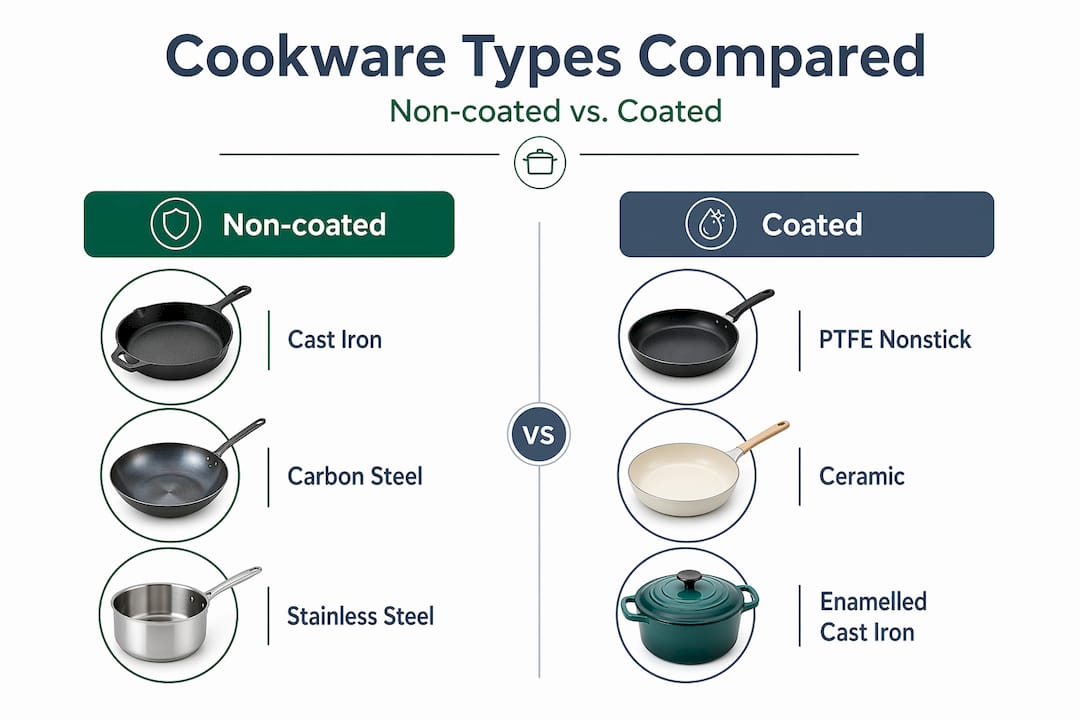
For European cooks particularly, awareness of PFAS compounds (sometimes called “forever chemicals”) has grown considerably. Regulatory bodies across the EU have been tightening restrictions on PFAS in consumer products, which makes the appeal of non-coated alternatives increasingly practical rather than merely ideological.
Benefits of choosing non-coated cookware include:
- No risk of coating degradation at high temperatures
- Suitable for metal utensils, oven use, and open flames
- Can be restored to full performance if damaged
- Builds a cooking surface that improves over time, not worsens
- Often more cost-effective over a decade of use when you consider replacement cycles
When comparing ceramic and nonstick options, you’ll find that even ceramic-coated pans, often marketed as the “safer” alternative, share similar wear limitations with PTFE variants. Non-coated bare metal remains the most durable long-term choice.
Common types of non-coated cookware
Understanding that “non-coated” includes several materials, it’s useful to examine the main types and how they shape both cooking and care.
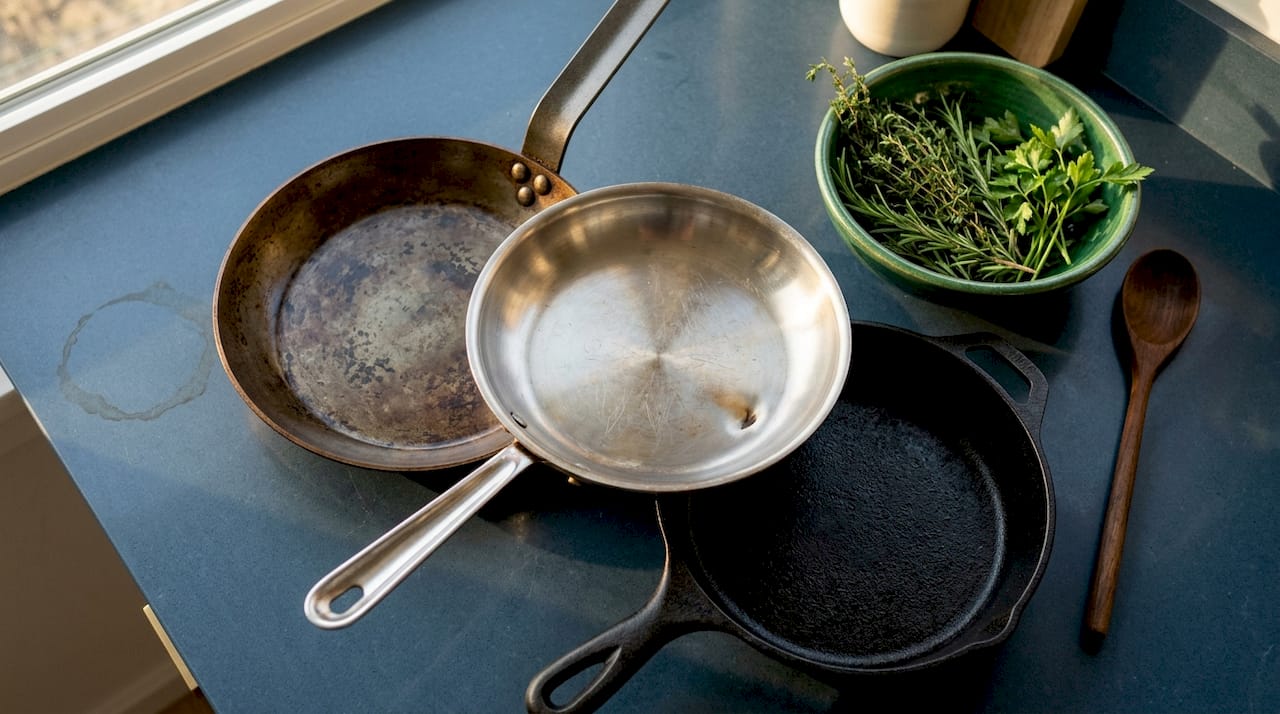
Carbon steel pans start bare and develop a natural nonstick surface over time through seasoning, a process of polymerising thin layers of oil onto the pan surface. This is what makes carbon steel such a compelling choice for serious home cooks and professional chefs alike. It combines the lightweight responsiveness of a steel pan with the food-release potential of a well-maintained surface that only gets better with use.
Here’s a quick-reference overview of the three main non-coated options:
| Material | Weight | Heat responsiveness | Seasoning required | Best use |
|---|---|---|---|---|
| Carbon steel | Light to medium | Excellent | Yes | Searing, sautéing, eggs, fish |
| Cast iron | Heavy | Moderate (retains well) | Yes | Slow cooking, braising, steaks |
| Stainless steel | Medium | Good | No | Sauces, acidic foods, boiling |
Each material suits a different cooking style. Here’s how to think about them:
-
Carbon steel is the closest thing to an all-round performer. It heats quickly, responds immediately to temperature changes, and develops a seasoning that rivals a well-used nonstick pan after several months of use. The importance of pan patina cannot be overstated: this dark, polymerised oil layer is what gives a seasoned carbon steel pan its food-release properties and rust protection.
-
Cast iron is unbeatable for heat retention, making it ideal for dishes that need consistent, even heat over a long period. It’s substantially heavier than carbon steel, which can be a real concern for everyday use, and it takes longer to heat up and cool down. Cast iron is also more brittle and prone to cracking if dropped or subjected to sudden temperature changes.
-
Stainless steel is the odd one out in this group because it requires no seasoning. Its chromium content forms a passive oxide layer that resists rust and corrosion without any treatment. However, food sticks to stainless more readily than to a seasoned carbon steel or cast iron pan, so technique matters more. It excels with acidic ingredients like tomato sauces, where carbon steel and cast iron can react before a strong seasoning is established.
Pro Tip: If you’re new to non-coated cookware and want a single pan that rewards long-term use, carbon steel is the best starting point. It’s lighter than cast iron, more responsive than stainless, and its seasoning builds with every cook.
Caring for non-coated cookware: what every home cook should know
Once you know which material suits your style, proper care is what turns a good pan into a long-lasting favourite. The good news is that caring for non-coated cookware isn’t complicated. It just requires consistency.
As Tom’s Guide notes about carbon steel, non-coated cookware is not automatically maintenance-free or completely non-reactive. Without the right care, bare metal pans can rust, develop uneven seasoning, or react with certain foods. These aren’t design flaws; they’re characteristics that respond directly to how you treat the pan.
For carbon steel and cast iron, follow these steps to build and maintain your seasoning:
- After each use, rinse with warm water while the pan is still slightly warm. Avoid soaking.
- Dry immediately using a clean cloth or by placing the pan over low heat for a minute.
- Apply a thin layer of oil (grapeseed, sunflower, or canola work well) and wipe away the excess so the surface looks almost dry.
- Store in a dry location away from moisture. If stacking pans, place a cloth or paper between them to protect the seasoning.
- Re-season when needed: if the surface looks dull, feels sticky, or food starts to stick more than usual, a light re-seasoning restores performance.
“The single biggest mistake home cooks make with carbon steel is applying too much oil during seasoning. A thin coat, almost imperceptible on the surface, builds a stronger and more even patina than a thick, uneven layer that turns gummy under heat.”
For mastering carbon steel care over time, small habits make the biggest difference. Cooking fatty foods like bacon or sautéed vegetables in butter during the first few weeks accelerates seasoning beautifully.
Stainless steel needs none of this. Its upkeep is closer to a conventional pan: wash with warm soapy water, dry thoroughly, and store. If food residue sticks, a short soak and a non-abrasive scrubber handle it easily. For daily care tips specific to carbon steel, consistent small actions far outperform occasional deep-clean sessions.
Nuances and edge cases: enamel and ceramic “coated” but not nonstick
Of course, there are always exceptions. Some pans look or sound non-coated but don’t fit neatly into either camp.
Enamelled cast iron is technically coated, but it is often grouped with nonstick-free or non-coated alternatives in health-focused discussions. The coating in this case is a glass-based enamel fused to the iron at extreme temperatures. It contains no PTFE or PFAS compounds, doesn’t require seasoning, and is safe for acidic foods. However, it is still a coating, and it can chip or crack if mishandled.
Ceramic-coated pans occupy a similarly nuanced space. They’re often marketed as the natural, safe alternative to PTFE. While they do avoid fluorine-based chemistry, their nonstick properties tend to fade faster than PTFE and significantly faster than a well-seasoned carbon steel pan. They’re coated, they wear, and they cannot be restored once the surface degrades.
Key distinctions to keep in mind:
- Enamelled cast iron: Coated with glass-based enamel, no PTFE, no seasoning required, but heavy and can chip.
- Ceramic-coated pans: PTFE-free but still a factory coating; wears within a few years.
- Truly non-coated pans: Bare carbon steel, bare cast iron, uncoated stainless steel; no factory coating of any kind.
Pro Tip: When shopping, look for pans described as “bare” or “uncoated” rather than relying on labels like “natural” or “eco-friendly.” These marketing terms don’t always mean what you’d expect.
For anyone weighing up the options, a clear look at ceramic cookware safety reveals that ceramic coatings, while safer than older PTFE formulations, are still a degrading surface rather than a permanent cooking material.
Why most cooks overcomplicate non-coated cookware
After a deep look at definitions and distinctions, it’s worth stepping back for a candid view of what truly matters in your daily kitchen routine.
The cookware world generates an enormous amount of anxiety. Online forums are full of posts asking whether a scratch in a pan is dangerous, whether water touching a cast iron for 30 seconds will cause irreversible rust, or whether a pan that’s not perfectly black after the first seasoning is a failure. Most of this worry is unnecessary.
The truth is that the heart of safer, more enjoyable cooking is simply understanding what your pan is made of and treating it accordingly. A carbon steel pan doesn’t need a chemistry degree to maintain. It needs warmth, a little oil, and regular use. That’s it.
The marketing noise around “non-toxic,” “natural,” and “chemical-free” cookware has created a strange situation where people spend more time researching pans than actually cooking in them. Labels distract from the basics: choose a material that suits your cooking style, learn its temperament, and cook in it often.
We believe, from our experience working with carbon steel, that almost any non-coated pan will perform brilliantly once the cook understands it. The health and safety benefits of carbon steel are genuine and meaningful, but they become tangible only when paired with regular use. A carbon steel pan cooked in daily will outperform any coated pan left in a drawer between uses.
Simplify your thinking: pick your material, season it properly if needed, cook with confidence, and maintain it consistently. The results will follow.
Explore your non-coated cookware options
If this guide has helped clarify your thinking about non-coated cookware, the next natural step is finding the right pan for your kitchen. At Brass & Steel, we craft carbon steel sauté pans forged from a single sheet of steel, with no rivets, no welds, and absolutely no chemical coatings.
Our 27 cm carbon steel sauté pan at €99 is ideal for everyday searing, sautéing, and oven work, while the 30 cm version at €119 handles family-sized meals with ease. Both are induction-compatible and built to develop a natural, seasoned nonstick surface that only improves over years of cooking. Explore our full range of guides, care tips, and product details at brass-steel.com and take the first confident step away from coated cookware for good.
Frequently asked questions
What are the health benefits of non-coated cookware?
Non-coated cookware avoids chemical coatings that may degrade or release substances over time, offering a simpler, lower-toxin cooking surface when cared for properly. The main advantage is that there is simply no coating present to wear, chip, or break down under high heat.
Does non-coated cookware still need oil to prevent sticking?
Yes; for most bare metal pans, oil and correct preheating are essential, especially before a solid seasoning builds up. Over time, carbon steel pans develop a natural nonstick surface that significantly reduces the amount of oil needed.
Is enamelled cast iron considered non-coated?
Enamelled cast iron is technically coated with a glass-based enamel, but it is generally grouped with nonstick-free alternatives because it contains no PTFE or PFAS compounds. It’s a useful middle-ground option, though it can chip and is heavier than carbon steel.
Which foods can react with non-coated metals?
Acidic foods such as tomatoes, wine-based sauces, and citrus can react with bare metals like unseasoned carbon steel or cast iron, affecting flavour and potentially disrupting early seasoning. Once a strong patina is established, this reactivity diminishes considerably.
How often should I season my carbon steel pan?
Season your carbon steel pan whenever food starts to stick more than usual, after a thorough scrub with an abrasive, or if the surface looks dull and dry. For most home cooks using the pan several times a week, a light oil wipe after each use is sufficient, with a full re-seasoning every few weeks as needed.