Master carbon steel cookware care for lasting performance

TL;DR:
- Proper maintenance routine prevents rust and preserves the nonstick patina of carbon steel pans.
- Key tools include high smoke point oil, non-metal scrubbers, coarse salt, and careful drying.
- Regular use, especially cooking fatty foods, naturally enhances seasoning and pan performance over time.
You pull your carbon steel pan off the hob, notice a patch of rust creeping across the surface, and feel that familiar frustration. Or perhaps food is sticking stubbornly despite your best efforts. These problems are not signs of a failing pan. They are signs of a maintenance gap. Carbon steel cookware rewards a consistent, simple workflow with a naturally nonstick surface that improves with every meal. This guide walks you through exactly that workflow, from the right tools to daily cleaning habits, so your pan stays in peak condition for decades. Whether you cook on an induction hob in Berlin or a gas range in Barcelona, the principles are the same.
Table of Contents
- Why a maintenance workflow matters for carbon steel pans
- Essential tools and materials for effective maintenance
- Step-by-step workflow: Cleaning, drying, and seasoning
- Troubleshooting: Rust, sticky residues, and common mistakes
- What most guides miss about carbon steel pan care
- Upgrade your cookware maintenance with Brass & Steel
- Frequently asked questions
Key Takeaways
| Point | Details |
|---|---|
| Heat-dry after washing | Eliminating moisture prevents rust and extends your pan’s lifespan. |
| Thin oil layer is key | Apply a thin layer of high-smoke-point oil after every use to protect seasoning and boost nonstick. |
| Don’t fear occasional rust | Light rust is fixable—use a vinegar soak and reseason promptly for a like-new finish. |
| Build patina with use | Regular high-heat cooking sessions naturally enhance your pan’s nonstick surface over time. |
Why a maintenance workflow matters for carbon steel pans
Carbon steel is not a passive material. Unlike stainless steel, which largely looks after itself, or cast iron, which is thick enough to absorb a degree of neglect, carbon steel is reactive. It forms a seasoned patina through polymerised oil layers, and that patina is both its greatest strength and its most delicate feature. Without a reliable routine, moisture breaks through the patina, rust forms quickly, and the nonstick quality you worked hard to build disappears.
A structured workflow matters because it removes guesswork. When you know exactly what to do after each cook, the pan never sits wet, never goes un-oiled, and the seasoning compounds over time rather than deteriorating. Think of it like maintaining a good kitchen knife. One careless wash in the dishwasher undoes months of careful sharpening.
| Property | Carbon steel | Cast iron | Stainless steel |
|---|---|---|---|
| Weight | Light to medium | Heavy | Light to medium |
| Heat retention | High | Very high | Moderate |
| Seasoning required | Yes | Yes | No |
| Rust risk | High without care | High without care | Low |
| Induction compatible | Yes | Yes | Depends on grade |
| Nonstick potential | Excellent with patina | Good with patina | Low |
Carbon steel is lighter than cast iron with similar heat properties and full induction compatibility, which makes it particularly well suited to European kitchens where induction hobs are increasingly standard. If you want to explore how it performs specifically on induction, our guide on best carbon steel induction cookware covers the detail.
Rushed cleaning is the most common maintenance mistake. Soaking the pan, leaving it to air dry, or scrubbing with abrasive metal pads strips the seasoning and invites rust within hours. Expert seasoning and rust care consistently emphasises one principle above all others:
“Water is enemy number one. Always heat dry your pan immediately after washing.”
This single habit, applied consistently, prevents the majority of carbon steel maintenance problems before they start.
Essential tools and materials for effective maintenance
Good maintenance does not require an expensive kit. In fact, a minimalist approach works better. Too many products introduce confusion, and some common cleaning tools actively damage carbon steel. Here is what you genuinely need.
Your core toolkit:
- High smoke point oil (grapeseed, sunflower, or rapeseed oil are all widely available across Europe and ideal for seasoning)
- Paper towels or a clean lint-free cloth for applying and wiping oil
- A non-metal scrubber such as a soft brush or nylon pad for daily cleaning
- Coarse salt for scrubbing off stuck food without stripping the patina
- Your hob for heat drying, the most reliable drying method available
- Optional: a chainmail scrubber for tougher residues without scratching
Note that brands like de Buyer coat their pans with beeswax before shipping, which requires an initial cleaning step before seasoning. Brass & Steel pans arrive with a light protective oil instead, so your first wash with warm soapy water is all you need before beginning the seasoning process. Always check what coating your pan has before the first use.
| Tool | Purpose | Recommended type |
|---|---|---|
| Oil | Seasoning and post-cook protection | Grapeseed, sunflower, rapeseed |
| Non-metal scrubber | Daily cleaning | Nylon brush or soft pad |
| Coarse salt | Removing stuck food | Standard cooking salt |
| Paper towels | Applying and wiping oil | Any absorbent brand |
| Chainmail scrubber | Stubborn residue | Stainless steel chainmail |
A word on soap: the debate is real. Most manufacturers advise against it because detergent can strip seasoning. However, occasional mild soap use is acceptable if you re-oil the pan immediately after drying. For carbon steel surface care, the key rule is never leave the pan bare after washing. For rust removal routines, the same principle applies: always finish with oil.
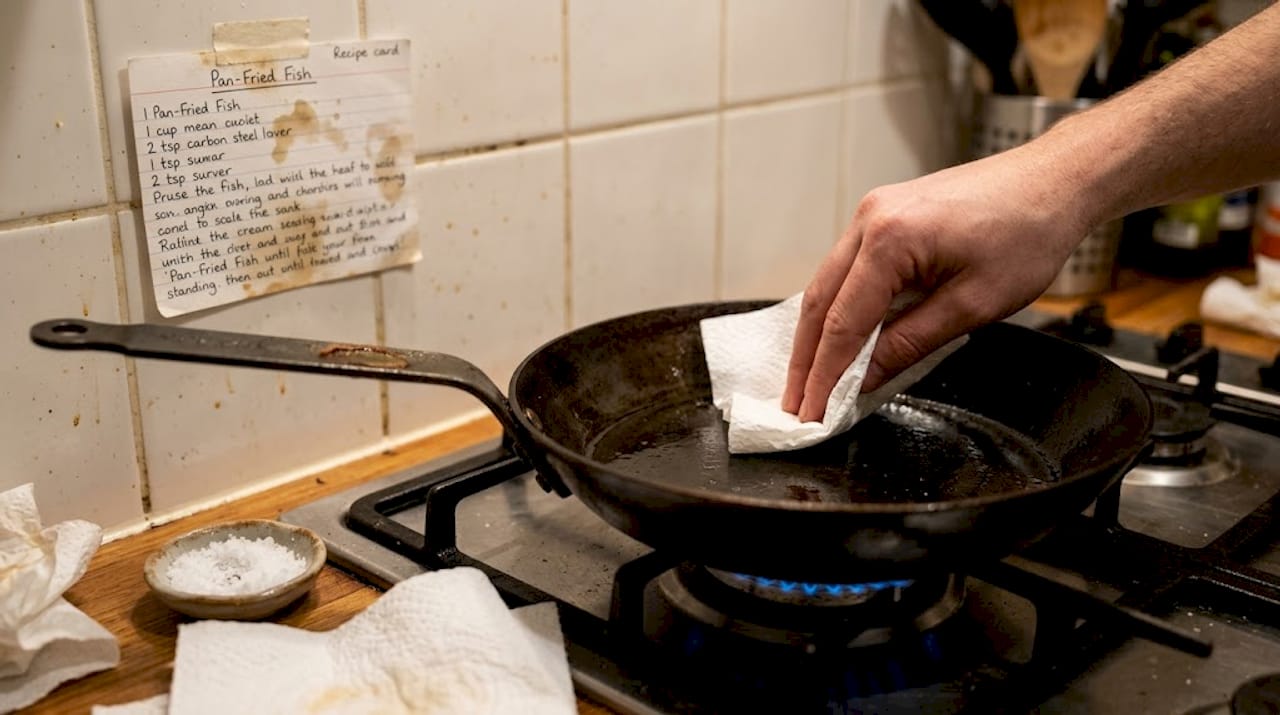
Pro Tip: After washing, place the pan directly on your hob over low heat for two minutes to drive off all moisture, then apply your oil while the pan is still warm. The warmth helps the oil absorb evenly into the surface.
Step-by-step workflow: Cleaning, drying, and seasoning
A reliable maintenance workflow has two distinct phases: the initial preparation you do once, and the daily routine you repeat after every cook. Both matter enormously.
Initial preparation (first use):
- Wash the pan with warm soapy water to remove the protective factory coating. Rinse thoroughly.
- Dry completely with a cloth, then place on the hob over medium heat for two to three minutes.
- Preheat your oven to 250°C.
- Bake the empty pan for ten minutes to ensure it is bone dry.
- Remove and apply a very thin coat of high smoke point oil across the entire surface, including the sides and handle base.
- Wipe off the excess until the pan looks almost dry. This step is critical. Too much oil creates a sticky, uneven layer.
- Return the pan to the oven upside down and bake for thirty minutes.
- Repeat steps five through seven two or three times to build a strong base patina.
As initial prep guidance confirms, removing the factory coating and seasoning at high heat is the essential foundation for all future performance.
Daily cleaning routine:
- While the pan is still warm after cooking, rinse with hot water.
- Use a non-metal scrubber or coarse salt for any stuck food. Avoid soaking.
- Rinse clean and place immediately on the hob over low to medium heat.
- Heat until all visible moisture has evaporated.
- Apply a thin wipe of oil with a paper towel, then wipe off the excess.
- Store in a dry place, ideally not stacked directly against other metal cookware.
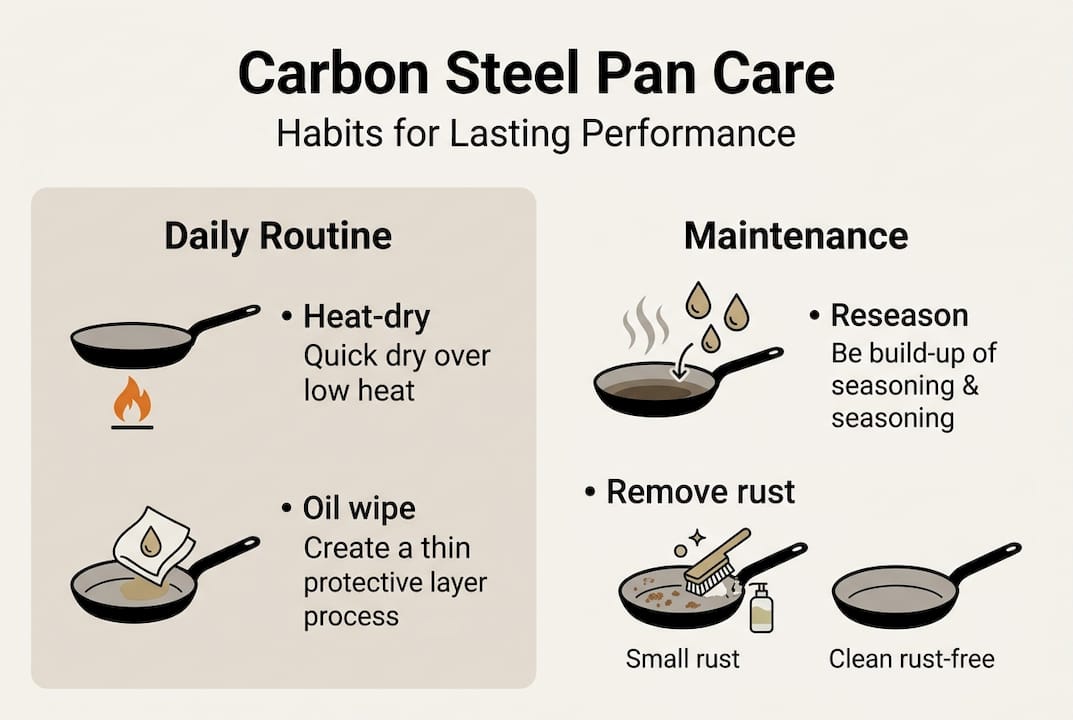
For preventing rust and warping, the most important step is heat drying. A daily care routine built around rinsing hot, scrubbing gently, heat drying, and applying a thin oil layer will keep your pan in excellent condition indefinitely.
For removing rust safely if it does appear, act quickly. The longer rust sits, the deeper it penetrates.
Pro Tip: Never skip the post-cooking oil wipe, even if you are tired after a long meal. Thirty seconds of oiling now prevents an hour of rust removal later.
Troubleshooting: Rust, sticky residues, and common mistakes
Even with a solid routine, problems arise. Knowing how to read the signs and fix them quickly is what separates confident carbon steel cooks from frustrated ones.
Common issues and quick solutions:
- Light surface rust: Normal after exposure to humidity. Scrub with coarse salt or a chainmail scrubber, rinse, heat dry, and reseason immediately.
- Sticky residue after cooking: Usually caused by too much oil during seasoning or cooking at too low a temperature. Scrub more firmly, re-season with a thinner oil coat.
- Flaking patina: Happens when seasoning layers are applied too thickly or unevenly. Strip the pan back with salt and a scrubber, then rebuild from scratch.
- Food sticking despite seasoning: The pan may not be hot enough before adding food. Always preheat carbon steel before adding oil or ingredients.
- Discolouration or blue tinge: Completely normal. This is the steel reacting to heat and is a sign of healthy use.
For significant rust, soak in white vinegar and water at a 1:1 ratio for no more than thirty minutes, then scrub, dry, and reseason. Do not leave the pan in vinegar longer than needed, as extended exposure can pit the steel.
“A darker patina means better nonstick performance. Do not overscrub in pursuit of a shiny surface.”
This is one of the most counterintuitive truths about carbon steel. Many cooks scrub too hard trying to restore a bright appearance, not realising that the dark, almost black surface is exactly what they should be aiming for.
For step-by-step rust care and strategies to prevent pan rust long term, consistent oiling after every use is the single most effective measure.
On the soap question: some cooks, including those at America’s Test Kitchen, argue that occasional mild soap use does not significantly harm a well-seasoned pan. Others insist on water only. Our position is practical: if you use soap, re-oil immediately. The pan will be fine.
What most guides miss about carbon steel pan care
Most maintenance guides make carbon steel sound like a demanding, high-maintenance relationship. The truth is almost the opposite. Once you have a basic routine in place, the pan becomes more forgiving with every use, not less.
The biggest misconception is that formal seasoning sessions are what build a great patina. They help, but the real magic happens during everyday cooking. Frying bacon, searing a steak, or cooking eggs in butter all deposit thin layers of polymerised fat that strengthen the surface far more effectively than an oven seasoning session alone. Your pan thrives on being used.
Imperfections are not failures. A slightly uneven patina, a small discoloured patch, a pan that still sticks a little in one corner: these are all normal stages of development. Every Brass & Steel pan we make is designed to improve over years of real cooking, not to look perfect on day one.
For those cooking on induction, our guide on induction pan usage advice explains how to build seasoning effectively on induction hobs, where heat distribution differs from gas.
Pro Tip: Cook fatty foods regularly in your carbon steel pan during the first month. Bacon, sausages, and pan sauces do more for your seasoning than any amount of oven baking.
Upgrade your cookware maintenance with Brass & Steel
You now have everything you need to maintain a carbon steel pan with confidence. A consistent routine, the right tools, and a willingness to cook regularly are all it takes to build a surface that rivals any nonstick coating on the market, without the PTFE, PFOA, or the need to replace your cookware every few years.
At Brass & Steel, we craft single-piece carbon steel pans forged in Jarocin, Poland, designed to last a lifetime with exactly this kind of care. Our Brass & Steel cookware resources include in-depth seasoning guides, troubleshooting articles, and expert advice tailored to European kitchens. Whether you are just starting out or looking to refine your technique, we have the guidance to help you get the most from your pan.
Frequently asked questions
How often should I reseason a carbon steel pan?
Reseason when food starts sticking or the surface looks dull, which with regular cooking typically means every few weeks. Regular use builds seasoning over months, so frequent cooking reduces how often formal reseasoning is needed.
Can I use dish soap on my carbon steel cookware?
Manufacturers advise against it, but occasional mild soap is acceptable if you dry and oil the pan immediately afterwards. The soap usage debate among experts suggests a well-seasoned pan can tolerate it in moderation.
What’s the fastest way to fix a rusty carbon steel pan?
Soak in a 1:1 mix of white vinegar and water for up to thirty minutes, scrub thoroughly, heat dry, and reseason straight away. Acting quickly prevents the rust from deepening into the steel.
Why does my carbon steel pan feel sticky after cleaning?
Excess oil left on the surface during maintenance is the usual cause. Always wipe off surplus oil until the pan looks almost dry, then heat it in to bond the layer properly. Applying a thin oil layer and removing the excess is the key step most people skip.
Recommended
- Carbon steel kitchenware: Expert care tips for lasting performance – Brass & Steel
- Essential Carbon Steel Care Routines for Lasting Performance – Brass & Steel
- Essential Upkeep for Carbon Steel Pans for Lasting Performance – Brass & Steel
- Maintenance for Carbon Steel Cookware – Key to Longevity – Brass & Steel
- Hardware Care & Maintenance: Metal Polish & Restoration Products