Best induction cooktop griddle for home chefs 2026
TL;DR:
- Dedicated carbon steel griddles are preferable for induction cooking due to their versatility and durability. They should be at least 4mm thick, flat, and made from single-piece magnetic steel to prevent warping and hot spots. Proper seasoning and maintenance of the griddle extend its lifespan and improve cooking performance over time.
Most home cooks searching for an induction cooktop with a built-in griddle are surprised to learn that such appliances are genuinely rare in domestic kitchens. The smarter path, and the one professional cooks have long favoured, is a dedicated carbon steel griddle placed directly on your induction hob. Induction-compatible carbon steel griddles offer far greater versatility, better heat control, and a cooking surface that actually improves with every use. This guide cuts through the confusion, compares materials honestly, and gives you the practical knowledge to choose and maintain the right griddle for your kitchen.
Table of Contents
- Understanding induction cooktops and griddle compatibility
- Comparing carbon steel, cast iron, and non-stick griddles
- Key features to look for in an induction griddle
- Mastering care and seasoning for long-lasting performance
- Why most home cooks miss out on true griddle potential
- Take your induction griddle skills further
- Frequently asked questions
Key Takeaways
| Point | Details |
|---|---|
| Carbon steel is ideal | Carbon steel griddles are best for induction cooktops due to their performance and durability. |
| Thickness matters | A thicker, single-piece griddle prevents warping and ensures even heat distribution. |
| Season for non-stick | Proper seasoning is key to creating a lasting non-stick surface and avoiding sticking. |
| Avoid heavy cast iron | Heavy cast iron griddles can damage glass induction tops and are less practical than carbon steel. |
| Dedicated griddles win | Separate, pro-grade griddles outperform niche integrated units for home chefs. |
Understanding induction cooktops and griddle compatibility
Induction cooking works differently from gas or electric. Instead of heating a burner, the hob generates a magnetic field that heats the cookware itself. This means only pans and griddles made from magnetic materials will work. Carbon steel is one of the best choices because it is naturally magnetic, heats quickly, and responds to temperature adjustments almost instantly.
Not every griddle sold in Europe is induction-compatible, even if it looks the part. The quickest way to check is the magnet test: hold a fridge magnet to the base of the griddle. If it sticks firmly, the griddle will work on induction. If it slides off or barely clings, leave it on the shelf.
Thickness matters enormously here. Thin griddles warp on induction because induction zones heat a concentrated area very rapidly. A griddle that is too thin cannot distribute that heat evenly, and the base buckles under thermal stress. Look for a minimum of 3mm, and ideally 4mm or more for a flat, stable cooking surface.
Here is what to prioritise when assessing induction compatibility:
- Magnetic base: Confirmed with a simple magnet test before purchase.
- Flat underside: Any bow or curve reduces contact with the induction zone and creates hot spots.
- Sufficient thickness: Thicker steel resists warping and holds heat more evenly.
- Single-piece construction: No rivets or welds means fewer weak points and easier cleaning.
“A flat, heavy griddle on induction is not just about performance, it is about protecting your cooktop. A warped base rocks and scratches the glass surface beneath it.”
Portable induction units are worth mentioning here too. They are popular across Europe for outdoor cooking, small kitchens, and caravanning. A good carbon steel griddle pairs brilliantly with a portable unit, giving you a flexible setup you can use at the table or on a terrace. For a detailed look at using carbon steel on induction, our guide covers the specifics of power settings and heat management.
Pro Tip: When placing a cold carbon steel griddle on an induction hob, start at medium power and allow it to warm gradually. Sudden high heat on a cold surface increases the risk of warping, even on thicker steel.
Comparing carbon steel, cast iron, and non-stick griddles
Understanding compatibility sets the stage for comparing leading griddle materials. Each has genuine strengths, but they are not equal when it comes to induction cooking at home.
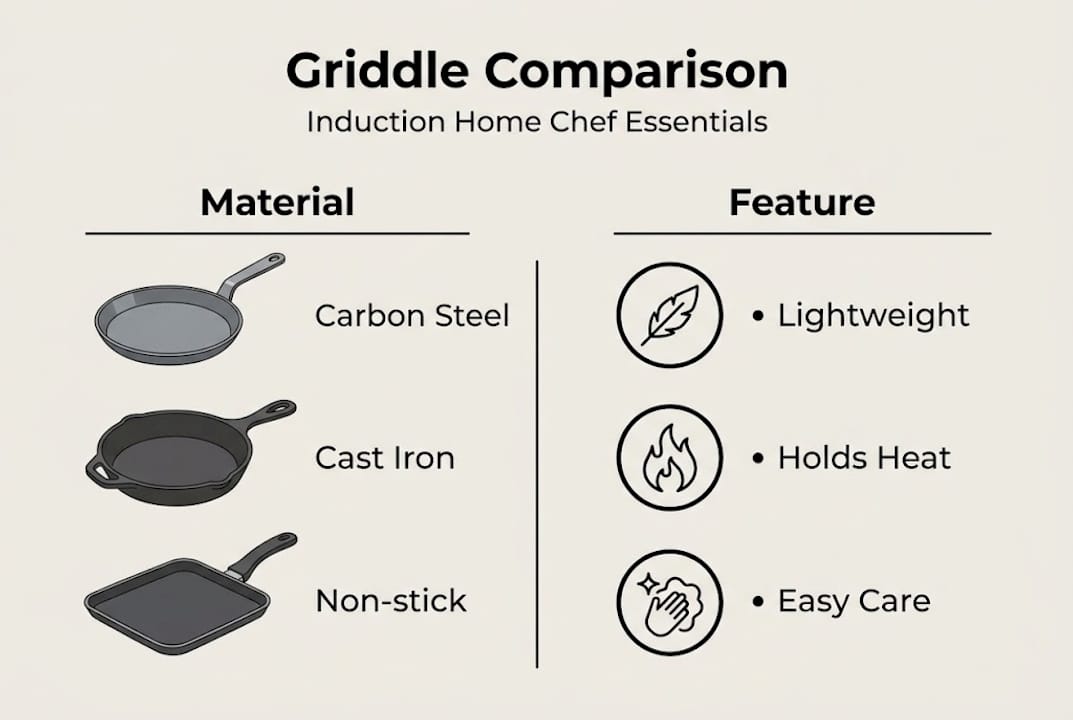
Carbon steel strikes the best balance for most cooks. It is lighter than cast iron, heats faster, and responds to temperature changes quickly. It does require seasoning, but that seasoning builds a natural, non-toxic non-stick surface over time. Professional chef advice on carbon steel consistently points to its versatility as the main reason it dominates professional kitchens.
Cast iron is durable and holds heat well, but it is heavy, heats slowly, and carries real risk on glass induction surfaces. A cast iron griddle dropped or dragged across a ceramic hob can crack the glass. It also takes a long time to reach cooking temperature, which is frustrating when you want speed.
Non-stick griddles are convenient out of the box, but the coating degrades with use, particularly at the higher temperatures induction can reach. Once the surface starts to chip or peel, the griddle needs replacing. That is neither economical nor environmentally sensible.
| Feature | Carbon steel | Cast iron | Non-stick |
|---|---|---|---|
| Induction compatible | Yes | Yes (with care) | Varies |
| Weight | Medium | Heavy | Light to medium |
| Heat-up speed | Fast | Slow | Fast |
| Durability | Excellent | Good | Poor over time |
| Non-stick quality | Builds with seasoning | Builds with seasoning | Immediate but fades |
| Glass cooktop safety | Safe | Risk of damage | Safe |
| PTFE/PFOA free | Yes | Yes | No (most models) |
Empirical testing backs this up. Made In outperforms Lodge in versatility, durability, and heat retention on induction, though some hot-spotting was noted across both. The lesson is that carbon steel, when well-made and properly seasoned, consistently outperforms the alternatives for induction griddle cooking.
For a deeper look at how these materials compare, our article on carbon steel vs cast iron and our guide on carbon steel vs stainless steel cover the nuances in full.
- Carbon steel improves with every cook.
- Cast iron is a long-term commitment that demands careful handling on glass hobs.
- Non-stick is a short-term convenience with long-term costs.
Key features to look for in an induction griddle
With a sense of the best materials, let us pinpoint exactly what to look for in an ideal griddle. Buying the wrong one is an expensive mistake, so these criteria matter.
- Thickness of at least 4mm. Thicker single-piece carbon steel reduces warping and improves stability on induction. This is the single most important specification to check before purchasing.
- A perfectly flat base. Place the griddle on a flat surface before buying. Any rocking indicates a bow in the base, which will cause uneven cooking and potential damage to your hob.
- Comfortable, heat-resistant handles. A long handle on one side gives you control. Avoid designs where both handles are short stubs, as these make manoeuvring a hot, heavy griddle awkward and risky.
- A size that suits your hob. Most European induction hobs have zones of 18 to 21 cm in diameter. A griddle that spans two zones can work, but heat distribution will be less consistent across the full surface.
- Single-piece pressed or forged construction. Rivets and welds are weak points. A seamless griddle is structurally stronger and far easier to clean.
Pro Tip: Before buying online, check whether the manufacturer states the exact thickness in millimetres. Vague descriptions like “heavy gauge” are not sufficient. Demand the number.
| Specification | Minimum acceptable | Recommended |
|---|---|---|
| Thickness | 3mm | 4mm or more |
| Base flatness | No visible bow | Confirmed flat |
| Construction | Welded | Single-piece forged |
| Handle type | Single long handle | Long handle with helper |
| Induction tested | Magnet passes | Manufacturer confirmed |
For guidance on keeping your griddle in top condition once you have chosen it, our best practices for carbon steel griddle care article is a practical starting point.
Mastering care and seasoning for long-lasting performance
You have chosen the right griddle. Now discover how to make it last for years, because even the finest carbon steel griddle will underperform if it is not looked after properly.
Seasoning is the process of baking thin layers of oil onto the steel surface until they polymerise into a hard, dark, non-stick coating. It is not complicated, but it does require patience and consistency. Carbon steel needs regular seasoning to maintain its non-stick quality, and neglecting this step is the most common reason cooks give up on carbon steel entirely.
Here is a straightforward seasoning process for home cooks:
- Wash the new griddle with warm, soapy water to remove any factory oil coating.
- Dry it completely, either with a cloth or briefly on the hob over low heat.
- Apply a very thin layer of high-smoke-point oil such as grapeseed, avocado, or sunflower oil.
- Wipe away almost all of the oil with a clean cloth. The surface should look nearly dry.
- Heat the griddle in an oven at 250°C for 30 minutes, placed upside down.
- Allow it to cool, then repeat the process two or three more times to build a solid base.
Pro Tip: Less oil is always better when seasoning. A thick application does not cure properly and leaves a sticky, patchy surface. If your griddle feels tacky after seasoning, you used too much oil. Scrub it back and start again.
For ongoing care, keep these habits in place:
- Clean with warm water only. Avoid soaking or using harsh detergents.
- Dry immediately after washing, never leave it wet.
- Rub a light coat of oil over the surface after each use.
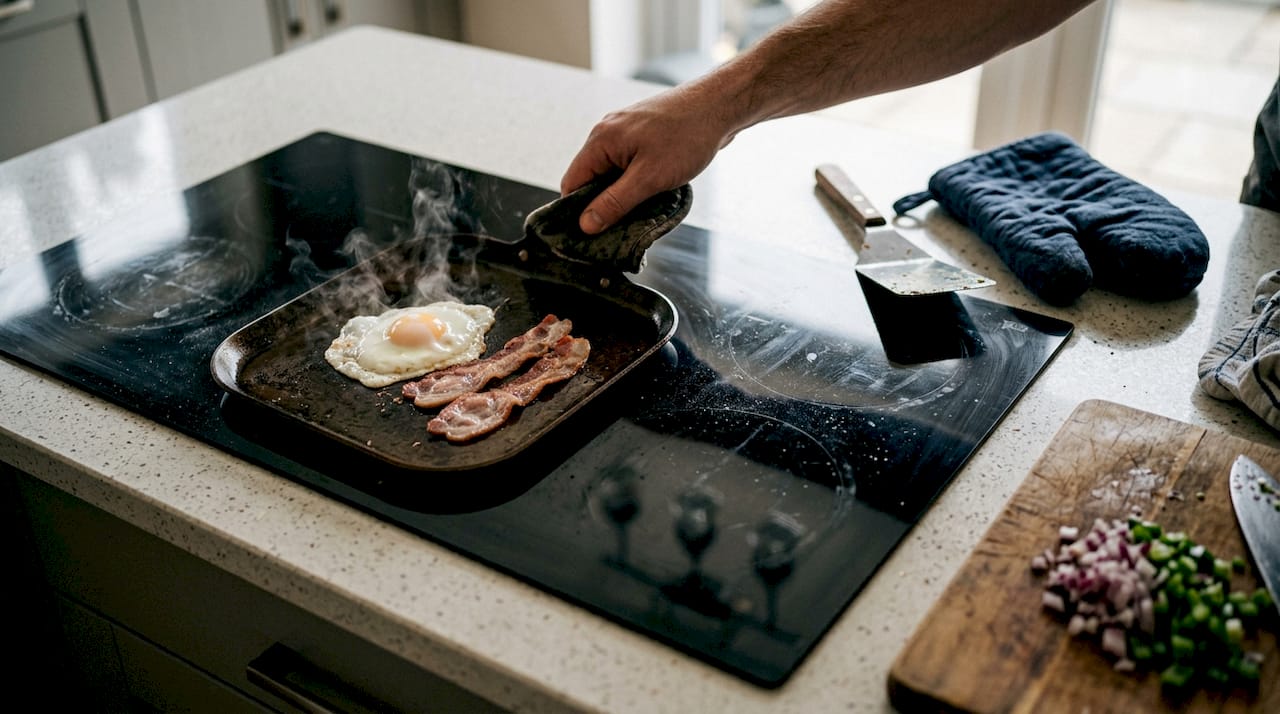
- Cook fatty foods like bacon or sausages regularly to strengthen the seasoning naturally.
Our seasoning checklist for carbon steel and upkeep guide for carbon steel walk through every step in more detail if you want to go further.
Why most home cooks miss out on true griddle potential
Before we recommend next steps, here is an insight most miss in the journey to great induction griddle cooking.
Most cooks approach a griddle purchase the way they approach buying a toaster: find something affordable, use it until it fails, replace it. That mindset works for appliances with motors and timers. It does not work for carbon steel.
The truth is that carbon steel outperforms nonstick and cast iron in long-term testing, but only when the cook invests in the relationship. A griddle that is seasoned consistently, dried properly, and used regularly becomes genuinely better over months and years. The surface darkens, smooths out, and releases food effortlessly.
Integrated induction griddles promise convenience but rarely deliver on performance. They are fixed in size, difficult to season properly, and cannot be moved to where you need them. A separate, pro-grade carbon steel griddle gives you control over every variable.
The cooks who get the most from carbon steel are not necessarily the most skilled. They are simply the most consistent. Technique and care, as our longevity of carbon steel cookware guide explains, matter far more than the price tag on the box.
Take your induction griddle skills further
Ready to transform your induction griddle experience? Here is where to take your next step.
Choosing the right carbon steel griddle is only the beginning. The real reward comes from building a cooking surface that improves every time you use it, one that works on every hob in your home, and one that could genuinely outlast every other piece of cookware in your kitchen.
At Brass & Steel, we design and forge carbon steel cookware from a single piece of steel, with no rivets, no welds, and no coatings to worry about. Our pans and griddles are built for induction from the ground up. For everything you need to keep your cookware performing at its best, our carbon steel maintenance tips are a practical, no-nonsense resource to return to again and again.
Frequently asked questions
Do I need a special griddle for an induction cooktop?
Yes, the griddle must be made from a magnetic material such as carbon steel or compatible cast iron for induction to work. A standard aluminium or copper griddle will not function on an induction hob.
Why avoid very heavy or thin griddles on induction?
Heavy cast iron risks cracking the glass surface if dropped or dragged, while thin griddles buckle under the rapid temperature changes that induction produces. Neither extreme serves you well.
What is the best way to season a carbon steel griddle?
Apply a very thin coat of high-smoke-point oil, wipe away the excess, and heat until it polymerises into a dark, hard layer. Repeat two or three times to build a reliable non-stick patina.
Can I use a griddle over two induction zones at once?
Yes, provided the griddle is flat and large enough to span both zones, but heat distribution across two burners is rarely even. Expect a hotter centre and cooler edges.
Are integrated induction griddles better than separate ones?
No. Integrated units are less durable and far less versatile than a dedicated pro-grade carbon steel griddle. A separate griddle gives you full control over size, seasoning, and placement.