The role of pan weight in cooking: your guide
TL;DR:
- Pan weight influences heat retention and cooking control, but heavier does not always mean better. A balanced approach considers thermal mass, ergonomic comfort, and your cooking style to optimize performance and reduce fatigue. Choosing the right carbon steel pan involves assessing size, handle ergonomics, and construction quality for consistent, efficient home cooking.
Most home cooks assume the role of pan weight in cooking is simple: heavier equals better. It is an understandable assumption. Heavy pans feel serious, professional, substantial. But weight without context is just mass. A thick, well-built 2 kg carbon steel pan can outperform a poorly constructed 4 kg cast iron skillet on certain tasks, and a pan that performs brilliantly for braising can be exhausting and counterproductive for a quick stir-fry. This guide cuts through that misconception. You will learn exactly how pan weight shapes heat retention, browning, and cooking control, with particular focus on carbon steel cookware and how to choose the right weight for the way you actually cook.
Table of Contents
- How pan weight influences heat performance and cooking results
- Balancing pan weight and ergonomic comfort in your kitchen
- Comparing carbon steel and cast iron: how weight shapes cooking styles
- Understanding thermal mass versus heat distribution in pan weight
- Practical tips for choosing the right pan weight for your home cooking
- Why pan weight is about balance, not just heft
- Explore our range of balanced carbon steel pans for your kitchen
- Frequently asked questions
Key Takeaways
| Point | Details |
|---|---|
| Thickness boosts thermal mass | Thicker pan bases hold more heat, helping maintain cooking temperature and improve browning outcomes. |
| Balance weight and comfort | A well-balanced pan weight reduces strain and improves control during cooking sessions. |
| Carbon steel is a moderate weight option | Carbon steel pans weigh less than cast iron but more than stainless steel, ideal for versatile kitchen use. |
| Material and construction matter | Weight alone doesn’t determine heat performance; pan design and thickness are key factors. |
| Choose weight for your cooking style | Select pans that match your strength, cooking habits, and ergonomic needs for best results. |
How pan weight influences heat performance and cooking results
Weight and thickness are not the same thing, but they are closely related. A heavier pan almost always means more material, and more material means greater thermal mass. Thermal mass is the ability of an object to absorb and hold heat. In cooking, this matters enormously.
When you place cold chicken thighs into a thin, lightweight pan, the surface temperature of that pan drops sharply. The result is steaming rather than searing, and you lose the Maillard browning that makes food taste genuinely good. A pan with real thickness resists that temperature drop. According to thicker pan testing, a 3.0 mm base holds roughly 2.5 times more thermal energy than a 1.2 mm base, buffering temperature drops that are crucial for browning.
Here is what that means practically for your cooking:
- Searing proteins: A weightier pan recovers heat faster after cold food hits the surface, producing a proper crust rather than a grey, steamed exterior.
- Consistent sautéing: Temperature spikes and dips flatten out, so vegetables cook evenly rather than burning at the edges whilst remaining raw in the centre.
- Oven-to-hob transitions: A pan with good thermal mass handles rapid environment changes without distorting.
- Predictable results: Once you learn how your pan behaves thermally, you can replicate results every time.
“The thickness of your pan’s base is arguably the single most important variable in achieving consistent, restaurant-quality browning at home.”
Understanding carbon steel pan essentials helps clarify why 3 mm and 4 mm carbon steel pans perform so differently from thin pressed-steel alternatives you might find at lower price points. The physics is straightforward: more metal at the food contact zone means more heat stored and less lost when it counts.
Balancing pan weight and ergonomic comfort in your kitchen
Knowing that thermal mass matters does not mean you should simply buy the heaviest pan available. There is a very real physical cost to working with overly heavy cookware, and it compounds quickly during longer cooking sessions.
Wrist strain is the most common complaint. Pans above roughly 4.8 lbs increase wrist strain by 23% during frequent stir-frying, making mid-weight pans considerably safer for repeated use. If you are cooking four nights a week and regularly tossing vegetables or moving the pan around the hob, that strain accumulates into real discomfort over months.
The practical weight sweet spot for home cooks working with 10 to 12 inch (25 to 30 cm) pans is roughly 1.5 to 2 kg. This range gives you enough thermal mass for serious searing without the fatigue of a heavier pan. Key ergonomic factors to weigh up alongside mass:
- Handle length and angle: A longer handle gives more leverage, making a heavier pan feel lighter in practice.
- Handle material: Steel handles stay cooler on the hob than cast handles, which encourages proper grip and control.
- Balance point: A well-balanced pan feels lighter than its actual weight because the mass is distributed logically.
- Your own physical context: Wrist strength, hand size, and any existing joint issues all affect what feels manageable.
The design of ergonomic cookware is genuinely worth studying before you invest in a pan you will use for years. A pan that causes discomfort gets used less, which defeats the purpose entirely.
Pro Tip: Before buying any pan online, visit a kitchen shop and hold the display model as you would when cooking, not just when lifting it off a shelf. The difference between “seems manageable” and “feels right” only reveals itself when you mimic your actual cooking grip.
Comparing carbon steel and cast iron: how weight shapes cooking styles
When people debate heavy pans, cast iron is usually the reference point. It is worth comparing it directly with carbon steel, because the weight difference between the two materials has a significant, practical impact on what you can realistically cook and how.
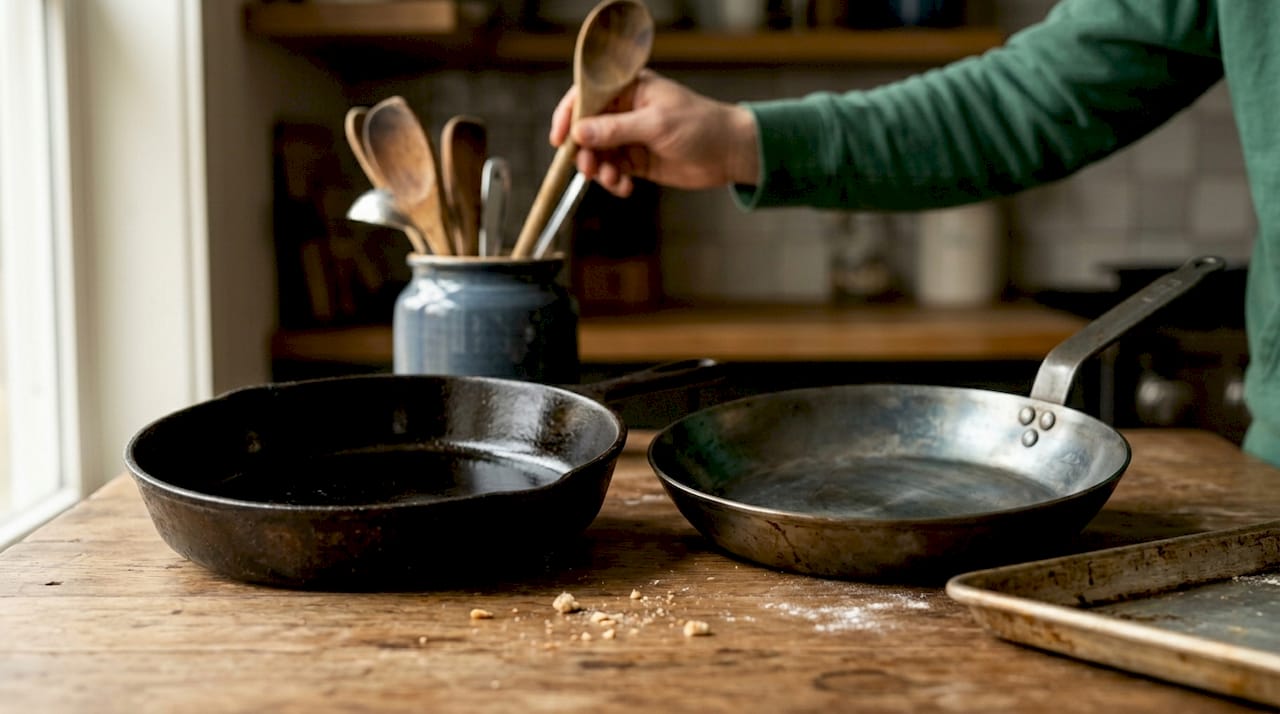
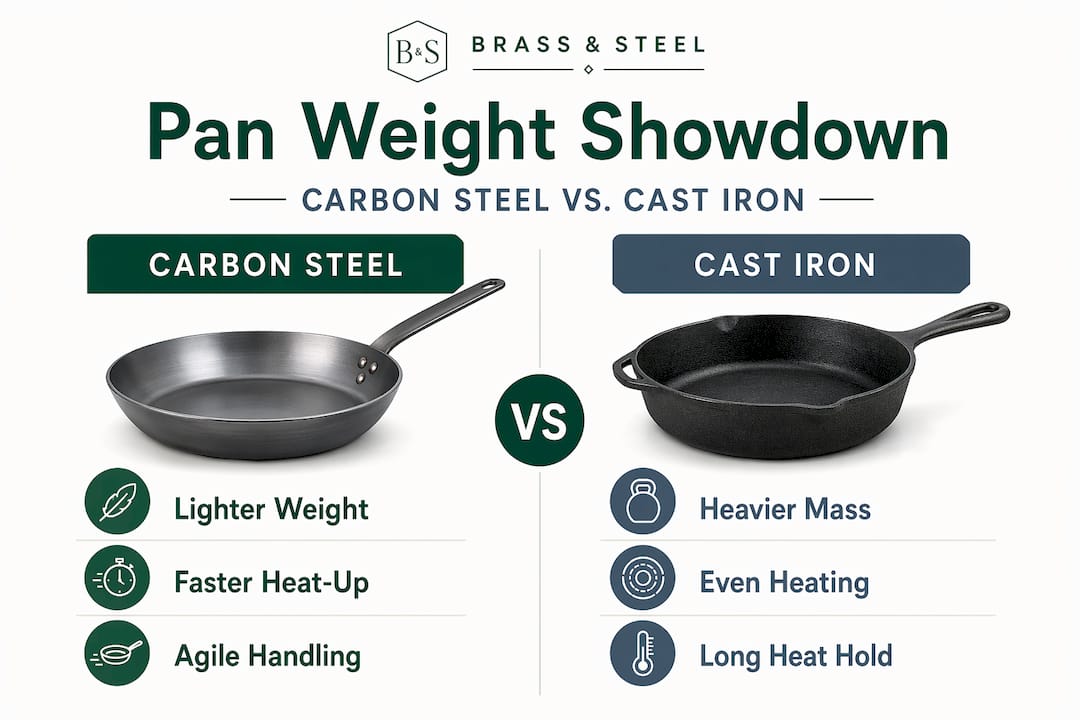
A typical 12-inch cast iron skillet weighs between 7 and 9 lbs (roughly 3.2 to 4.1 kg), whereas a comparable carbon steel pan weighs 4 to 6 lbs (roughly 1.8 to 2.7 kg). That difference does not just affect your wrist. It shapes your entire cooking approach.
| Feature | Carbon steel | Cast iron |
|---|---|---|
| Typical weight (30 cm) | 2.5 to 3 kg | 3.5 to 4.5 kg |
| Heat-up speed | Fast | Slow |
| Heat retention | Good | Excellent |
| Responsiveness to heat changes | High | Low |
| Manoeuvrability on the hob | Easy | Effortful |
| Best for | Searing, sautéing, tossing | Slow searing, baking, braising |
| Seasoning required | Yes | Yes |
Carbon steel’s lighter weight is not a compromise. It is a feature for cooks who want responsive, agile cookware. You can toss pasta, flip vegetables, and move the pan from hob to oven without the sense that you are hauling furniture. Cast iron, by contrast, excels when you want to set it on a heat source and leave it, letting that enormous thermal mass do the work.
The key insight about carbon steel versus cast iron is that neither is universally superior. The right choice depends on your dominant cooking style. If you braise and bake, cast iron earns its weight. If you sear, sauté, and cook on high heat with movement, carbon steel’s lighter profile gives you genuine control.
Understanding thermal mass versus heat distribution in pan weight
Here is a distinction that most cookware discussions skip over, and it genuinely matters: thermal mass and heat distribution are not the same thing. Confusing them leads to poor purchasing decisions.
Thermal mass is about stability. A heavy, thick pan resists temperature change. That is valuable when food hits the surface.
Heat distribution is about evenness. How consistently does heat spread from the centre of the pan outward? This is governed by the conductivity of the material and the uniformity of the construction, not weight alone.
“Material and thickness together define thermal mass and heating response; two heavy pans can behave very differently depending on build quality and geometry.”
A thick cast iron pan may have excellent thermal mass but uneven heat distribution, producing hot spots near the centre where the flame is strongest. A carbon steel pan of similar weight but better construction geometry can spread heat more evenly across the cooking surface. Weight tells you about stability. Build quality tells you about consistency.
This is why inspecting construction details before buying matters as much as checking the weight specification. Look for:
- Uniform base thickness across the entire cooking surface, not just at the centre.
- Single-piece construction that eliminates cold spots around welded joins.
- Appropriate material thickness for the pan’s intended use.
Pro Tip: If you notice food consistently browning faster near the centre of your pan than at the edges, the issue is uneven heat distribution rather than too little or too much weight. Changing the heat source, or choosing a better-constructed pan, will fix this faster than switching to a heavier model.
Choosing between carbon steel and cast iron becomes considerably easier once you separate these two concepts and ask yourself which quality you actually need for your cooking.
Practical tips for choosing the right pan weight for your home cooking
Theory is useful. Practical steps are better. Here is how to actually translate everything above into a buying decision that will serve you well in real kitchen conditions.
Testing pan weight and handle comfort before buying is one of the most important steps home cooks overlook, particularly when shopping online. Whenever possible, handle the pan in a shop before committing.
- Match size to your cooking volume. A 27 cm pan suits most meals for one to three people. A 30 cm pan handles family-sized portions and batch cooking without crowding, which would cause steaming instead of searing.
- Consider your most frequent cooking task. Tossing and stirring demand a lighter, well-balanced pan. Long-duration searing or oven use favours a slightly heavier, thicker base.
- Hold the pan in your dominant hand at arm’s length for 30 seconds. If it feels uncomfortable at 30 seconds, it will feel genuinely tiring after 15 minutes of cooking.
- Check handle ergonomics. Grip the handle as you would during cooking. Does it sit naturally in your hand? Is the angle comfortable for both hob and oven use?
- Factor in your cooktop. Induction hobs respond quickly to heat changes, which pairs well with the responsiveness of carbon steel. Gas hobs suit both materials. Ceramic hobs benefit from a flat, stable base that heavier warped pans may not provide.
Our carbon steel versus cast iron guide walks through additional scenarios in detail, which is particularly useful if you are deciding between your first serious pan purchase.
Pro Tip: If you frequently cook for two to four people, a 27 cm pan at around 2 kg is the most versatile starting point. It gives you enough thermal mass for a proper sear, stays manageable during longer sessions, and fits comfortably on most European hob sizes.
Why pan weight is about balance, not just heft
Here is what fifteen years of watching home cooks choose their cookware has taught us: the most common expensive mistake is equating weight with quality. Walk into any kitchenware shop in Europe and you will find beautifully finished, enormously heavy pans marketed as professional-grade. Many of them are. But professional kitchens also have brigade cooks rotating tasks frequently. You do not.
The impact of pan weight on cooking is real and significant, but only when that weight is doing useful work. Extra weight matters only if it improves thermal mass where it counts, specifically at the food contact zone, and ergonomic risks rise sharply with heavier pans when you are cooking for long durations. A pan that is 500g heavier than it needs to be is not giving you better cooking. It is giving you more fatigue.
The cooks who get the most from their cookware are not the ones with the heaviest pans. They are the ones with pans that are appropriately thick at the base, well-balanced in the hand, and made from materials that respond predictably to heat. Carbon steel sits in a genuinely useful middle ground: thick enough to hold heat, light enough to manoeuvre, and responsive enough to give you real control over what happens in the pan.
We would also argue that weight distribution matters more than total weight. A pan with mass concentrated in the base and a lightweight handle outperforms a pan of equal total weight with a heavy handle and thin base. The former does the thermal work where you need it. The latter just makes your wrist ache. Thinking about ergonomic cookware importance through this lens changes how you evaluate every pan you pick up.
Explore our range of balanced carbon steel pans for your kitchen
Understanding the advantages of using heavy pans, and knowing when lighter is genuinely better, puts you in an excellent position to choose cookware that improves your cooking rather than simply adding mass to your kitchen.
At Brass & Steel, our carbon steel sauté pans are built around exactly this balance. The 27 cm pan at 3 mm thickness and approximately 2 kg offers serious thermal performance for everyday cooking without the fatigue of heavier alternatives. The 30 cm pan at 4 mm and approximately 3 kg steps up for family meals and high-volume searing. Both are forged from a single piece of carbon steel, eliminating the weak points and cold spots that riveted construction creates. Free from PTFE and PFOA, compatible with all hob types including induction, and designed to build a natural nonstick seasoning over time, these pans are built to last decades. Explore the full Brass & Steel cookware collection and find the weight that works for your kitchen.
Frequently asked questions
Does a heavier pan always mean better cooking?
Not necessarily. Heavier pans increase thermal mass but weight alone does not guarantee even heat distribution or comfortable use, particularly during longer or more dynamic cooking sessions.
Are carbon steel pans heavy for everyday cooking?
Carbon steel pans sit at a practical middle weight. Most users find carbon steel lighter than cast iron and comfortable for daily use, offering good heat performance without the strain of heavier alternatives.
How can I choose the right pan weight for my kitchen?
Consider your strength, cooking style, and handle ergonomics together. Testing pan weight and handle comfort before buying is one of the most reliable ways to avoid strain and find a pan that genuinely suits how you cook.
What is the difference between carbon steel and cast iron pans in terms of weight?
Cast iron pans are significantly heavier. Typical 12-inch cast iron pans weigh between 7 and 9 lbs, while equivalent carbon steel pans weigh 4 to 6 lbs, which affects both heat retention and ease of handling.
Why is pan thickness important besides weight?
Thickness directly governs thermal mass. Thickness buffers against temperature drops that are crucial for achieving good browning, whereas total weight alone does not guarantee this stability at the cooking surface.