Pots vs pans: 5 key differences for better cooking
TL;DR:
- Pots are tall and retain moisture, ideal for boiling and braising.
- Pans are wide and shallow, perfect for browning and searing.
- Material choice and shape significantly impact cooking outcomes and efficiency.
Reach into most kitchen cupboards across Europe and you will find a jumble of pots and pans used almost interchangeably. A shallow frying pan pressed into service for soup. A deep stockpot used to sauté vegetables, which then steam rather than colour. These are not minor errors. The vessel you choose directly shapes how heat moves, how moisture escapes, and whether the Maillard reaction — the browning that creates flavour — actually happens. Understanding the structural and functional differences between pots and pans is one of the most practical upgrades any home cook can make, and this guide covers exactly that.
Table of Contents
- What makes a pot different from a pan?
- How design affects cooking results
- Material choices: Why they matter more than you think
- Choosing the right cookware for every task
- Why mastering the differences matters more than most guides suggest
- Upgrade your kitchen: Cook like a pro with the right kit
- Frequently asked questions
Key Takeaways
| Point | Details |
|---|---|
| Key structural difference | Pots have higher sides for volume and even simmering; pans offer wide, flat surfaces for browning. |
| Design shapes cooking outcome | Surface area, material, and depth all affect whether food steams, browns, or simmers perfectly. |
| Material really matters | Fully-clad, quality materials make a bigger difference than most realise—especially on induction hobs. |
| Match tool to recipe | Using the correct vessel prevents common problems like soggy vegetables or burnt sauces. |
What makes a pot different from a pan?
At first glance, the distinction seems obvious. Pots are tall and deep; pans are wide and shallow. But the real difference lies in what those shapes are engineered to do.
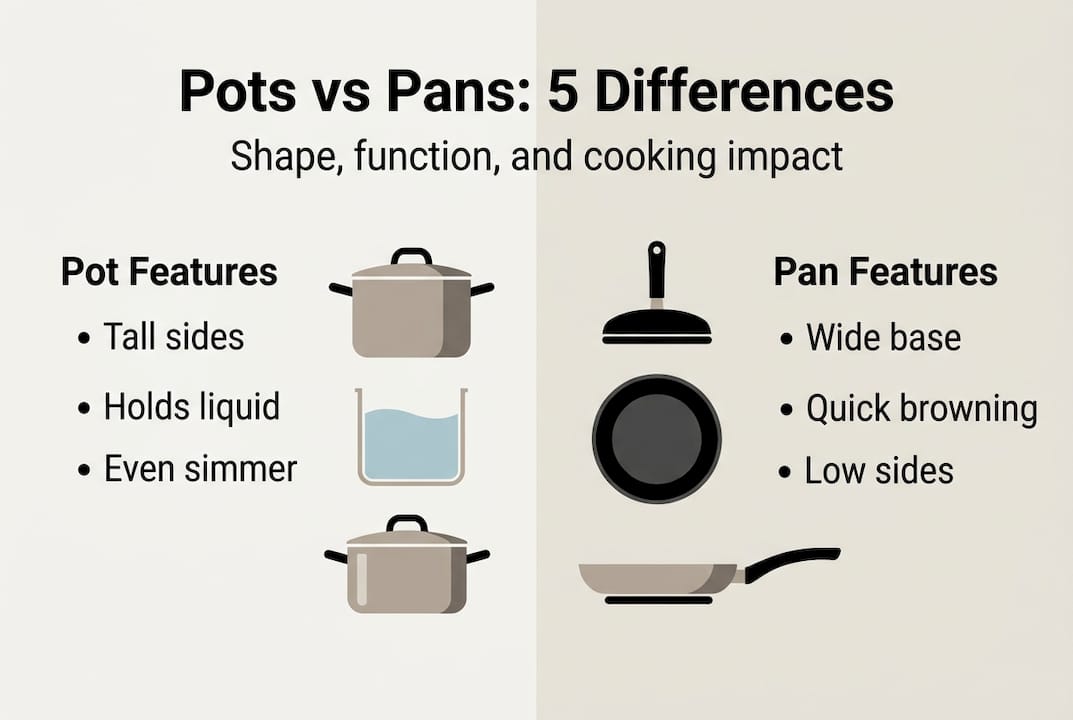
A pan is designed to maximise bottom surface contact with the heat source. Its wide, flat base and low sides allow moisture to escape quickly, which is essential for browning, searing, and crisping. A pot, by contrast, prioritises volume and heat retention. Its tall sides trap steam and liquid, making it ideal for boiling, braising, and slow simmering.
These structural choices have measurable consequences. Tri-ply pans achieve roughly a 2°F centre-to-edge temperature difference during high-heat tests, while pots are engineered for consistent, even heat retention across a large volume of liquid rather than rapid surface browning.
Here is a quick comparison to make the distinction concrete:
| Feature | Pan | Pot |
|---|---|---|
| Depth | Shallow (2–5 cm) | Deep (10–30 cm) |
| Surface area | Wide base | Narrower base relative to volume |
| Primary use | Browning, searing, frying | Boiling, braising, simmering |
| Moisture behaviour | Escapes quickly | Retained as steam |
| Heat focus | Surface contact | Volume retention |
For a deeper look at how pan shapes and usage vary across cooking tasks, it is worth understanding the full range before building your collection.
Key structural differences that affect your cooking:
- Flared or straight sides on pans allow easy tossing and moisture release
- Tall, straight sides on pots lock in liquid and flavour
- Handle design differs: pans often have a single long handle, pots use two short handles for safe lifting when full
- Lid fit matters more on pots, where pressure and steam control are central to the cooking method
Choosing the wrong vessel is not just inconvenient. It actively works against the physics your recipe depends on.
How design affects cooking results
Now that you know how pots and pans differ in build, let us look at why those differences matter in practice.
The most critical concept is the relationship between surface area and moisture. When food sits in a wide, shallow pan over high heat, moisture evaporates rapidly from the large exposed surface. This is exactly what you want when browning a steak or crisping potatoes. The moment you switch to a deeper vessel, that moisture has nowhere to go. It accumulates above the food as steam, and instead of a golden crust, you get a grey, soft result.
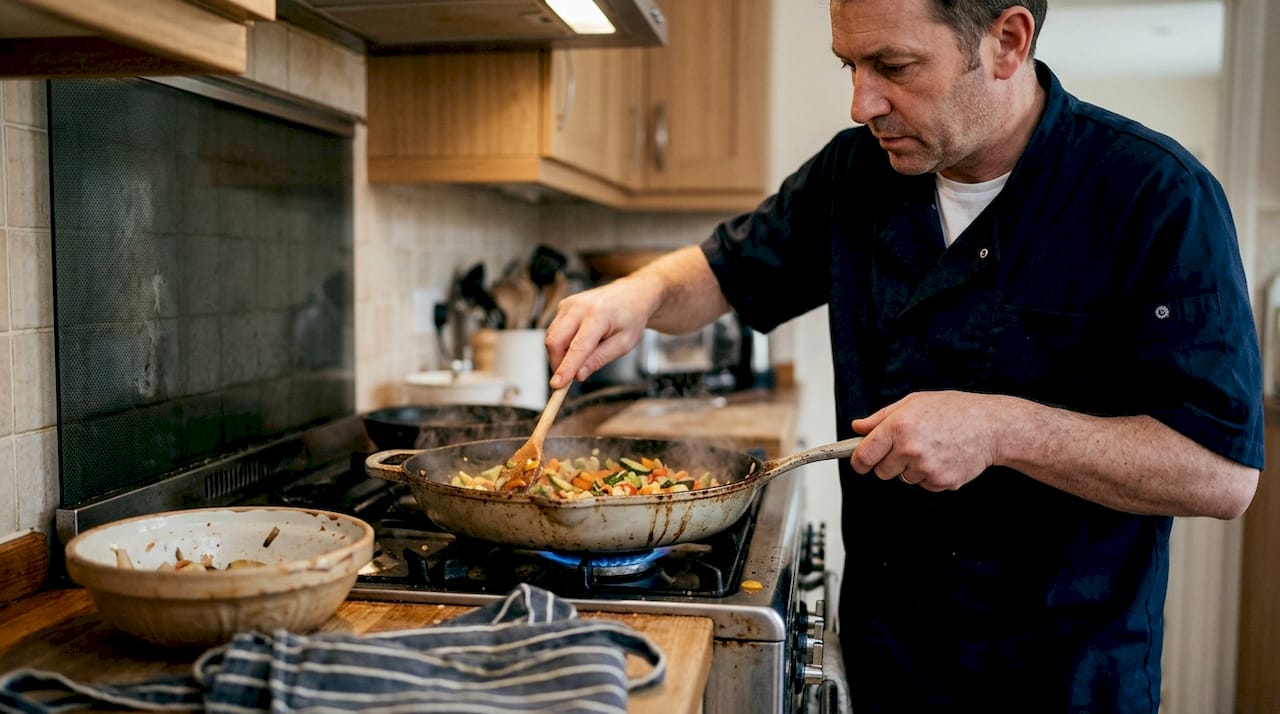
Wider pans of 8 to 10 inches brown evenly without steaming, while tri-ply saucepans boil two quarts of water in roughly three to four minutes with no hot spots, and fully clad pots retain heat for consistent simmers. These are not marginal gains. They are the difference between a dish that works and one that does not.
Consider a practical example. You are making a French-style chicken sauté. If you use a stockpot, the chicken pieces crowd together, the liquid pools at the bottom, and the skin never crisps. Use a wide carbon steel sauté pan, and the skin renders and browns beautifully because heat reaches every piece evenly and moisture escapes freely.
The choice of materials for heat distribution also plays a role here, but design comes first. Even the best material cannot compensate for the wrong shape.
“The vessel is not just a container. It is an active participant in how your food cooks.”
For pans used in high heat cooking, responsiveness and surface contact are everything. A pan that heats unevenly or retains moisture will undermine even the most carefully sourced ingredients.
Pro Tip: When sautéing vegetables, never fill the pan more than halfway. Overcrowding drops the surface temperature and traps steam, turning what should be a quick, vibrant sauté into a slow, soggy stew.
Material choices: Why they matter more than you think
Understanding the design is key, but your choice of material is equally crucial for cooking success.
The material of a pot or pan determines how quickly it heats up, how evenly it distributes that heat, and how well it holds temperature when cold food is added. For European home cooks using both gas and induction hobs, this is not a minor consideration.
Here are the main materials and what they bring to the table:
- Carbon steel: Lightweight relative to cast iron, heats quickly, and builds a natural nonstick patina with seasoning. Excellent responsiveness makes it ideal for high-heat searing and sautéing. The advantages of forged carbon steel pans include superior durability and no synthetic coatings.
- Stainless steel (tri-ply or fully clad): An aluminium or copper core bonded between steel layers gives even heat distribution. Works on all hobs including induction. Durable and non-reactive.
- Aluminium: Heats fast but can react with acidic foods. Usually used as a core layer rather than a standalone material in quality cookware.
- Cast iron: Exceptional heat retention, but heavy and slow to respond. Better suited to pots and braisers than quick-sear pans.
- Ceramic-coated: Easy release when new, but the coating degrades with high heat and metal utensils over time.
Using the wrong vessel mismatches the physics of your recipe. A sauce reduced in a frying pan loses liquid too fast and scorches at the edges. Pasta cooked in a shallow pan overflows before it is done. These are not user errors. They are material and design mismatches.
For a full breakdown of how each option performs, the guide to cookware materials explained is a useful reference before making any purchasing decision.
Pro Tip: If you cook on induction, check that the base of your pan contains enough ferromagnetic material to trigger the hob. Fully clad stainless or carbon steel pans work reliably. Thin aluminium pans often do not.
Choosing the right cookware for every task
With shape and material in mind, let us turn this into everyday cooking practicality.
The clearest way to choose the right vessel is to ask two questions: Does this recipe need moisture to escape, or to stay in? And does it need rapid heat response, or sustained, steady warmth?
Here is a step-by-step approach to making the call:
- Identify the cooking method. Browning, searing, and frying need a pan. Boiling, braising, and slow-cooking need a pot.
- Consider the volume of food. A large batch of vegetables needs a wide pan so each piece touches the base. A large batch of soup needs a deep pot.
- Think about the liquid. If the recipe calls for reduction, use a pan or wide sauté pan. If it calls for submersion, use a pot.
- Match the material to your hob. For induction, choose stainless or tri-ply for gas and induction hobs, or carbon steel. Both respond well and heat evenly.
- Account for finishing. If the dish goes from hob to oven, make sure the vessel and its handle are oven-safe.
For common European dishes, here is a quick reference:
- Pasta: Deep stockpot, plenty of water, high heat
- Risotto: Wide, deep sauté pan or shallow casserole for even absorption
- Steak or fish: Wide carbon steel or stainless pan, very high heat
- Stew or braise: Heavy pot or casserole with a tight-fitting lid
- Scrambled eggs: Small pan, low heat, responsive material
- Tomato sauce: Medium saucepan, not a frying pan, to avoid rapid reduction and scorching
For a broader view of essential cookware types and how they map to cooking tasks, it is worth reviewing the full range. And if you are deciding between materials, the comparison of carbon vs stainless steel pans offers a detailed breakdown.
Why mastering the differences matters more than most guides suggest
Most cookware guides draw a clean line: pots boil, pans fry. That is true as far as it goes, but it misses something important. The longer you cook, the more you realise the boundary is genuinely blurry.
A large sauté pan with straight, high sides behaves like a pot for small braises. A wide, shallow casserole can stand in for a frying pan when you need even browning across a large surface. The most capable cooks are not the ones who follow vessel rules rigidly. They are the ones who understand why the rules exist, so they know when to break them.
This is also why buying a full matching cookware set is rarely the smartest investment. Two or three well-chosen, high-quality pieces will cover ninety per cent of what you cook. A forged carbon steel pan built for professionals will outperform a full set of mid-range pans in almost every high-heat task. Invest in fewer pieces, but invest in the right ones. Build intuition over time, and the vessel choice becomes instinctive rather than a source of confusion.
Upgrade your kitchen: Cook like a pro with the right kit
The knowledge in this guide only becomes useful when you have cookware that can actually deliver on it. Choosing a vessel with the right shape is the first step. Having a pan that responds to heat precisely, browns evenly, and lasts for decades is what makes the difference in practice.
At Brass & Steel, we forge our professional carbon steel pans from a single sheet of steel, with no rivets, no coatings, and no compromises. The 27 cm and 30 cm carbon steel sauté pans are built for exactly the kind of high-heat, responsive cooking this guide describes. If you are ready to cook with a pan that genuinely performs, explore our range and see what a difference the right tool makes.
Frequently asked questions
Can I use a pan instead of a pot for boiling pasta?
A pan is not ideal for boiling pasta because its shallow sides often cause overflow and pasta in a shallow pan cooks unevenly. Use a deep pot for best results.
Why do my sautéed vegetables steam rather than brown?
This usually happens when the pan is overcrowded or too deep, so moisture cannot escape. Overcrowding prevents searing and causes steaming instead of browning.
Are stainless steel pans better than ceramic for high-heat cooking?
Yes. Stainless steel, especially tri-ply, distributes heat more evenly and is far more durable. Tri-ply pans have no hot spots and hold up to repeated high-heat use without degrading.
What is a sauté pan, and does it count as a pot or a pan?
A sauté pan has high, straight sides and a wide flat base, making it a hybrid. Sauté pans blur the line between pots and pans and are classed as pans with pot-like versatility.
Do I need fully clad pans and pots for induction hobs?
Fully clad tri-ply or carbon steel vessels are strongly preferred for induction. Material-clad pans for induction provide consistent heating across the whole base, which is essential for even results.
Recommended
- 7 Essential Pot and Pan Types for European Kitchens – Brass & Steel
- 7 Essential Pans for Kitchen Every Serious Cook Needs – Brass & Steel
- Saute Pan vs Skillet: Choosing for Precision Cooking – Brass & Steel
- 7 Different Pan Names Every Cook Should Know – Brass & Steel
- Preventing Injuries in Kitchens: Safety Tips for 2025 - Probe IT