Ergonomic cookware design for comfort and performance
TL;DR:
- Ergonomic cookware involves measurable design factors like handle geometry, weight distribution, and material, which reduce joint strain during cooking. Research shows that subjective comfort alone is unreliable; combining biomechanical metrics and posture scoring provides a more accurate assessment of ergonomic performance. Selecting tools with proper handle design and task-specific features helps prevent strain injuries and enhances long-term kitchen productivity.
Most cooks assume that if a pan feels comfortable in hand, it is ergonomic. That assumption is costing people energy, causing strain injuries, and limiting performance in both home and professional kitchens. Research now shows that measured hand kinematics differ across real cooking tasks, which means subjective comfort feedback alone is a poor guide. The science of ergonomic cookware goes deeper than feel. Understanding what actually governs hand mechanics during cooking gives you a practical framework for selecting tools that genuinely protect your body and improve your work.
Table of Contents
- What makes cookware ergonomic?
- The science behind comfortable cooking: Metrics and measurement
- Handle design: The unsung hero of ergonomic cookware
- Reducing bending, lifting, and other kitchen strains
- A fresh perspective: Why ergonomic cookware is the missing ingredient in efficient kitchens
- Explore ergonomic cookware solutions with Brass & Steel
- Frequently asked questions
Key Takeaways
| Point | Details |
|---|---|
| Data over comfort alone | Objective measures like posture and hand motion are key to evaluating ergonomic cookware. |
| Handle design matters | The shape, diameter, and adjustability of handles can drastically affect comfort and hand health. |
| Reduces strain and injury | Ergonomic cookware minimises unnecessary bending, lifting, and awkward movements in the kitchen. |
| Tailored solutions exist | Special handle designs help users with limited mobility, making cooking accessible for all. |
What makes cookware ergonomic?
Ergonomics in cookware is not simply about padding or soft-touch coatings. At its core, ergonomic design reduces the physical load placed on your joints, muscles, and tendons during repetitive kitchen tasks. A pan you use dozens of times a week becomes a tool that either builds cumulative strain or actively prevents it.
The factors that define truly ergonomic cookware are measurable and specific:
- Handle geometry: The angle, length, and contour of the handle determines wrist deviation and the force required to stabilise the pan during lifting, stirring, or tossing.
- Weight distribution: A well-balanced pan reduces the muscular effort needed to control it. A front-heavy pan forces your forearm and wrist into sustained compensatory tension.
- Material and surface texture of the handle: Smooth metal transfers heat; textured or contoured surfaces improve grip without requiring excessive finger pressure.
- Total weight: Heavier pans demand greater effort and are harder to manoeuvre safely, particularly over long cooking sessions.
- Compatibility with different hand sizes: A handle designed for large hands can force smaller hands into uncomfortable extended grips, increasing joint strain.
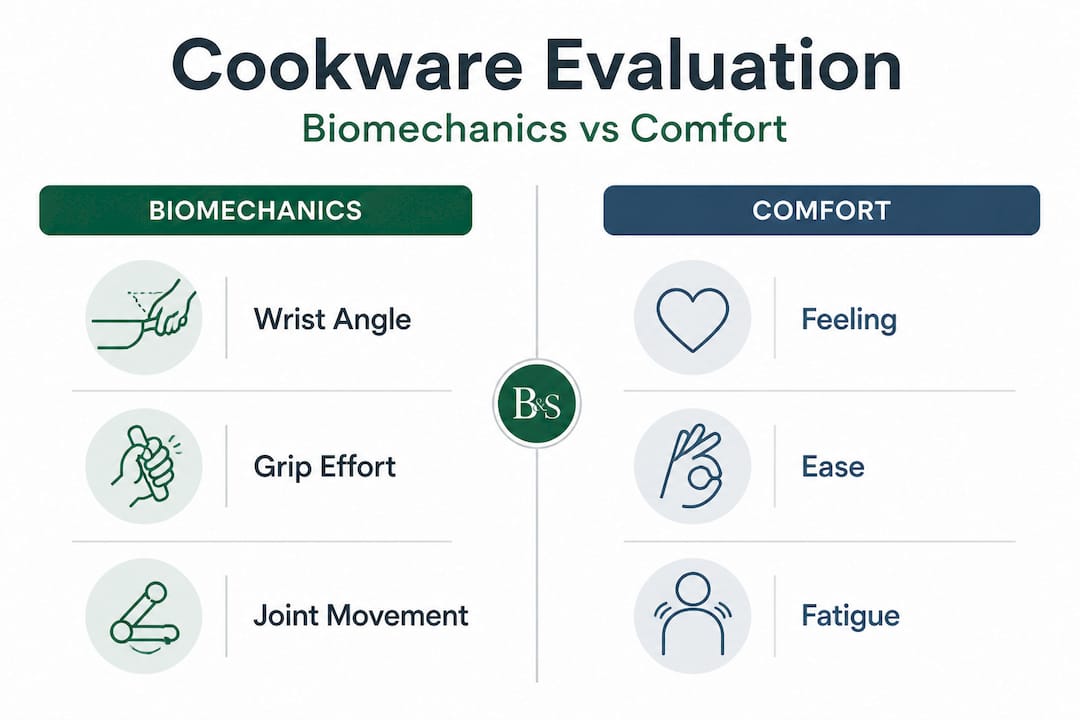
The problem with relying purely on how a pan “feels” in the shop is that it captures nothing about how your hand and wrist behave over twenty minutes of sautéing. As hand kinematic metrics show, comfort feedback alone cannot predict joint load during sustained tasks. A proper cookware checklist for chefs should therefore include biomechanical benchmarks alongside more familiar criteria like heat performance and material quality.
“Cookware ergonomics should be evaluated with motion and kinematic metrics rather than relying only on subjective comfort feedback.”
This is a meaningful shift in how we should think about selecting kitchen tools. Objective metrics give you something concrete to compare, and they reveal differences that subjective impressions consistently miss.
The science behind comfortable cooking: Metrics and measurement
Now that we know what defines ergonomic cookware, let us examine how experts and manufacturers actually measure and validate these qualities. The field draws on two complementary approaches: task-level posture risk scoring and objective hand motion measurement.
Ergonomic evaluation methods compared
| Method | Type | What it measures | Limitations |
|---|---|---|---|
| Comfort questionnaires | Subjective | Perceived ease of use | Biased by familiarity; misses joint load |
| REBA posture scoring | Semi-objective | Body and limb posture risk during tasks | Requires trained assessors; snapshot-based |
| Hand kinematics | Objective | Finger and wrist joint angles and motion | Requires instrumentation; time-intensive |
| Electrogoniometry | Objective | Joint angle deviation during grip tasks | Clinical setting; less practical in kitchens |
| Load cell measurement | Objective | Grip force and distribution | Captures force, not posture |
The most rigorous approach, as outlined in recent methodology, is to combine REBA posture scoring with objective hand kinematic measurements. This pairing connects specific design changes, such as a different handle geometry or altered grip position, to measurable biomechanical outcomes rather than general impressions.
Here is a simplified version of how a structured ergonomic assessment works in practice:
- Define the task: Identify the specific cooking motion (lifting, tossing, stirring, pouring) you are evaluating, since joint demands differ significantly across each.
- Establish a baseline posture score: Use REBA to score body posture and wrist angle under current conditions, producing a risk level from 1 (negligible) to 15 (very high).
- Attach motion sensors or electrogoniometers: Instruments placed on the hand and wrist track joint angles throughout the task in real time.
- Record and analyse: Capture the range of motion, peak joint angles, and duration of high-risk postures across multiple repetitions.
- Introduce design variable: Change one design feature (handle length, diameter, angle) and repeat the measurement to quantify any improvement.
- Compare outcomes: Look at peak joint deviation, cumulative strain, and grip force alongside subjective ratings to form a complete picture.
Pro Tip: Do not discard subjective comfort data entirely. The most useful ergonomic insights come from pairing biomechanical measurements with user feedback. If objective data shows reduced joint strain but users still report discomfort, there is likely a secondary design factor you have not yet controlled for.
When choosing cookware wisely, applying even a basic version of this process, such as noting wrist angle and grip effort when holding a loaded pan at arm’s length for ten seconds, gives you far more useful information than a quick in-store trial.
Handle design: The unsung hero of ergonomic cookware
With measurement techniques in mind, it is time to focus on the aspect of cookware that most influences hand comfort. The handle is where your body meets the tool, and its geometry has more impact on joint health than almost any other design decision.
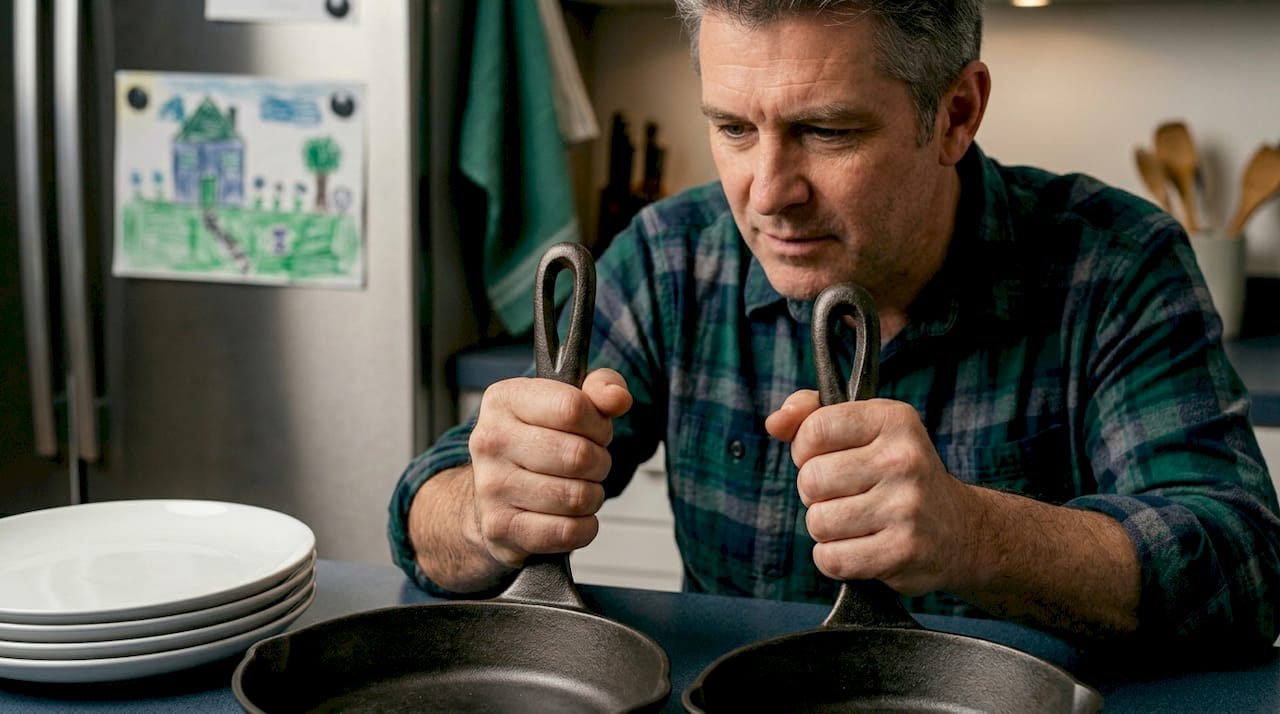
Handle diameter comparison
| Handle type | Diameter | Effect on finger joint angles | Best suited for |
|---|---|---|---|
| Standard slim handle | 20-25 mm | High MCP and PIP flexion required | Users with strong grip and full mobility |
| Standard medium handle | 28-32 mm | Moderate joint flexion; better distribution | Most adult users |
| Built-up handle | 38-50 mm | Reduced finger flexion; lower joint stress | Users with arthritis, limited grip strength |
| Ergonomic contoured handle | Variable | Optimised joint position; reduced deviation | Professionals seeking sustained comfort |
Research is precise on this point. Handle diameter changes required finger joint angles in a meaningful way, and this matters well beyond clinical populations. In tests using electrogoniometers on participants with rheumatoid arthritis, built-up handle diameters of 1.50 inches produced significantly more favourable MCP, PIP, and DIP joint angles compared to standard 1.00-inch handles during simulated tasks. The implication is direct: a thicker handle reduces the degree of finger flexion your joints must maintain to hold a grip securely.
Practical handle features worth evaluating when selecting cookware include:
- Material: Carbon steel and cast iron handles conduct heat, which matters for oven use. Phenolic or wooden inserts stay cooler but may limit oven temperature tolerance.
- Underside contour: A slight concave profile on the underside of the handle allows the thumb and forefinger to seat naturally, reducing lateral wrist deviation.
- Length: A longer handle provides greater mechanical advantage when lifting a loaded pan, reducing the grip force needed to keep it stable.
- Taper: Handles that are slightly wider near the pan and narrower at the grip end allow a more relaxed finger position for most hand sizes.
- Weight contribution: A heavy handle can actually improve overall pan balance by counteracting the weight of the cooking surface.
Pro Tip: If you are dealing with hand pain or reduced grip strength, look for pans with a handle diameter closer to 38 mm or above. The broader surface area distributes grip load across more of your palm and reduces peak pressure at the finger joints. This is not only a consideration for clinical users; it is valuable for any cook who works long hours repeatedly. Exploring safe cookware materials alongside handle ergonomics gives you a complete picture of how design choices interact with long-term health.
Reducing bending, lifting, and other kitchen strains
Handles are not the only ergonomic opportunity in the kitchen. Modern design increasingly addresses the full range of physical demands that cooking places on your body, including the lifting, reaching, and bending that accumulate invisibly during meal preparation.
Consider the physical sequence involved in managing a heavy sauté pan: lifting from a low cabinet shelf, carrying it to the hob, manoeuvring it during cooking, then transferring food to a serving dish. Each of these actions involves different muscle groups and joint positions. Good ergonomic design reduces the peak load at every stage.
Common sources of kitchen strain and how thoughtful product design addresses them:
- Lifting heavy pans from low storage: Balanced pan weight and a longer handle reduce the lumbar load during this movement. Storing heavier pans at waist height is complementary advice.
- Sustained wrist deviation during stirring: A handle angled slightly upward from the pan surface keeps the wrist in a more neutral position during continuous stirring or sautéing.
- Gripping a hot handle under pressure: Textured or heat-resistant grip zones reduce the force needed to maintain control, preventing the over-gripping that contributes to forearm fatigue.
- Transferring a full, heavy pan: Pans with a secondary helper handle on the opposite side distribute the load across both hands and reduce shoulder strain during transfer.
- Awkward reach during loading and unloading: The principle of reducing reach applies to cookware storage and workflow as much as to the tools themselves.
This principle of built-in strain reduction is well demonstrated in adjacent product categories. Commercial product design addresses ergonomics by eliminating awkward postures; Electrolux’s ComfortLift dishwasher, for example, uses a mechanism that raises the bottom rack by 25 cm so users can load and unload heavy items without bending. The insight transfers directly to cookware: design that removes even small postural compromises adds up to meaningful physical relief across an entire working day.
“Every centimetre of unnecessary reach, every degree of awkward wrist angle, and every gram of unbalanced weight contributes to cumulative strain. Ergonomic design is the discipline of eliminating those costs before they reach your body.”
When evaluating European performance cookware brands with ergonomics in mind, look beyond heat performance and material quality to these physical design details. They distinguish cookware that performs brilliantly for one dish from tools that protect your body across years of professional use.
A fresh perspective: Why ergonomic cookware is the missing ingredient in efficient kitchens
Here is something most cookware conversations miss entirely. Professionals who have spent ten or fifteen years in a kitchen rarely talk about their best pan in terms of how it looks or what it cost. They talk about how their shoulder felt at the end of a double shift, whether their wrist was aching by service, and which tools they could rely on for the full duration without compensating their technique.
Conventional wisdom in cookware selection prioritises material, price point, and brand prestige. Those are not irrelevant factors. But comfort and ergonomic fit ultimately determine whether a tool enhances your performance or quietly degrades it over time. Career longevity in professional cooking is a real issue, and cumulative strain injury is one of the most common reasons experienced cooks are forced to change roles or reduce their hours.
The genuinely useful insight that most cooks arrive at too late is this: ergonomic cookware is not a premium feature for people with injuries. It is a preventive investment that pays back in sustained performance, reduced fatigue, and the ability to work precisely even when tired. A pan that keeps your wrist neutral saves energy you can direct into technique.
“I only started paying attention to handle angle and weight distribution after my first repetitive strain diagnosis. Looking back, I wish I had evaluated cookware this way from the start.”
This experience is not unusual. It represents a gap between what cookware marketing emphasises and what actually matters during extended cooking. Our recommendation is to apply objective criteria when evaluating any cookware purchase. Lift a loaded pan and hold it for thirty seconds. Note the wrist angle. Observe whether your grip tightens or stays relaxed. These are simple but genuinely informative tests.
Considering the full range of essential cookware types through an ergonomic lens also reveals that different task categories demand different design priorities. A sauté pan you lift and toss constantly has different ergonomic requirements from a stock pot you carry with two hands. Matching tool design to task is as important as any other selection criterion.
Explore ergonomic cookware solutions with Brass & Steel
Understanding the science of ergonomic cookware is the first step. Finding products that genuinely meet these standards is the next.
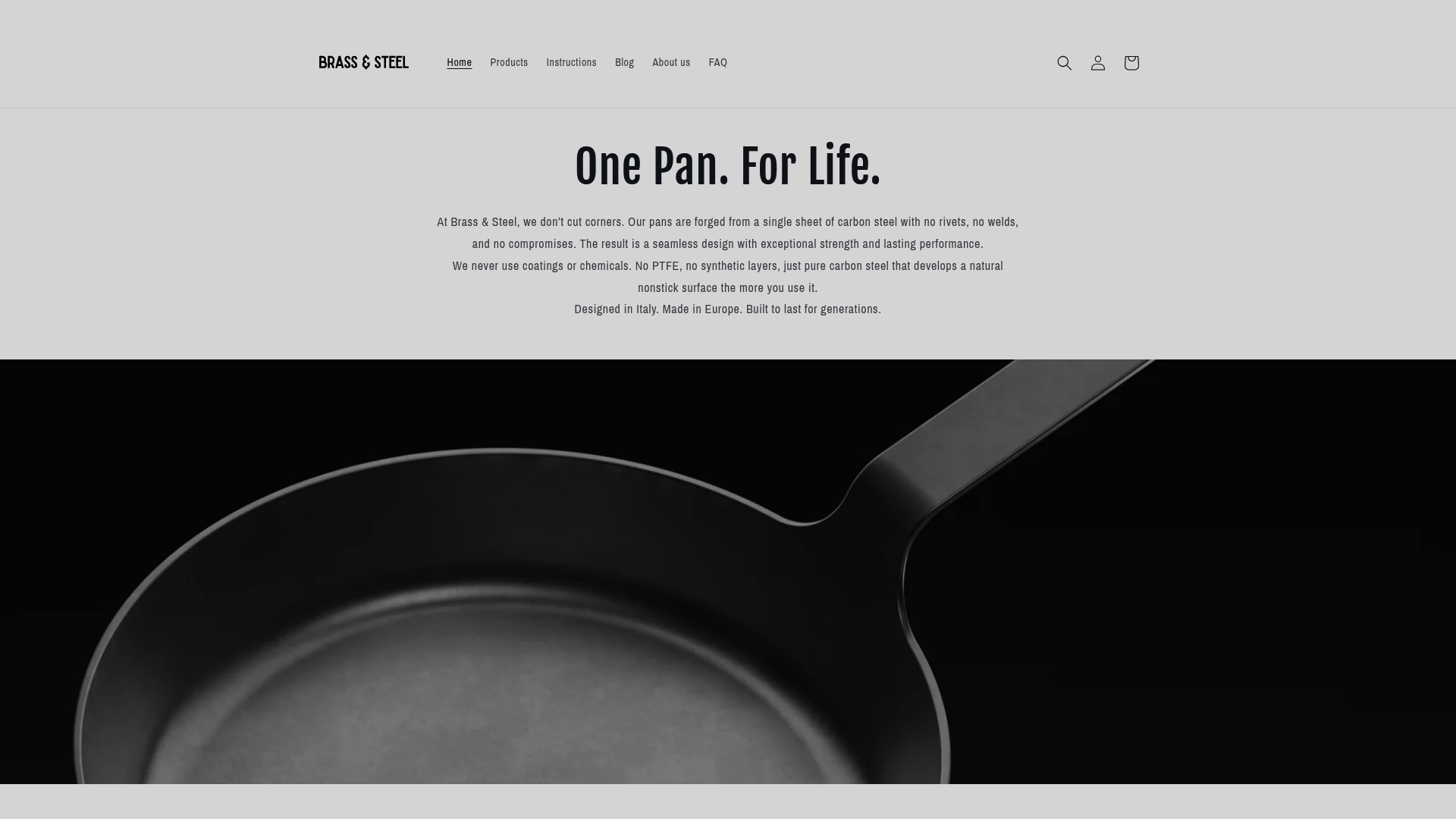
At Brass & Steel, we design and forge carbon steel pans in a single piece from high-grade carbon steel, which means no rivets, no welds, and no weak points where handles can loosen over time. Our handles are designed with balance and grip in mind, keeping the pan controllable whether you are searing at high heat or finishing a dish in the oven. Both the 27 cm and 30 cm sauté pans are built for sustained, daily professional use across all cooktops. If you are ready to invest in ergonomic carbon steel pans that reward serious cooking, explore our full range and discover the difference that precision engineering makes in your kitchen.
Frequently asked questions
How can I tell if my cookware is ergonomic?
Ergonomic cookware minimises awkward wrist angles and joint strain during real tasks. For accurate evaluation, hand kinematic metrics provide far better insight than a simple comfort impression in-store.
Why does handle diameter matter in cookware ergonomics?
Handle diameter directly affects the joint angles required to maintain a grip. Research confirms that handle diameter changes finger joint angles, with wider built-up handles producing lower joint stress, especially for users with limited mobility or arthritis.
What role does ergonomic design play for professional chefs?
Ergonomic cookware reduces fatigue, protects against repetitive strain injury, and allows chefs to work precisely over long shifts. Combining REBA posture scoring with kinematic data shows that small design changes can produce significant biomechanical improvements over time.
Are there ergonomic cookware options for people with arthritis or hand pain?
Yes. Pans with built-up or wider handle diameters are clinically supported for reducing joint stress. Adjustable or built-up grip options allow users with arthritis to maintain a safer, more comfortable grip during everyday cooking tasks.
Recommended
- Ceramic vs Aluminium Cookware – Performance and Safety Explained – Brass & Steel
- Healthy Cookware Explained: Essential Guide to Safe Choices – Brass & Steel
- Copper cookware: Performance, maintenance, and chef insights – Brass & Steel
- Top European cookware brands for performance and durability – Brass & Steel
- Foldable Steam Fry Cooking Basket | Amazing Garden – AMAZING GARDEN