Riveted vs Seamless Carbon Steel Pans

TL;DR: Most carbon steel pans attach their handle with rivets, and some French-style makers weld it on rivet-free. Both work, and there are excellent riveted pans out there. But rivets add a joint that can loosen over years, trap grease, and complicate cleaning. A truly seamless, one-piece pan forged from a single sheet of steel has nothing to loosen, nothing to trap food around, and no welded seam to fail in the oven or over an open flame. The trade-offs are honest: one-piece pans are harder to make, less common, cost more, and the metal handle gets hot. If you want a pan you can hand down, seamless is the construction worth paying for.
How pan handles are usually attached
Pick up almost any carbon steel or stainless skillet and look where the handle meets the body. Nine times out of ten you'll see two or three rivets: small metal studs punched through the pan wall and hammered flat on the inside to clamp the handle in place. Rivets are cheap, fast, and genuinely strong. They've held cookware together for well over a century, and a well-riveted pan from a good maker can outlive its owner. I want to be clear about that up front: rivets are not a scam, and a quality riveted pan beats a poorly made seamless one every day of the week.
A step up in difficulty is welding. Some French-style carbon steel makers skip rivets entirely and weld the handle to the body instead. This removes the studs poking into your cooking surface (a real improvement for cleaning), but it introduces a different thing: a weld bead, a line where two pieces of metal have been fused. Welding is harder and more expensive than riveting, which is why rivet-free welded pans are less common and usually pricier.
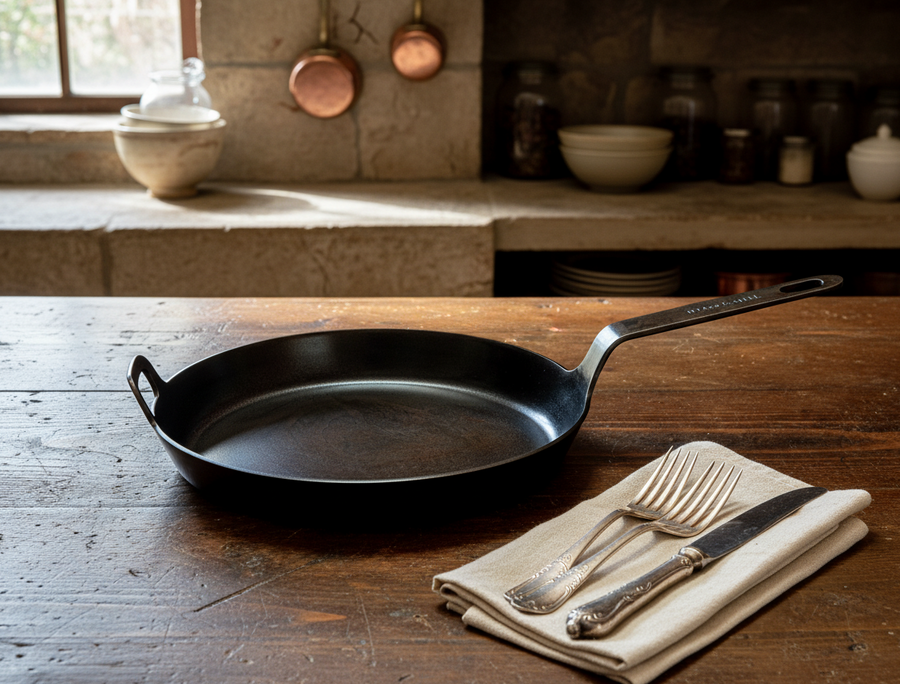
Then there's the rarest approach of all: no join at all. A seamless, one-piece pan is shaped from a single sheet of steel, body and handle together, with nothing attached to anything. No rivets. No weld. This is the hardest to manufacture, and it's why genuinely single-sheet pans are uncommon on the market.
Rivets, welds, and seams: a quick vocabulary check
- Riveted: handle bolted on with metal studs; studs are visible inside the pan.
- Welded (rivet-free): handle fused to the body with a weld seam; cooking surface is clean, but a join still exists.
- Seamless / one-piece: body and handle are the same continuous piece of steel; there is no join at all.
The real-world weak points of riveted handles
None of what follows means riveted pans are bad. It means every rivet is a compromise, and compromises show up over years of daily use.
Rivets can loosen. Every time a pan heats and cools, the metal expands and contracts. A rivet is a mechanical clamp holding two parts together through thousands of those cycles. Most stay tight for a very long time. But over years (especially with heavy pans, high heat, and the occasional knock) a rivet can work loose, and a wobbly handle is both annoying and, on a hot pan full of food, genuinely unsafe. It's the single most common structural failure point on otherwise durable cookware.
Rivets trap food and grease. Those studs on the inside of the pan sit slightly proud of the cooking surface. Oil, browned bits, and residue collect in the tiny gap around each rivet head. On a seasoned carbon steel pan, that's exactly where seasoning goes gummy and uneven. You end up scrubbing around each rivet with the corner of a sponge, and it's the last place to get properly clean and the first place to look grimy.
It's a hygiene and cleaning tax. Any recess that holds grease is harder to keep sanitary and takes more effort every wash. A few extra seconds of scrubbing around rivet heads, meal after meal for a decade, adds up.
It's a potential leak and stress point. A hole punched through the pan wall is a discontinuity in the metal, a place where stress concentrates and, in cheaper pans, where corrosion can start. Welding removes the studs but keeps a seam, and a weld is only as good as the process that made it. A perfect weld is superb; an imperfect one is a latent fault line under the thermal shock of a broiler or open flame.
What "seamless" one-piece construction actually means
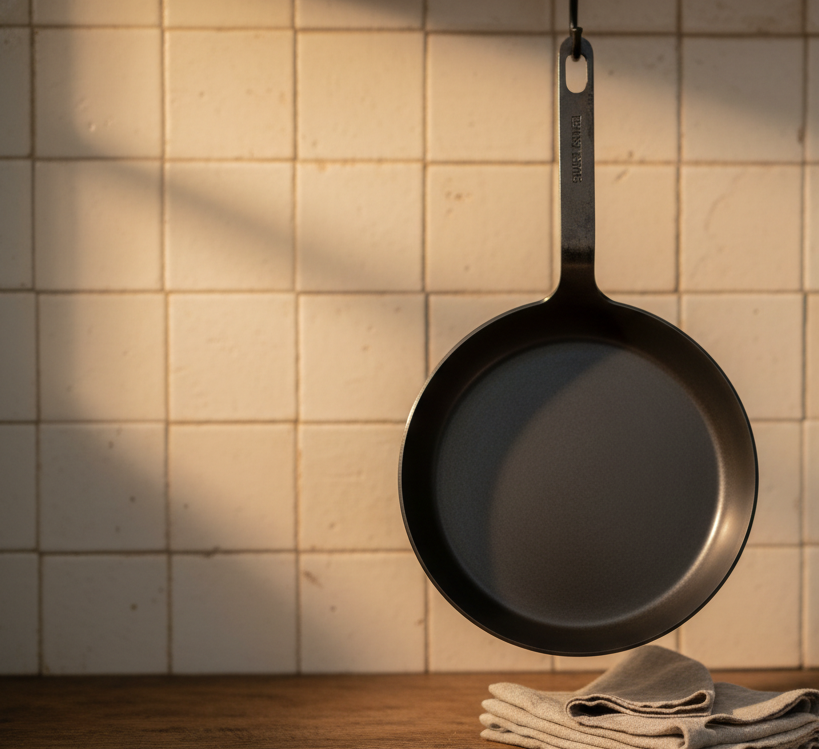
A seamless pan starts as a single flat disc (or sheet) of carbon steel and is shaped, under force, into a finished form: cooking face, sloped wall, and handle all flowing out of the same continuous piece of metal. Nothing is added. Nothing is joined. If you run your finger from the middle of the pan up the wall and out along the handle, you never cross a rivet, a weld, or a seam, because there isn't one.
That's the whole idea behind how we build at Brass & Steel. Every pan is forged from a single sheet of carbon steel (3mm thick on the 27cm, 4mm on the 30cm) with no rivets, no welds, no coatings, and no loose parts. It's fully seamless from cooking face to handle tip. We then apply our Carbon Lock™ Surface, a heat-and-glass treatment that primes the raw steel to grip seasoning from the very first layer, so the pan starts building its natural non-stick patina immediately rather than fighting you for the first month.
Why one piece lasts longer
The benefits of seamless construction aren't marketing abstractions: they're the direct, physical consequence of removing every join.
- Nothing to loosen. No rivets means no rivets to work free. The handle can't wobble because it isn't attached: it is the pan. This is the single biggest longevity argument.
- Easier to clean, better hygiene. A continuous surface has no recesses to trap grease. There's no ring of residue around a rivet head, nothing to scrub with the corner of a sponge. Wipe, rinse, dry, done.
- Confident oven, broiler, and open-flame use. Cookware fails in extreme heat at its joints. With no rivets and no weld, there's no join to fail, which is precisely why our pans are oven-, broiler-, and open-flame-safe without an asterisk. They're also PFAS-free and PTFE-free, so there's no coating to break down at high temperature either.
- Longevity worthy of a hand-me-down. A solid slab of carbon steel with no attached parts and no coating has very little that can actually break. That's why it comes with a lifetime guarantee, and why it's the kind of pan that ends up in someone else's kitchen a generation later.
The honest trade-offs
Seamless is not free lunch, and I'd be doing you a disservice to pretend otherwise.
It's harder to make, so it costs more. Forcing a single thick sheet of steel into a body-and-handle shape takes more force, more precision, and more skilled work than punching in a few rivets. That's the honest reason one-piece pans are uncommon and sit at a higher price than mass-market riveted skillets. You're paying for the construction, not a logo.
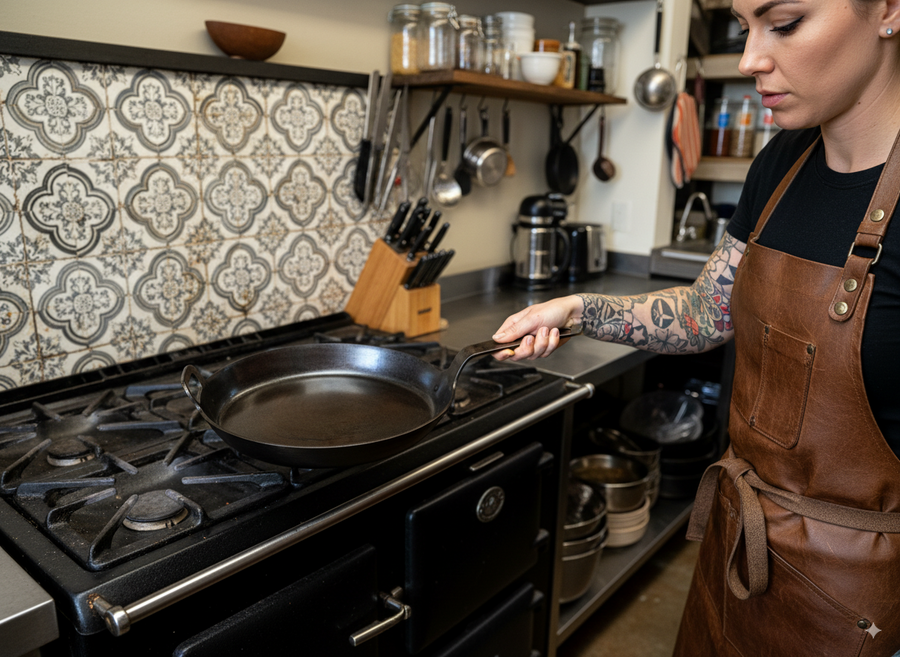
The metal handle gets hot. Because the handle is the same continuous steel as the pan, heat travels up it. This is the flip side of having no insulating join. In practice you keep a folded cloth or a leather handle cover nearby and grab the pan the way generations of cooks have grabbed cast iron. It becomes second nature within a week. Some riveted pans use handles designed to stay cooler; that's a fair point in their favour.
It's heavier and more deliberate. A 3 to 4mm slab of carbon steel is a serious tool. It holds heat beautifully and sears like nothing else, but it's not a flimsy pan you flick around one-handed. Our guide on why artisan pans matter for serious home cooks makes the fuller case.
Riveted vs welded vs seamless one-piece: side by side
| Factor | Riveted | Welded (rivet-free) | Seamless one-piece |
|---|---|---|---|
| Durability | Strong; rivets can loosen over years | Strong; depends on weld quality | Highest; no join to fail |
| Hygiene | Grease traps around rivet heads | Clean cooking surface; seam on exterior | Fully continuous; nothing to trap |
| Cleaning effort | Extra scrubbing around studs | Low | Lowest |
| Oven / broiler / flame | Safe, but rivets are the weak point | Safe if weld is sound | No join to fail; safe with confidence |
| Weak points | Rivet holes and studs | The weld seam | None inherent to construction |
| Price | Lowest | Mid to high | Highest (hardest to manufacture) |
Read across that table and a pattern emerges: every column moves in the same direction. Removing joins removes weak points, removes cleaning friction, and removes failure modes, at the cost of manufacturing difficulty and price. That's the trade you're weighing.
Where this leaves you
If budget is the deciding factor and you want a capable everyday pan, a well-made riveted carbon steel skillet is a perfectly good buy. Don't let anyone shame you out of one. But if you're choosing a pan the way you'd choose a good knife or a cast-iron Dutch oven (as a tool you intend to keep for decades and pass on), the seamless argument becomes hard to ignore. You're removing the exact parts that fail. For more on what "oven-safe" really means once joins are out of the picture, see our practical guide to oven-safe cookware, and if you're building a kit from scratch, our essential cookware guide for home cooks puts it in context.
Key takeaways
- Most carbon steel pans use rivets; some French-style makers weld the handle rivet-free; truly seamless one-piece pans are rare because they're hard to make.
- Rivets can loosen over years, trap grease around the studs, add cleaning effort, and create a stress point in the pan wall.
- A seamless pan is forged from a single sheet of steel, so there's nothing to loosen, nothing to trap food, and no join to fail in the oven, under a broiler, or over an open flame.
- Honest trade-offs: one-piece pans cost more, are heavier, and have a metal handle that gets hot: keep a cloth or leather cover handy.
- For a pan meant to be handed down, seamless construction removes exactly the parts that tend to fail.
Built from one sheet, made to be handed down
Every Brass & Steel pan is forged from a single sheet of carbon steel (no rivets, no welds, no coatings) and finished with our Carbon Lock™ Surface so it seasons from the first cook. Designed in Italy, made in Europe, backed by a lifetime guarantee. If you want one pan that does almost everything, start with the 27cm carbon steel sauté pan (€99). Cooking for 3 to 4 people or want a little more room to sear? The 30cm carbon steel sauté pan (€119) steps up to a 4mm sheet. Either way, keeping it in shape is simple: our care guide walks you through seasoning and everyday cleaning in a couple of minutes.
FAQ
Are riveted carbon steel pans bad?
No. A well-made riveted carbon steel pan is durable, effective, and often the best value. Rivets are a proven, strong way to attach a handle. The honest downside is that they add a join that can loosen over many years and traps grease around the studs, which makes cleaning a little harder. Seamless construction simply removes that compromise, at a higher price.
What does "seamless" or "one-piece" carbon steel pan mean?
It means the body and handle are shaped from a single continuous sheet of steel, with no rivets and no welded seam joining separate parts. Every Brass & Steel pan is forged this way from one sheet (3mm on the 27cm, 4mm on the 30cm), so there is no join anywhere on the pan.
Is a seamless pan really more durable than a welded one?
In principle, yes, because it removes the last remaining join. A welded pan has a clean cooking surface and no protruding rivets, which is a real improvement over riveting, but it still relies on the quality of the weld seam. A one-piece pan has no seam to depend on, so there's simply nothing there to fail.
Does the metal handle on a seamless pan get too hot to use?
It gets hot, because the handle is the same continuous steel as the pan and heat travels up it. This is the honest trade-off for having no insulating join. In practice you use a folded cloth or a leather handle cover, exactly as generations of cooks have with cast iron. It becomes second nature quickly, and in exchange you get a pan with no weak point to fail.