Nonstick pan toxicity: what health-conscious cooks need to know
TL;DR:
- Scratched nonstick pans release millions of microplastic particles during cooking, posing health risks.
- EU regulations allow PTFE use, but heat damage and scratches increase toxicity.
- Alternatives like carbon steel and ceramic pans offer safe, durable, and non-toxic cooking options.
A scratched nonstick pan sitting on your hob might be releasing up to 2.3 million microplastic particles into your food every single time you cook. Most people assume that as long as their pan looks fine, it is safe. That assumption is worth questioning. The reality of nonstick cookware toxicity is shaped by chemistry, heat, and everyday habits that most of us never think twice about. This article breaks down exactly what makes nonstick pans potentially harmful, how European regulations currently stand, and which alternatives give you genuine peace of mind without sacrificing cooking performance.
Table of Contents
- The science behind nonstick coatings and toxicity
- How nonstick pans become toxic: key risk factors
- Regulatory landscape in Europe: what cooks need to know
- Safe and durable alternatives to traditional nonstick pans
- Why most cooks misunderstand nonstick toxicity risks
- Discover safer cookware for professional results
- Frequently asked questions
Key Takeaways
| Point | Details |
|---|---|
| Scratches drive toxicity | Damaged nonstick coatings release millions of microplastic particles, heightening health risks. |
| Heat and fumes matter | Overheating empty nonstick pans produces toxic fumes, especially dangerous to pets. |
| Regulations evolving | EU bans many toxic substances but exceptions and proposals are changing cookware safety rules. |
| Alternatives offer safety | Carbon steel and ceramic pans provide durable, non-toxic options for health-conscious cooks. |
| Everyday practices count | Many toxicity risks arise from routine kitchen behaviour, not chemistry alone. |
The science behind nonstick coatings and toxicity
Most nonstick pans owe their slippery surface to PTFE (polytetrafluoroethylene), the synthetic polymer sold under the brand name Teflon. PTFE belongs to a much larger family of chemicals known as PFAS (per and polyfluoroalkyl substances), sometimes called “forever chemicals” because they resist breakdown in the environment and the human body. Understanding nonstick coating types helps clarify where the real risks lie.
For decades, the manufacturing of PTFE relied on PFOA (perfluorooctanoic acid), a processing aid now recognised as a likely carcinogen. PFOA was phased out across the EU by 2020 and is formally banned. Manufacturers responded by switching to alternatives such as GenX chemicals, which early research suggests carry similar persistence and potential health concerns, even if the long-term picture is not yet complete.
| Chemical | Status in EU | Primary concern |
|---|---|---|
| PFOA | Banned | Carcinogenicity, persistence |
| PTFE | Currently permitted | Degrades under heat and physical damage |
| GenX | Under review | Persistence, potential toxicity |
| Broader PFAS group | Proposed ban pending | Environmental and health accumulation |
The key issue with PTFE is that it is not inherently dangerous when intact and used at low temperatures. Problems arise when the coating degrades. Heat above approximately 260°C begins to break PTFE down, and at temperatures exceeding 350°C, it releases fumes containing toxic fluorinated compounds. Physical damage accelerates this: scratches disrupt the molecular surface, creating pathways for particles to migrate into food.
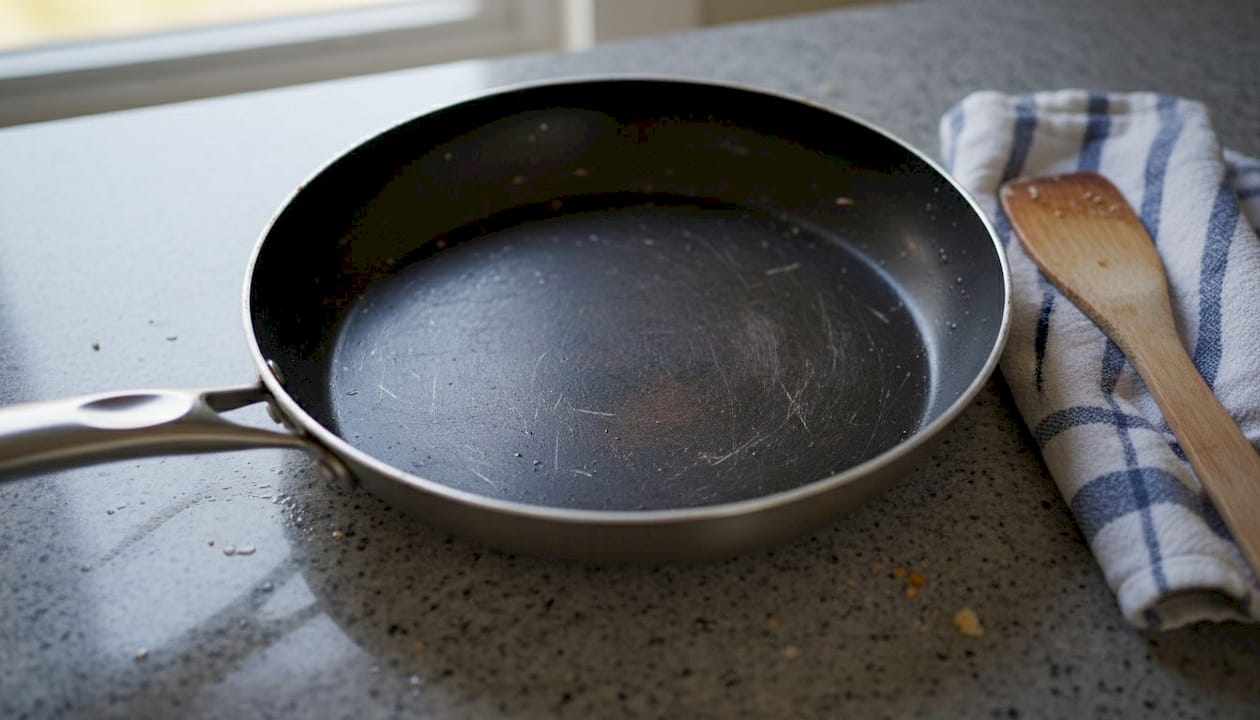
The science of what makes cookware nonstick reveals that the smoothness of PTFE relies on a very thin, layered film. Once that film is compromised, every subsequent use carries greater risk. As for regulation, PTFE remains permitted in the EU whilst a broader PFAS ban is under active discussion.
Pro Tip: If you are unsure whether your nonstick pan is still safe, hold it up to a light source and look for dull patches, flaking, or discolouration. Any of these signs mean it is time to replace it immediately.
How nonstick pans become toxic: key risk factors
Theory matters, but kitchen reality is where toxicity actually occurs. The following scenarios represent the most common ways nonstick pans cross from safe to harmful.
Scratches and physical damage are the single biggest practical risk. Research confirms that scratched PTFE coatings release up to 2.3 million microplastic particles during a single cooking session. These particles are ingested directly with food, and their long-term effects on the body are still being studied.
Here is how toxicity risk escalates in practice:
- Metal utensils cut through PTFE layers, immediately exposing underlying material.
- Abrasive cleaning with steel wool or harsh scourers strips the coating unevenly.
- Overheating an empty pan can reach dangerous temperatures within two to three minutes on a high flame.
- Repeated high-heat use degrades the coating cumulatively, even without visible scratches.
- Dishwasher use weakens the coating structure through detergent and high-temperature cycles.
| Scenario | Risk level | Key hazard |
|---|---|---|
| Low-heat cooking, intact pan, wooden utensils | Low | Minimal particle release |
| Medium-heat cooking, minor scratches | Moderate | Microplastic ingestion possible |
| High-heat cooking, scratched or worn coating | High | Significant particle and fume release |
| Empty pan on high heat | Very high | Toxic fume production above 360°C |
Regulatory bodies like Germany’s BfR advise that filled pans used below 270°C are generally safe. However, even their guidance acknowledges that damaged coatings should not be used for cooking.
One overlooked hazard involves pet birds. Fumes from overheated nonstick pans are acutely toxic to birds, whose respiratory systems are far more sensitive than those of humans. This is a genuine safety concern, not a minor footnote. Exploring nonstick pan degradation further explains why the coating’s physical structure is so vulnerable under real cooking conditions. Induction hobs can also heat pans faster than expected, making temperature control more critical than on a traditional gas flame. The full picture of nonstick safety is often more nuanced than marketing material suggests.
Regulatory landscape in Europe: what cooks need to know
Europe’s regulatory framework for nonstick cookware is shifting, but it has not yet caught up with the science. Here is where things stand in 2026.
Current EU rules:
- PFOA is formally banned across the EU as a persistent organic pollutant.
- PTFE remains legal for cookware use, provided it meets general food contact material standards.
- GenX and related short-chain PFAS alternatives are under increasing scrutiny.
- The European Chemicals Agency (ECHA) has proposed a sweeping restriction on the broader PFAS group, covering thousands of substances.
The proposed PFAS ban, if implemented, would be one of the most significant shifts in cookware manufacturing in decades. France has taken a more proactive stance: French legislation has moved to restrict PFAS in cookware ahead of an EU-wide decision, putting pressure on major manufacturers including Tefal.
The gap between what is legal and what is safe is where health-conscious cooks need to pay attention. A pan can comply fully with current EU food contact regulations and still contain PTFE coatings that degrade under the conditions of everyday use. Regulators focus on products as manufactured, not as they behave after months of kitchen use.
Organisations such as the NRDC have long argued that PFAS exposure through cookware is systematically underestimated in regulatory risk assessments. Consumer advocacy groups across Europe echo this concern, particularly regarding cumulative PFAS exposure from multiple household sources.
For those wanting to avoid uncertainty altogether, looking at ceramic nonstick cookware and other PFAS-free options is increasingly practical. Regulation will eventually catch up, but your kitchen choices do not have to wait.
Safe and durable alternatives to traditional nonstick pans
Moving away from PTFE-coated pans does not mean sacrificing cooking performance. Health-conscious home cooks are increasingly choosing materials such as carbon steel and ceramic as genuinely non-toxic alternatives.
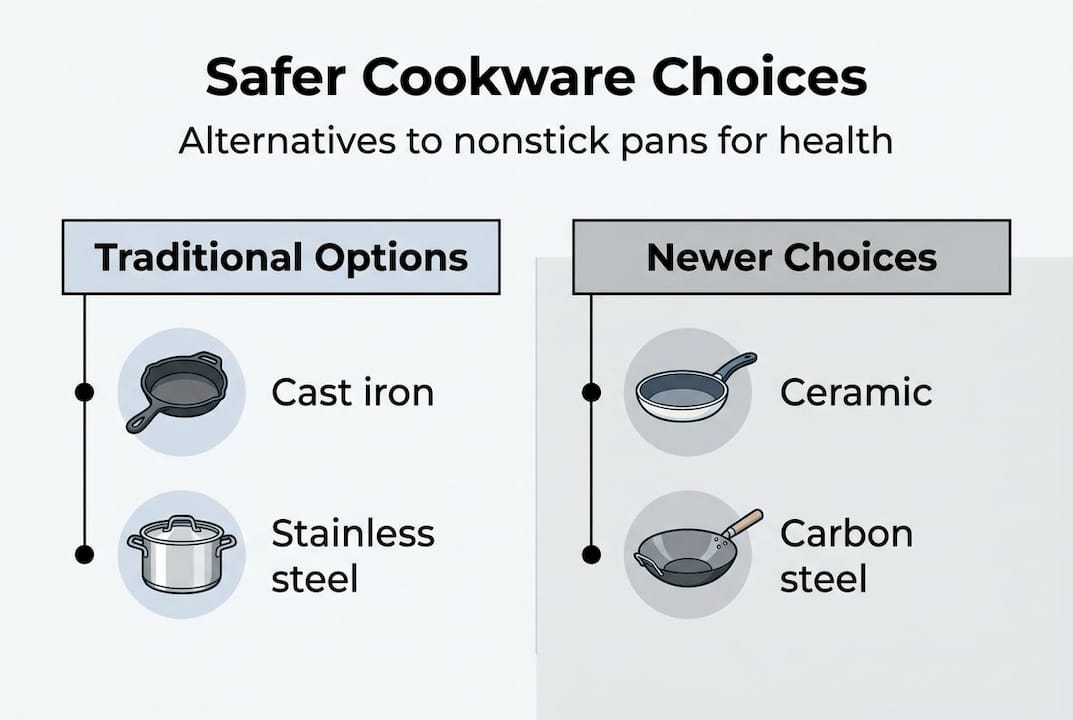
Carbon steel is the standout choice for serious cooks who want performance and safety. When seasoned properly, carbon steel develops a natural, non-toxic patina that functions as an effective nonstick surface. It handles high heat without releasing chemicals, works on all hob types including induction, and lasts a lifetime with basic care. A detailed comparison of carbon steel vs ceramic shows where each material excels.
Key alternatives at a glance:
- Carbon steel: Excellent heat responsiveness, natural seasoned surface, induction-compatible, no coatings whatsoever. Requires initial seasoning and regular maintenance.
- Ceramic-coated: Genuinely PFAS-free, easy to clean, lower heat tolerance than carbon steel. Coating can still wear over time.
- Stainless steel: Highly durable, no coatings, dishwasher-safe. Requires more fat to prevent sticking and has less even heat distribution.
- Cast iron: Virtually indestructible, excellent heat retention, naturally nonstick when seasoned. Heavy and slow to heat up.
- Glass: Completely inert, safe at any temperature. Not suitable for stovetop use and prone to thermal shock.
For those exploring non-toxic pan options more broadly, the evidence strongly favours materials that develop their cooking properties through seasoning or structure rather than applied coatings. Reviewing Teflon-free frying pan choices makes the transition far more straightforward.
Pro Tip: When transitioning from nonstick to carbon steel, start with eggs and proteins. Cook on medium heat with a small amount of butter or oil and allow the pan to preheat fully before adding food. This single habit prevents sticking in 90% of cases.
If you want a thorough grounding in cooking safely with carbon steel, it is genuinely simpler than the learning curve might suggest.
Why most cooks misunderstand nonstick toxicity risks
Here is an uncomfortable truth: most of the safety guidance around nonstick pans assumes perfect conditions that do not exist in real kitchens. Regulatory advice typically focuses on undamaged pans used below specific temperatures. But routine kitchen practices regularly breach safe-use boundaries, even among careful cooks.
People forget pans on the hob. They use metal spatulas out of habit. They buy inexpensive pans that thin out after six months of use. These are not unusual behaviours; they are normal ones. The regulatory framework does not account for a pan that is two years old, slightly scratched, and used on a gas burner set to maximum.
What most articles miss is that microplastics and degradation fumes are not dramatic, one-time events. They are cumulative. Every scratched surface, every moment of overheating adds to your overall exposure. The honest answer is that switching to non-toxic pan recommendations is not alarmist; it is practical risk management. Choosing materials with no coatings to degrade is simply the more logical long-term decision.
Discover safer cookware for professional results
If this article has shifted how you think about what is sitting on your hob, the next step is straightforward. The good news is that safer cookware does not mean compromise. Carbon steel, in particular, delivers professional-level heat performance with zero PTFE, PFOA, or synthetic coatings of any kind.
At Brass & Steel, our carbon steel sauté pans are forged from a single piece of steel, with no rivets, no welds, and no coatings to degrade over time. The full carbon steel cookware range includes both a 27 cm pan at €99 and a 30 cm pan at €119, covering everyday meals through to larger family cooking. Read more about the health and performance benefits of cooking with carbon steel before you decide.
Frequently asked questions
Is PTFE in nonstick pans toxic if the coating is intact?
BfR advises that filled pans used below 270°C with an undamaged coating are generally considered safe. The risk rises sharply once the coating is scratched or the pan is overheated.
What happens if I use metal utensils or scratch my nonstick pan?
Physical damage to the coating can cause it to release microplastic particles at a rate of up to 2.3 million per cooking session. Discard scratched nonstick pans rather than continuing to use them.
Are nonstick pan fumes dangerous to pets?
Birds are especially vulnerable to fumes from overheated nonstick cookware and can suffer fatal respiratory damage. Keep pet birds well away from the kitchen whenever nonstick pans are in use.
Are ceramic and carbon steel pans safer than traditional nonstick?
Carbon steel and ceramic pans are widely recognised as safer alternatives, containing no PFAS or synthetic coatings that degrade with heat or physical wear.
Recommended
- 7 Top Examples of Non-Toxic Pans for Pro Cooks – Brass & Steel
- Non-stick pans explained: types, safety, and alternatives – Brass & Steel
- Natural nonstick pan materials for healthy cooking in 2026 – Brass & Steel
- Defining Nonstick Alternatives: Safer Choices for Cooks – Brass & Steel
- Glyphosate Bans in Bath: What You Need to Know