How carbon steel evolves over time in your kitchen
TL;DR:
- Carbon steel develops a functional, non-stick patina over time through seasoning polymerization, which enhances durability and cooking performance. Its colour deepens from silver-grey to black, signaling progress, as layers of polymerized oil create rust-resistant, non-stick surfaces with consistent use. Proper maintenance, patience, and understanding of carbon content are vital for optimal seasoning, leading to a better cooking tool that improves with experience.
Carbon steel evolves over time by developing a protective, non-stick patina through a process called seasoning polymerisation, transforming a raw, reactive metal surface into a refined cooking tool that improves with every use. This transformation is not cosmetic. It is a functional development that professional chefs and culinary enthusiasts have relied on for centuries, long before synthetic coatings existed. Understanding the history of carbon steel cookware and the science behind its ageing process gives you a real advantage in the kitchen, both in how you cook and how you care for your pan.
How carbon steel evolves over time: the chemistry behind it
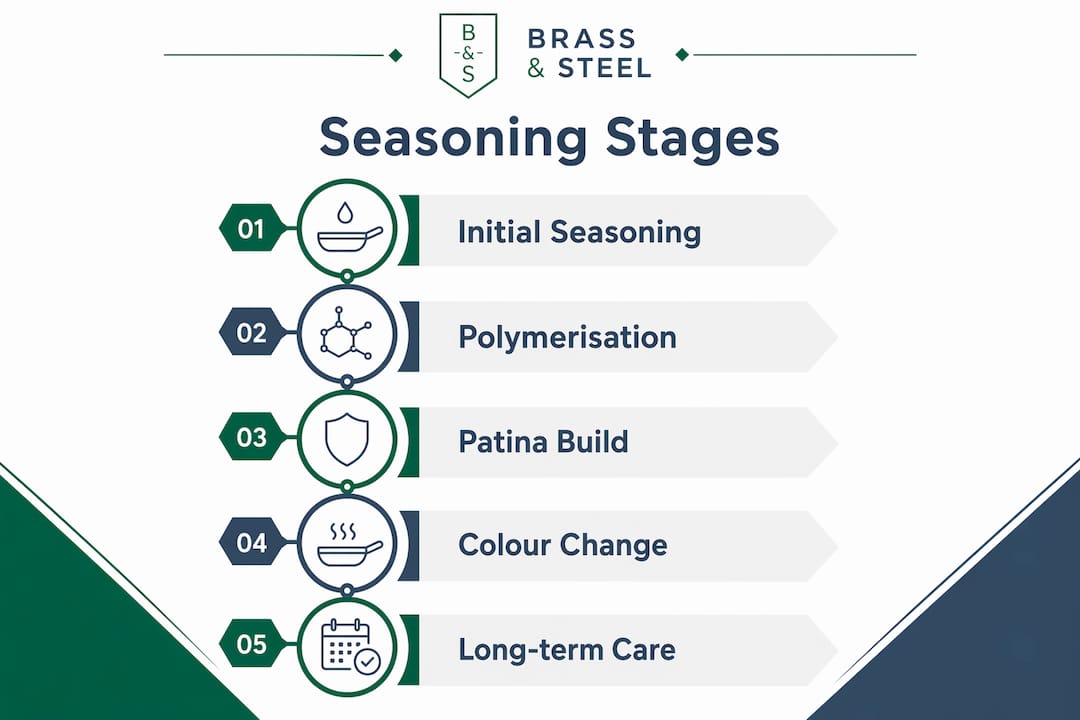
The most visible sign of carbon steel’s evolution is colour change. A new pan starts silver-grey and raw. With regular use and proper seasoning, it progresses through light gold, amber, dark brown, and eventually reaches a near-black patina. This colour progression from gold to black is not damage. It is evidence that your pan is working exactly as it should.
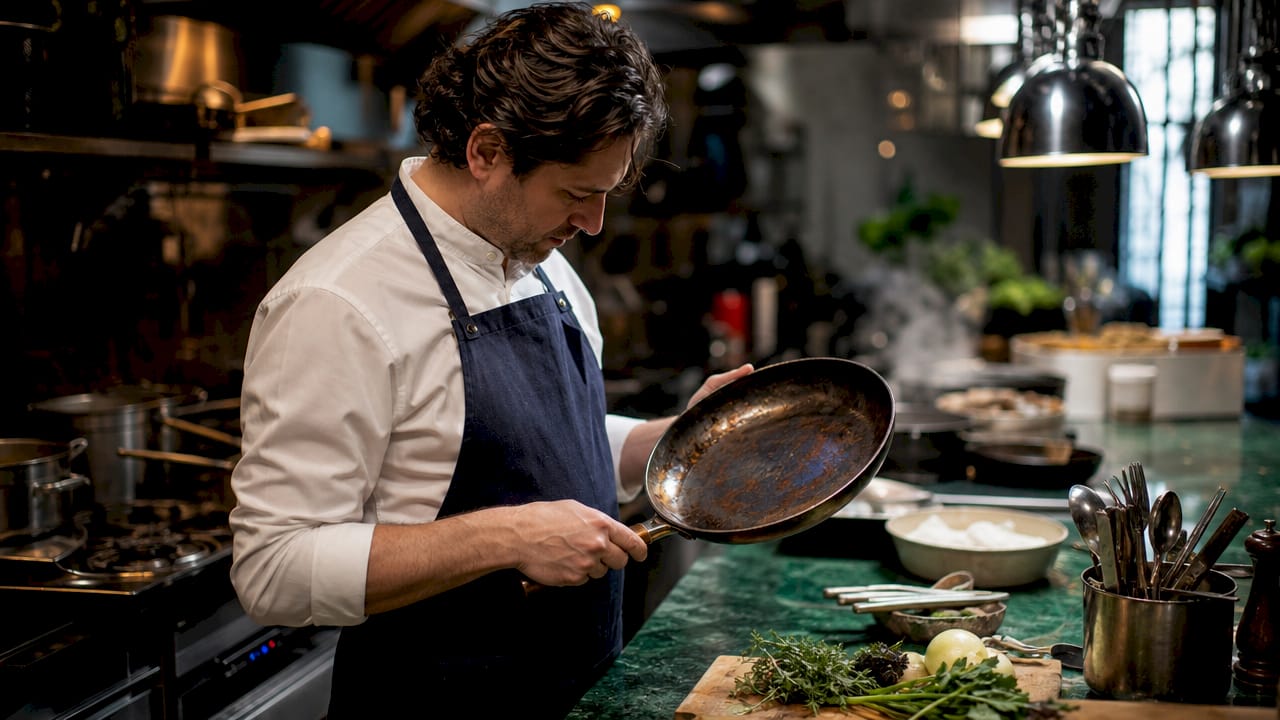
The mechanism driving this change is polymerisation. When you heat oil on carbon steel, the fatty acid chains in the oil break down and bond to the metal surface, forming a hard, thin polymer layer. Each cooking session adds another micro-layer on top of the last. Over months of regular use, these layers accumulate into a dense, rust-resistant seasoning coating that also reduces food sticking significantly.
Unlike stainless steel, which forms a natural passive oxide film through its chromium content, carbon steel has no inherent self-protection. Its evolution depends entirely on this artificial seasoning barrier. Without it, the iron in the steel reacts with oxygen and moisture through electrochemical oxidation, forming porous iron oxides that offer no protection and compromise the pan’s surface.
The microstructural changes happening beneath the surface are equally significant. As carbon steel is repeatedly heated and cooled, the internal grain structure stabilises. Phases such as pearlite, which is a layered mix of ferrite and cementite, become more defined with higher carbon microstructures, contributing to the pan’s long-term hardness and wear resistance.
Key changes during the carbon steel aging process:
- Silver-grey raw surface transitions to a golden-amber tone after the first few seasonings
- Repeated oil application and heat build progressively darker, denser polymer layers
- Non-stick performance improves noticeably after three to five cooking sessions with fatty foods
- Rust resistance increases as the patina thickens and covers micro-pores in the steel
- Heat distribution becomes more even as the surface stabilises through use
Pro Tip: Cook bacon, sausages, or other fatty foods in your new pan during the first week. The natural fats accelerate patina formation far more effectively than oil alone.
How does carbon content shape the steel’s properties over time?
Carbon steel is defined as steel containing between 0.05% and 2.1% carbon by weight. That range sounds narrow, but it produces dramatically different materials at each end of the scale. This is the single most important variable in understanding carbon steel properties over time.
Low-carbon steel, sitting below 0.3% carbon, is soft, ductile, and easy to form. It resists cracking under stress but wears more quickly. High-carbon steel, above 0.6%, is harder and more wear-resistant, but it becomes more brittle and more susceptible to corrosion without maintenance. Cookware typically uses medium to high-carbon grades because they balance formability during manufacturing with the hardness needed for long-term cooking performance.
The metallurgical phase trade-offs between ferrite, pearlite, and martensite directly affect how a pan behaves over years of use. Ferrite is soft and tough. Pearlite adds strength. Martensite, formed through rapid quenching, is extremely hard but brittle. Cookware grades avoid martensite-heavy compositions because brittleness is a liability in a kitchen environment where thermal shock is common.
| Carbon level | Microstructure | Cookware relevance |
|---|---|---|
| Low (0.05–0.3%) | Mostly ferrite | Soft, easy to form, lower wear resistance |
| Medium (0.3–0.6%) | Ferrite and pearlite mix | Good balance of toughness and hardness |
| High (0.6–2.1%) | Pearlite dominant | Hard, wear-resistant, higher corrosion risk |
Higher carbon content also means greater corrosion susceptibility due to microstructural heterogeneity. The varied grain boundaries in high-carbon steel create more sites for electrochemical reactions to begin. This is why a high-carbon pan left wet overnight will rust faster than a lower-carbon equivalent. The trade-off is that the same hardness that makes it corrosion-prone also makes it an outstanding cooking surface once properly seasoned and maintained.
The history of carbon steel as a material stretches back thousands of years, with early high-carbon alloys produced in Tanzania and India. Ancient smiths working with wootz steel understood intuitively what metallurgists now confirm: the carbon balance determines everything about how the material performs and ages.
Why does seasoning change colour and what does it mean?
Seasoning development is the most misunderstood part of owning a carbon steel pan. Many cooks see a darkening surface and assume something has gone wrong. The opposite is true. A well-seasoned patina is the goal, and its darkening is the clearest sign of progress.
The colour change follows a predictable sequence tied directly to the number of polymerised layers on the surface. Light gold appears after the first seasoning session. Amber and brown tones develop over the first few weeks of cooking. A deep, near-black surface typically takes several months of regular use, though cooking fatty foods and proteins accelerates the process considerably.
Compare this to stainless steel, which maintains its bright silver appearance because chromium forms a self-renewing passive oxide layer. Carbon steel has no such mechanism. Its protective surface is entirely the result of your cooking habits and care routine. That is both the challenge and the appeal.
Here is how to build and maintain seasoning deliberately:
- Wash the new pan with warm soapy water and dry it completely before the first seasoning.
- Preheat your oven to 250°C and bake the empty pan for ten minutes to remove all residual moisture.
- Apply a very thin coat of a high-smoke-point oil such as grapeseed, avocado, sunflower, or canola. Wipe off the excess so the pan looks almost dry.
- Bake the pan upside down for thirty minutes, then allow it to cool in the oven.
- Repeat this process two to three times to build a solid base layer before cooking.
Pro Tip: Less oil is always better during seasoning. A thick coat will polymerise unevenly and leave a sticky, patchy surface. Thin layers bond properly and build a uniform patina.
What maintenance practices protect your pan’s evolution?
Good maintenance is not complicated, but it is consistent. The goal is to protect the seasoning layers you have built and give the pan every opportunity to keep improving. Proper care routines are the difference between a pan that lasts a decade and one that rusts within a month.
The most common mistakes that degrade seasoning are soaking the pan in water, using harsh detergents, and leaving it wet after washing. Carbon steel rusts when exposed to oxygen and moisture together. Even a few hours of standing water can begin the oxidation process on an unprotected surface.
Practices that support positive evolution:
- Rinse with warm water after cooking, using a soft brush or cloth to remove food residue
- Dry the pan immediately on the hob over low heat to evaporate all moisture
- Apply a very light coat of oil after drying, then wipe off the excess before storing
- Cook eggs, fish, and other delicate foods only after the patina is well established
- Re-season the pan if the surface looks dull, patchy, or begins to stick
| Practice | Effect on seasoning |
|---|---|
| Drying on the hob after washing | Prevents rust, preserves existing layers |
| Oiling after each use | Reinforces patina and fills micro-pores |
| Cooking fatty foods regularly | Accelerates patina development naturally |
| Soaking in water | Strips seasoning and causes rust |
| Using metal scourers | Removes polymer layers, requires full re-seasoning |
For a deeper look at long-term care, the guide on carbon steel cookware care covers everything from rust removal to restoring a neglected pan.
How does understanding this evolution make you a better cook?
A well-seasoned carbon steel pan performs differently from a new one in ways that matter at the stove. Heat responsiveness is faster than cast iron because the material is thinner and lighter. The seasoned surface releases food more cleanly than a raw pan, which means better searing without tearing the crust on a piece of fish or a steak.
Flavour development also improves. A seasoned surface retains trace compounds from previous cooking sessions, contributing subtle depth to dishes cooked repeatedly in the same pan. Professional chefs who use carbon steel consistently describe their pans as developing a character that synthetic non-stick surfaces never achieve.
Choosing the right grade matters too. A 3mm pan like the Brass-steel 27 cm sauté pan responds quickly to heat changes, making it ideal for sautéing vegetables or cooking eggs once seasoned. A 4mm pan like the 30 cm version retains heat longer, which suits searing proteins at high temperatures. Understanding how carbon steel is made and how its properties shift with thickness helps you match the tool to the task.
The key insight is patience. A carbon steel pan at six months of regular use is a fundamentally better cooking tool than it was on day one. That improvement is not accidental. It is the direct result of how you cook, what you cook, and how you care for the surface between sessions.
Key takeaways
Carbon steel cookware improves with use because its seasoning patina builds functional, protective layers that enhance non-stick performance, resist rust, and develop cooking character over time.
| Point | Details |
|---|---|
| Seasoning is functional, not cosmetic | Polymerised oil layers build a non-stick, rust-resistant surface that improves with every use. |
| Carbon content determines behaviour | Steel with 0.05–2.1% carbon balances hardness and ductility, affecting both performance and maintenance needs. |
| Colour change signals progress | A darkening patina from gold to near-black indicates healthy seasoning development, not damage. |
| Maintenance protects your investment | Drying immediately, oiling after use, and avoiding soaking preserves seasoning and prevents rust. |
| Patience produces the best results | A well-used pan at six months outperforms a new one in every measurable cooking quality. |
What I have learned from watching carbon steel change
By Davide
I have used carbon steel pans long enough to stop worrying about the early stages and start trusting the process. The first few weeks with a new pan are the hardest. The surface is reactive, food sticks more than you expect, and the colour looks uneven. Most people give up here, which is a shame, because they are abandoning the pan right before it becomes genuinely good.
What I have found is that the cooks who get the most from carbon steel are the ones who treat the pan as a project rather than a product. They cook bacon in it on day three. They dry it on the hob without thinking twice. They do not panic when a patch of rust appears after a holiday because they know it scrubs off and re-seasons in an afternoon.
The comparison to stainless steel is instructive. Stainless steel is forgiving and low-maintenance, but it does not improve. Carbon steel demands more from you, and in return it gives you a surface that becomes genuinely personal over time. I have never met a professional chef who switched back after committing to carbon steel properly. The difference between carbon steel and stainless steel is not just metallurgical. It is a different relationship with your cookware entirely.
— Davide
Explore Brass-steel carbon steel cookware
If this article has made you want to start or deepen your carbon steel journey, Brass-steel makes it straightforward. The pans are forged from a single piece of carbon steel with no rivets or welds, which means no weak points and no crevices for food to hide in. Both the 27 cm and 30 cm sauté pans are free from PTFE and PFOA, work on all cooktops including induction, and are built to develop exactly the kind of patina this article describes. Visit the Brass-steel cookware range to see the full product details, care guides, and seasoning instructions in one place.
FAQ
What does “carbon steel evolves over time” actually mean?
It refers to two parallel processes: the build-up of a polymerised oil patina on the cooking surface, and the stabilisation of the steel’s internal microstructure through repeated heating and cooling. Both changes improve the pan’s performance and durability.
How long does it take for a carbon steel pan to fully season?
A functional base seasoning takes two to three initial sessions in the oven, but a fully developed, near-black patina typically takes several months of regular cooking. Fatty foods and proteins accelerate the process considerably.
Why does my carbon steel pan rust even after seasoning?
Rust occurs when moisture and oxygen reach the bare metal beneath the seasoning layer. This usually happens after soaking, leaving the pan wet, or using abrasive cleaners that strip the patina. Dry the pan immediately after washing and apply a thin coat of oil to prevent it.
Does higher carbon content make a better cookware pan?
Not necessarily. Higher carbon levels increase hardness and wear resistance but also raise corrosion susceptibility and require more attentive maintenance. Medium-carbon grades offer the best balance of performance and practicality for most kitchen environments.
What oils work best for seasoning carbon steel?
Grapeseed, avocado, sunflower, and canola oils are the most reliable choices because of their high smoke points and neutral fatty acid profiles. Avoid olive oil and animal fats, as they polymerise unevenly and can turn rancid in the seasoning layer.