Best non stick pans explained: find the right fit
TL;DR:
- Choosing the right non-stick pan depends on your cooking habits, with PTFE offering excellent food release at moderate heat. Ceramic pans provide a PFAS-free option but tend to degrade faster, while hybrid pans combine durability and high-heat performance. Ultimately, the best choice aligns with your needs, preferring a durable, natural alternative like seasoned carbon steel for long-term, high-quality cooking.
Picking the right non stick pan sounds simple until you’re standing in a kitchen shop staring at thirty options, each claiming to be the safest, slickest, and most durable choice on the market. Marketing language like “diamond-reinforced” or “ultra-ceramic” tells you almost nothing about real-world performance. The wrong choice means sticky scrambled eggs, a coating that flakes after six months, or a pan that warps the moment it touches your induction hob. This article cuts through the noise and walks you through the three main types of non stick pans, what makes each one tick, and which one actually suits your kitchen.
Table of Contents
- How to evaluate non stick pans: key criteria for European cooks
- PTFE-coated pans: the classic non stick choice
- Ceramic-coated pans: PFAS-free, glassy-slick alternatives
- Hybrid non stick pans: combining stainless steel and non stick innovations
- Comparison table: which non stick pan suits your needs?
- Our perspective: the coating conversation misses the bigger picture
- Discover carbon steel: a natural nonstick alternative
- Frequently asked questions
Key Takeaways
| Point | Details |
|---|---|
| PTFE remains the classic | PTFE pans offer reliable non stick performance but require mindful care and avoiding high heat. |
| Ceramic is PFAS-free but less durable | Ceramic-coated pans are safer for PFAS-conscious users but may lose their slickness faster, especially under frequent use. |
| Hybrids blend durability and versatility | Hybrid pans combine browning ability and non stick convenience, making them ideal for both home cooks and professionals. |
| Match your pan to your main cooking | Select pan types based on your most frequent dishes and hob type for the greatest satisfaction and pan lifespan. |
How to evaluate non stick pans: key criteria for European cooks
Before spending money on any pan, you need a clear set of criteria. Not all non stick pans are created equal, and the gap between a great one and a frustrating one often comes down to details that marketing materials skip entirely.
The first thing to check is the coating type. As non-stick pan types explained on the Brass & Steel blog, there are meaningful performance and safety differences between PTFE, ceramic sol-gel, and hybrid surfaces. Each behaves differently under heat, pressure, and daily washing. Understanding what your coating is made of tells you how to use the pan and how long it will last.
In Europe specifically, PFOA-free coatings are legally required, and PTFE remains widely sold because modern formulations no longer use PFOA in production. However, for cooks who want to avoid PFAS chemicals entirely, ceramic sol-gel is the preferred alternative. That said, PTFE still dominates the market because of its superior, long-lasting food release.
Here are the core factors every European cook should weigh before buying:
- Coating material: PTFE, ceramic, or hybrid design
- Base material and thickness: Aluminium, stainless steel, or carbon steel
- Induction compatibility: Requires a magnetic stainless steel base
- Heat resistance: How high can the pan safely go before the coating degrades?
- Utensil tolerance: Can it handle silicone or wooden tools, or even metal?
- Ease of cleaning: Is it dishwasher safe, or does it need hand washing?
- Coating lifespan: How many years of daily use can you realistically expect?
Pro Tip: If you cook on an induction hob, always check that the base is specifically labelled induction-compatible. Many aluminium-base non stick pans are not, and placing them on an induction hob simply does nothing.
Home cooks and professional chefs have genuinely different needs here. A home cook making weekend pancakes needs a lightweight pan with an easy-release surface. A professional cook searing proteins at 300°C needs something that will not warp, fume, or degrade under sustained high heat. Knowing which camp you fall into makes the next sections much easier to apply.
PTFE-coated pans: the classic non stick choice
PTFE, short for polytetrafluoroethylene and sold under brand names like Teflon, is the material that defined non stick cooking for decades. It works because of its extraordinarily low surface energy, meaning food simply has nowhere to grip. The strong carbon-fluorine bonds in PTFE repel almost everything, which is why your eggs slide straight off a well-maintained PTFE pan.
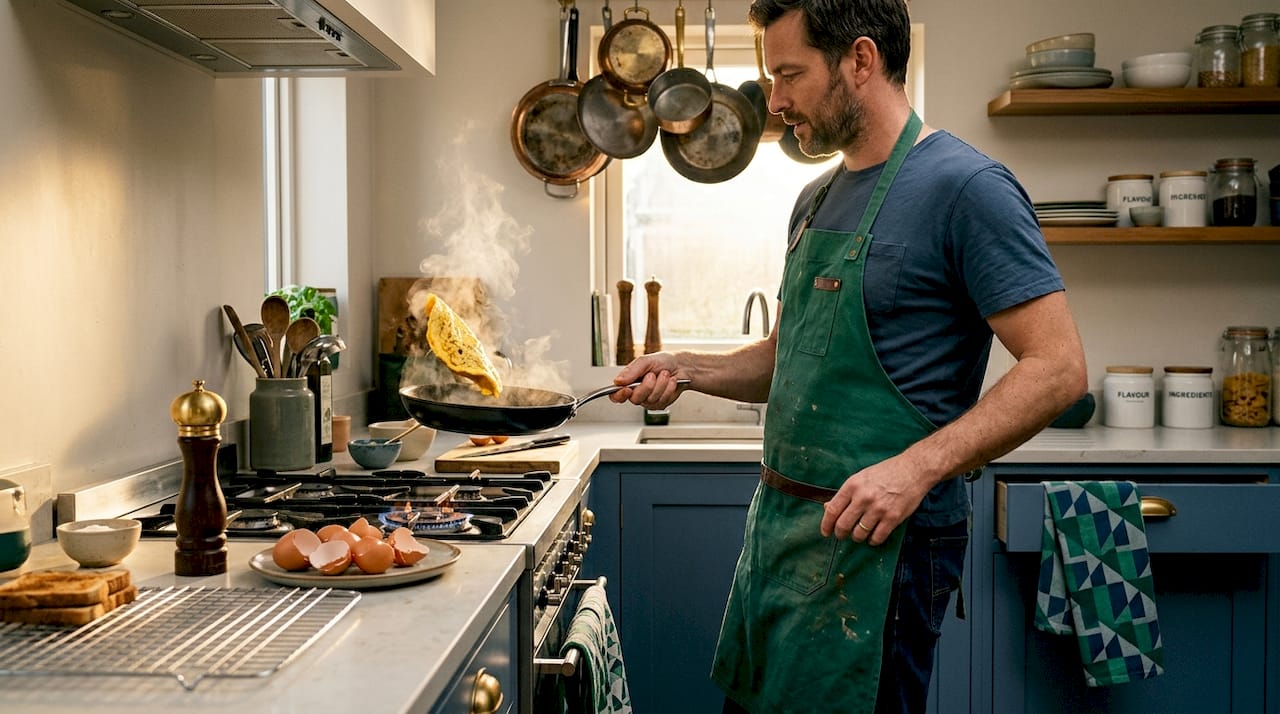
This matters in practice because PTFE offers a level of food release that no other coating has consistently matched at scale. Crepes, omelettes, fish fillets, and sticky glazed vegetables all lift cleanly from a properly used PTFE surface. For delicate cooking tasks that require gentle heat and minimal oil, it remains the most reliable coating available.
That said, PTFE has real drawbacks worth knowing:
- High heat risk: Above roughly 260°C, PTFE begins to break down and can emit fumes. This is especially hazardous to pet birds, and at extreme temperatures it becomes an issue for humans too.
- Coating wear: Scratches and abrasion from metal utensils damage the surface. Once the coating chips or peels, the pan needs replacing.
- Limited searing ability: Because you must keep temperatures moderate, PTFE is not suited to high-heat searing or browning.
- Short lifespan under heavy use: Even with careful handling, most PTFE pans in regular use last two to five years before performance drops noticeably.
“PTFE pans deliver outstanding food release for low to medium heat cooking, but they require attentive handling to preserve both performance and safety over time.”
For everyday home cooking, particularly eggs, fish, and pancakes, PTFE remains a sensible choice. But if you regularly cook at high temperatures or want a pan that lasts a decade, it falls short. It is also worth reading about nonstick pan safety in Europe before committing, particularly if you have concerns about coating longevity or household safety.
A useful side-by-side read is the ceramic vs Teflon comparison, which gives you a clearer picture of how the two leading coating types perform against each other in real kitchen conditions.
Ceramic-coated pans: PFAS-free, glassy-slick alternatives
Ceramic non stick pans entered the market as the health-conscious answer to PTFE. They use a sol-gel silica-based coating applied to a metal base, typically aluminium, which produces a hard, glassy surface with good initial food release. Crucially, ceramic coatings contain no PFAS chemicals, no PTFE, and no PFOA, which makes them immediately appealing to buyers who have read about the broader concerns around fluorinated coatings.
In practical terms, a new ceramic pan often feels just as slick as a PTFE pan, sometimes more so. Fried eggs glide off, pancakes release cleanly, and the surface wipes down easily. That initial performance explains why ceramic pans have captured a significant share of the European market, particularly among health-focused cooks.
The complications emerge over time:
- Faster degradation: Ceramic coatings can lose their non stick properties within one to two years of regular use, significantly faster than high-quality PTFE.
- Thermal sensitivity: Sudden temperature changes, such as rinsing a hot pan under cold water, cause micro-cracking in the ceramic layer. Once cracked, food starts sticking.
- Scratch vulnerability: Ceramic surfaces are harder than PTFE but more brittle. A metal utensil can leave marks that accelerate wear.
- Aluminium base concerns: Most ceramic pans use an aluminium base, which limits induction compatibility unless a stainless steel disc is bonded to the bottom.
“Ceramic sol-gel coatings offer a genuinely PFAS-free cooking surface with excellent initial slickness, but real-world longevity often disappoints compared to manufacturer claims.”
If you cook mostly at low to medium heat, replace your pans every couple of years without issue, and want to avoid fluorinated coatings entirely, ceramic makes sense. For those wanting to learn more about ceramic vs nonstick performance in deeper detail, it is worth exploring how the two hold up across different cooking styles before making a final decision.
The key lesson with ceramic is to treat it gently from day one. Avoid high heat, never shock it with cold water, and use wooden or silicone utensils exclusively.
Hybrid non stick pans: combining stainless steel and non stick innovations
Hybrid pans are the newest category, and they represent a genuine attempt to solve the central tension in non stick cookware: you want easy food release and the ability to sear at high heat. Traditional non stick coatings deliver one or the other, not both.
The hybrid design uses a textured surface of raised stainless steel “peaks” with non stick coated “valleys” between them. When you sear a steak, the steel peaks make contact with the food and create a Maillard crust. The non stick valleys prevent food from sticking in the gaps. This design makes hybrid pans metal-utensil safe and suitable for high-heat professional use, which neither PTFE nor ceramic can claim with confidence.
Key advantages of hybrid pans include:
- High heat tolerance: The stainless steel component handles temperatures well above what PTFE coatings can withstand.
- Metal utensil compatibility: The raised steel peaks take the contact, protecting the coated valleys from scratching.
- Induction-ready: Most hybrid pans use a full stainless steel or clad base, making induction compatibility standard.
- Longer lifespan: The combination of steel and coating typically outlasts pure ceramic or lower-grade PTFE pans.
- Versatility: One pan can transition from gentle egg cooking to serious searing without switching equipment.
Pro Tip: When using a hybrid pan, preheat it gradually on medium heat rather than blasting it immediately on high. This protects the coated valleys and ensures even heat distribution across the steel peaks.
The main drawback is price. Quality hybrid pans sit at a noticeably higher price point than standard PTFE or ceramic options. They are also heavier, which may matter if you cook for long periods or have limited wrist strength.
For cooks who want to understand the broader landscape of natural nonstick innovations, including seasoned carbon steel as a coating-free alternative, hybrid pans sit at an interesting crossroads between engineered surfaces and the old-school approach of building up a natural patina.
Comparison table: which non stick pan suits your needs?
To tie it all together, here’s a head-to-head breakdown of the major non stick pan types, including practical insights from both research and professional kitchens.
| Feature | PTFE | Ceramic | Hybrid |
|---|---|---|---|
| Food release | Excellent, long-lasting | Excellent initially, fades faster | Good across heat ranges |
| Heat tolerance | Up to ~260°C | Up to ~400°C (coating degrades sooner) | High, 400°C+ |
| PFAS-free | No (PTFE is PFAS) | Yes | Varies by valley coating |
| Induction compatible | If stainless base fitted | Often not (aluminium base) | Usually yes |
| Metal utensil safe | No | No | Yes (peaks only) |
| Lifespan | 2-5 years with care | 1-2 years typically | 4-7 years with care |
| Price range | Low to mid | Low to mid | Mid to high |
| Best for | Eggs, crepes, fish | Low-heat everyday cooking | Searing, versatile cooking |
As the pan longevity comparison shows, the right choice depends almost entirely on how you cook. For delicate, low-heat cooking on a gas or electric hob, PTFE gives you superior long-term release for eggs and pancakes compared to ceramic. For induction hobs with varied heat levels, a hybrid or well-chosen PTFE pan with a stainless base is the more practical option. For the health-conscious cook who rarely sears, ceramic offers peace of mind. The one universal rule across all three: avoid heating an empty pan and never use metal utensils unless the manufacturer explicitly states it is safe.
Our perspective: the coating conversation misses the bigger picture
Here is something the non stick pan market rarely admits openly. Almost every discussion about which coating is best sidesteps the more important question: Why are you relying on a coating at all?
Coatings, by definition, wear out. They scratch, degrade, and eventually need replacing. The most sustainable answer to non stick cooking is not a better coating. It is a cooking surface that gets stronger with use rather than weaker. Seasoned carbon steel does exactly that. Each time you cook with fat in a carbon steel pan, the polymerised oil layer deepens and becomes more non stick. After six months of regular use, a well-seasoned carbon steel pan releases eggs as cleanly as a new PTFE pan. After two years, it often outperforms it.
This does not mean PTFE, ceramic, and hybrid pans are without value. For someone who wants to pick up a pan and cook without any break-in period or maintenance habit, a coated pan makes total sense. But for serious home cooks who invest in their kitchens and want equipment that lasts twenty years rather than two, the coating conversation is the wrong starting point.
The real question is what kind of relationship you want with your cookware. Coated pans ask very little of you initially but ask you to replace them regularly. Carbon steel asks more of you upfront but rewards that effort with a surface that improves with every use.
Discover carbon steel: a natural nonstick alternative
If this article has made you question whether a coated pan is really what you need, you are not alone. Many European home cooks are discovering that carbon steel offers everything they wanted from non stick cookware without the coating concerns or replacement cycle.
At Brass & Steel, we make carbon steel sauté pans forged from a single piece of steel, with no rivets, no welds, and no synthetic coatings. Our 27 cm carbon steel pan at €99 is ideal for everyday cooking, while our 30 cm version at €119 handles larger family meals and professional-level searing with ease. Both work on all hob types including induction, and both build a natural, PTFE-free non stick surface through seasoning. Explore our full range and guides at brass-steel.com.
Frequently asked questions
Are ceramic non stick pans safer than PTFE?
Ceramic pans are free from PFAS chemicals, which appeals to those avoiding fluorinated compounds, but both ceramic and PTFE pans are considered safe when used within manufacturer guidelines and at appropriate temperatures.
How should I prolong the life of my non stick pan?
Keep temperatures moderate, use only silicone or wooden utensils, and avoid overheating an empty pan or rinsing a hot pan under cold water, as both degrade coatings rapidly.
Which non stick pans are best for induction hobs?
Hybrid pans and any PTFE or ceramic pan with a stainless steel base are your best options for induction compatibility, as a magnetic base is essential for the hob to generate heat.
Why does my ceramic pan lose its non stick effect so quickly?
Ceramic coatings are more prone to micro-cracking from heat changes than PTFE, and once those micro-cracks form, food begins to grip the surface and the non stick effect declines rapidly.