What is responsive cookware: a complete guide
TL;DR:
- Responsive cookware heats and cools instantly with temperature changes, offering precise control during cooking. Copper and clad pans are most responsive, while cast iron is slow to respond and better suited for steady heat tasks. Home cooks should choose a combination of pans to balance responsiveness, durability, and maintenance.
Responsive cookware is defined as any pan or pot that heats up and cools down almost instantly in response to changes in heat source, giving you precise control over cooking temperature at every stage. The term “responsive cookware” is not a formal industry classification. Professional cooks and manufacturers typically refer to this quality as thermal responsiveness or heat conductivity, measured by how quickly a material transfers and adjusts heat. Copper and multi-ply clad pans are the most common examples. Understanding what makes cookware responsive is the first step to choosing the right pan for the cooking you actually want to do.
What is responsive cookware made from?
The material a pan is made from determines almost everything about its thermal behaviour. Copper conducts heat 25 times faster than stainless steel, which is why solid copper pans are the gold standard for responsiveness. That speed means the pan reacts the moment you turn the heat up or down, with almost no delay.
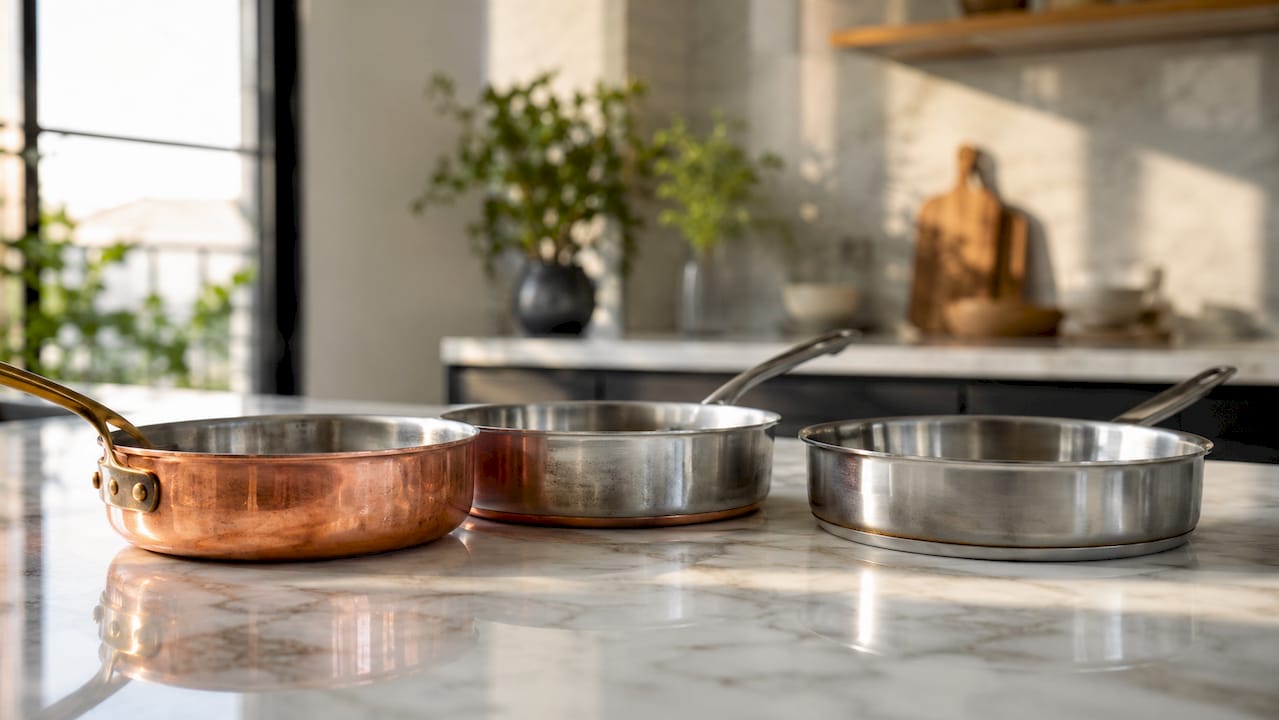
Aluminium sits in the middle of the spectrum. It conducts heat far better than stainless steel but falls short of copper. It is lightweight, affordable, and widely used as the core layer in multi-ply clad construction, where a stainless steel exterior wraps around an aluminium or copper core. This design balances responsiveness with durability and ease of care.
Carbon steel is another strong performer. It heats quickly, responds well to temperature changes, and builds a natural nonstick surface through seasoning. It sits between aluminium and copper in terms of raw conductivity, but its thinness compared to cast iron means it reacts far faster. Cast iron, by contrast, is the least responsive material. It heats slowly and holds that heat for a long time, which suits low-and-slow cooking but makes precise temperature control difficult.
| Material | Thermal responsiveness | Durability | Maintenance |
|---|---|---|---|
| Copper | Excellent | Moderate | High (polishing, re-tinning) |
| Aluminium core (clad) | Very good | High | Low |
| Carbon steel | Good | High | Moderate (seasoning) |
| Stainless steel (alone) | Poor | Very high | Very low |
| Cast iron | Very poor | Very high | Moderate (seasoning) |
Pro Tip: If you want responsiveness without the upkeep of solid copper, choose a pan with a thick aluminium or copper core clad in stainless steel. You get most of the performance at a fraction of the maintenance effort.
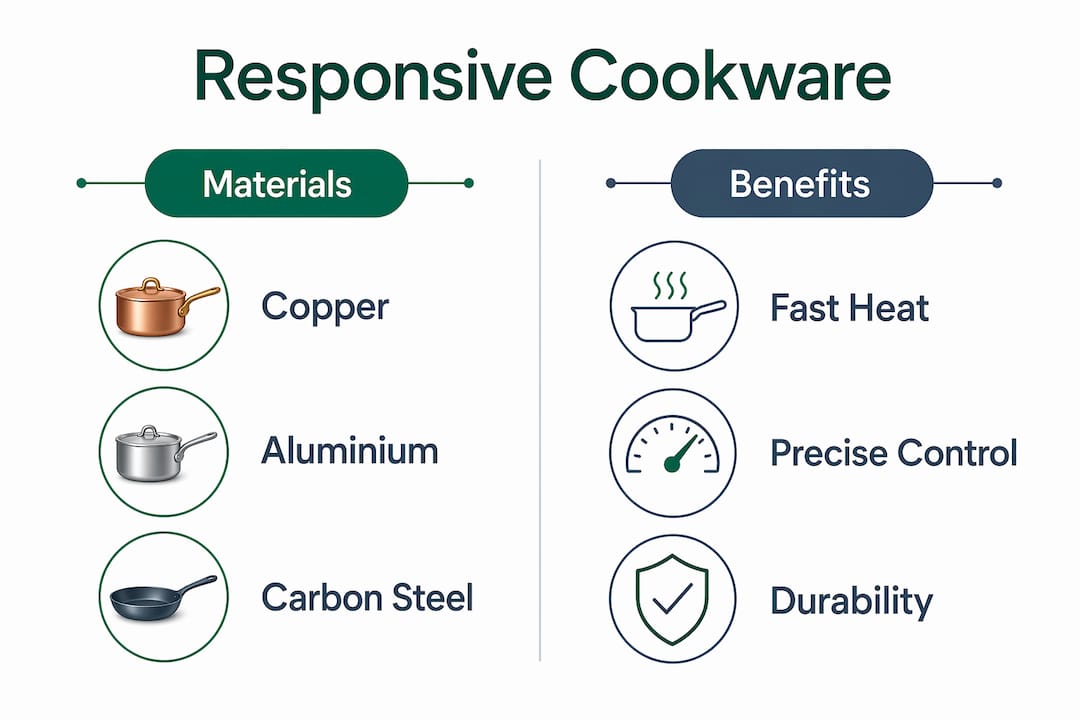
Understanding cookware metallurgy helps you see why no single material is perfect. Every choice involves a trade-off between speed, durability, and how much care you are willing to give your pans.
What are the cooking benefits of using responsive pans?
The most direct benefit of thermal responsiveness is precise temperature control. Responsive cookware allows precise control for delicate techniques like tempering chocolate, making hollandaise, and cooking custard without curdling. These tasks fail when a pan holds too much residual heat after you reduce the flame.
Here is where responsive cookware makes the biggest practical difference:
- Delicate sauces. A beurre blanc or crème anglaise can split in seconds if the pan stays too hot. A responsive pan drops in temperature the moment you reduce the heat, giving you the control to pull it back from the edge.
- Chocolate tempering. Professional pastry chefs demand highly responsive cookware for sugar work and chocolate, where a few degrees of difference determines whether the result is glossy or grainy.
- Sautéing vegetables. You want high heat for colour, then a quick drop to finish cooking without burning. A responsive pan follows your lead immediately.
- Searing proteins. Uniform heat distribution across the pan surface ensures consistent Maillard reactions, which means even browning rather than patchy colour.
- Reductions. When a sauce reaches the right consistency, you need to stop the cooking fast. A responsive pan lets you do that without moving the pan off the hob entirely.
The deeper benefit is confidence. Responsive cookware removes heat lag as a variable, so you can focus entirely on timing and technique. That shift changes how you cook. You stop compensating for the pan and start cooking the food.
Responsiveness is also most critical at low heat, where the difference between a gentle simmer and a scorch is a matter of seconds. Thick, slow pans make that margin almost impossible to manage.
Responsive cookware vs traditional options: what are the trade-offs?
Choosing between responsive and traditional cookware is not simply a question of which is better. Each type suits different cooking styles and priorities.
Cast iron retains heat brilliantly and distributes it evenly once hot, making it ideal for cornbread, braising, and pan pizza. The problem is that it reacts slowly. Turn the heat down and the pan stays hot for minutes. That is useful for steady cooking but a liability when you need to stop a sauce from breaking.
Stainless steel alone heats unevenly and slowly. Most quality stainless pans solve this by adding an aluminium or copper core, which is why copper clad cookware offers excellent heat distribution and merges copper’s conductivity with stainless steel’s durability. A bare stainless pan without a core is the worst of both worlds: slow to heat and prone to hot spots.
Non-stick pans vary widely. Their responsiveness depends entirely on the core material, not the coating. A non-stick pan with a thick aluminium disc base will perform better than one with a thin pressed steel base, but neither will match a proper clad or copper pan.
| Cookware type | Responsiveness | Best use | Main trade-off |
|---|---|---|---|
| Solid copper | Excellent | Sauces, delicate cooking | Expensive, high maintenance |
| Copper or aluminium clad | Very good | Everyday precision cooking | Higher cost than single-ply |
| Carbon steel | Good | Searing, sautéing, high heat | Requires seasoning |
| Non-stick (aluminium core) | Moderate | Eggs, fish | Coating degrades over time |
| Cast iron | Poor | Braising, steady heat | Slow to adjust temperature |
Comparing aluminium, stainless steel, and ceramic options in detail reveals that no single pan covers every cooking task. Most serious home cooks end up with two or three pans from different categories rather than one all-purpose solution.
Pro Tip: Solid copper pans react instantly but require regular polishing and re-tinning. Clad pans with a copper or aluminium core are slower but far more durable and low maintenance. For most home cooks, clad or carbon steel is the practical answer.
How to use responsive cookware effectively
The biggest adjustment when switching to a responsive pan is learning to cook actively. Responsive pans require active heat management because temperature changes instantly, unlike thicker pans where heat stays stable for longer. The “set it and forget it” approach does not work here.
Follow these steps to get the best from a responsive pan:
- Preheat gradually. Start on medium heat and let the pan warm evenly before adding oil or food. Responsive pans heat fast, so you rarely need full power.
- Adjust heat early. Because the pan responds immediately, make your heat adjustments a few seconds before you need them rather than reacting after the fact.
- Use lower heat settings than you think. Most home cooks overshoot on temperature when they first use a responsive pan. Medium heat on a copper or carbon steel pan often delivers what high heat achieves on a thick stainless pan.
- Watch the food, not the clock. Responsive cookware rewards attention. Colour, sound, and steam tell you more than a timer.
- Avoid sudden temperature changes. Moving a very hot responsive pan directly into cold water can cause warping, particularly with thinner carbon steel. Let it cool naturally or wipe with a damp cloth.
- Care for the surface. Copper pans need regular polishing and periodic re-tinning of the interior lining. Carbon steel pans need seasoning with a high-smoke-point oil such as grapeseed or avocado oil to maintain their natural nonstick surface.
For a deeper look at how different pan materials perform at high heat, the differences between carbon steel, copper, and aluminium become especially clear when you push the temperature.
Key takeaways
Responsive cookware is defined by thermal conductivity, and the right material choice determines the precision and control you have over every dish you cook.
| Point | Details |
|---|---|
| Responsiveness is material-driven | Copper leads, followed by aluminium core clad pans, carbon steel, and cast iron last. |
| Low heat is where it matters most | Responsive pans prevent scorching on delicate sauces where slow pans overshoot. |
| Active cooking is required | You must adjust heat early and watch the food closely, not rely on timers. |
| Trade-offs are real | Solid copper is fastest but high maintenance; carbon steel and clad pans balance performance and durability. |
| Most cooks need more than one pan | A responsive pan for precision work and a cast iron or heavy stainless for steady heat covers most tasks. |
Why I think most home cooks underestimate responsive cookware
I have cooked with copper, carbon steel, and every clad configuration in between, and the thing that surprises people most is not the speed. It is the silence. A responsive pan does not fight you. You turn the heat down and the pan obeys. That sounds simple, but after years of cooking on thick stainless or cast iron, it feels like a revelation.
The learning curve is real, though. Your first few sessions with a copper or carbon steel pan will probably involve one overcooked sauce and one moment of panic when the pan heats faster than expected. That is normal. The adjustment is not about skill. It is about recalibrating your instincts.
My honest advice for home cooks: do not start with solid copper. The maintenance is demanding and the cost is high. A well-made carbon steel pan or a quality aluminium-core clad pan gives you 80% of the responsiveness at a fraction of the complexity. Season it properly, cook with it regularly, and you will notice the difference within a week.
The cooks who benefit most from responsive cookware are not necessarily the most experienced. They are the ones who pay attention. If you are the kind of cook who tastes as you go and adjusts constantly, a responsive pan will feel like it was made for you.
— Davide
Ready to cook with a pan that actually responds?
If this article has made you think differently about your cookware, the next step is straightforward. Brass-steel designs carbon steel sauté pans forged from a single piece of steel, free from PTFE, PFOA, and synthetic coatings. They heat quickly, respond well to temperature changes, and build a natural nonstick surface over time.
The 27 cm and 30 cm carbon steel sauté pans from Brass-steel are built for exactly the kind of cooking this article describes: precise, attentive, and rewarding. Whether you are searing a steak, finishing a sauce, or sautéing vegetables, a well-seasoned carbon steel pan gives you the control to do it properly. Browse the full range at Brass-steel and find the pan that fits how you cook.
FAQ
What is the most responsive cookware material?
Copper is the most thermally responsive cookware material, conducting heat 25 times faster than stainless steel. For home cooks, aluminium-core clad pans and carbon steel offer strong responsiveness with lower maintenance demands.
Is responsive cookware worth it for everyday cooking?
Yes, particularly if you cook sauces, sauté vegetables, or sear proteins regularly. The precise temperature control prevents burning and overcooking, which makes a measurable difference to the quality of everyday meals.
How does carbon steel compare to copper for responsiveness?
Carbon steel heats faster than cast iron and stainless steel but is slower than copper. Its thinness and relatively high conductivity make it a practical choice for home cooks who want responsiveness without the upkeep of solid copper pans.
Can non-stick pans be thermally responsive?
Non-stick pans can be responsive if the core material is aluminium or copper. The non-stick coating itself does not affect responsiveness. A thin pressed-steel non-stick pan will perform poorly compared to one with a thick aluminium disc base.
Why does cast iron feel so different from responsive cookware?
Cast iron heats slowly and retains heat for a long time, which is the opposite of responsiveness. This makes it excellent for steady, even cooking like braising or baking, but poor for tasks that require rapid temperature adjustment.