Hard anodized vs stainless steel: which pan wins?
TL;DR:
- Stainless steel cookware is more durable and suitable for high-heat, induction, and professional use.
- Hard anodized pans are lighter, nonstick, and ideal for delicate foods but have a shorter lifespan.
- Choosing between them depends on cooking needs, with a mix often serving best in the kitchen.
Walk into any kitchenware shop in Europe and you will hear the same two names: hard anodized and stainless steel. Both promise professional results, both sit at similar price points, and both have loyal followings. Yet their actual performance in a real kitchen differs in ways that marketing rarely explains honestly. If you have ever stood in a shop holding two pans, unsure which one genuinely suits how you cook, this guide cuts through the noise and gives you a clear, evidence-based answer.
Table of Contents
- What makes hard anodized and stainless steel cookware different?
- Performance in real kitchens: heat, induction, and everyday cooking
- Durability, longevity, and maintenance: how long will they last?
- Health, safety, and food compatibility
- Why the best cookware for you is all about context (and what most guides miss)
- Explore top cookware options for your style
- Frequently asked questions
Key Takeaways
| Point | Details |
|---|---|
| Choose by cooking style | Stainless steel excels for searing and sauces while hard anodized is best for eggs and gentle frying. |
| Induction and longevity | Stainless steel is usually induction compatible and can last decades, unlike most hard anodized cookware. |
| Non-stick convenience | Hard anodized pans offer reliable non-stick cooking but their coatings may wear over time. |
| Safety considerations | Both types are safe for acidic foods when undamaged and used properly. |
| Mix for flexibility | Owning both kinds of pans can cover all your home cooking needs efficiently. |
What makes hard anodized and stainless steel cookware different?
The difference starts with the material itself, long before the pan ever touches a hob. Hard anodized cookware is made from aluminium that has been hardened through an electrochemical process called anodisation. This makes the surface significantly denser and more scratch-resistant than ordinary aluminium. Most hard anodized pans also carry a nonstick coating on top of the anodised layer, which is where much of the day-to-day ease comes from.
Stainless steel cookware, by contrast, is made from an iron and chromium alloy. The chromium content, usually around 18%, makes the surface non-reactive, meaning it will not interact with acidic foods like tomatoes or citrus. Quality stainless pans sold across Europe typically use a multi-ply construction, where layers of stainless steel sandwich an aluminium or copper core. This construction is specifically designed to fix stainless steel’s one genuine weakness: uneven heat distribution.
Here is how the two materials compare side by side:
| Feature | Hard anodized | Stainless steel |
|---|---|---|
| Base material | Aluminium | Iron and chromium alloy |
| Surface | Nonstick coating | Bare metal, no coating |
| Weight | Lighter | Heavier (multi-ply) |
| Heat response | Fast, responsive | Steady, even |
| Fond development | Minimal | Excellent |
| Induction ready | Rarely, unless stated | Yes, typically |
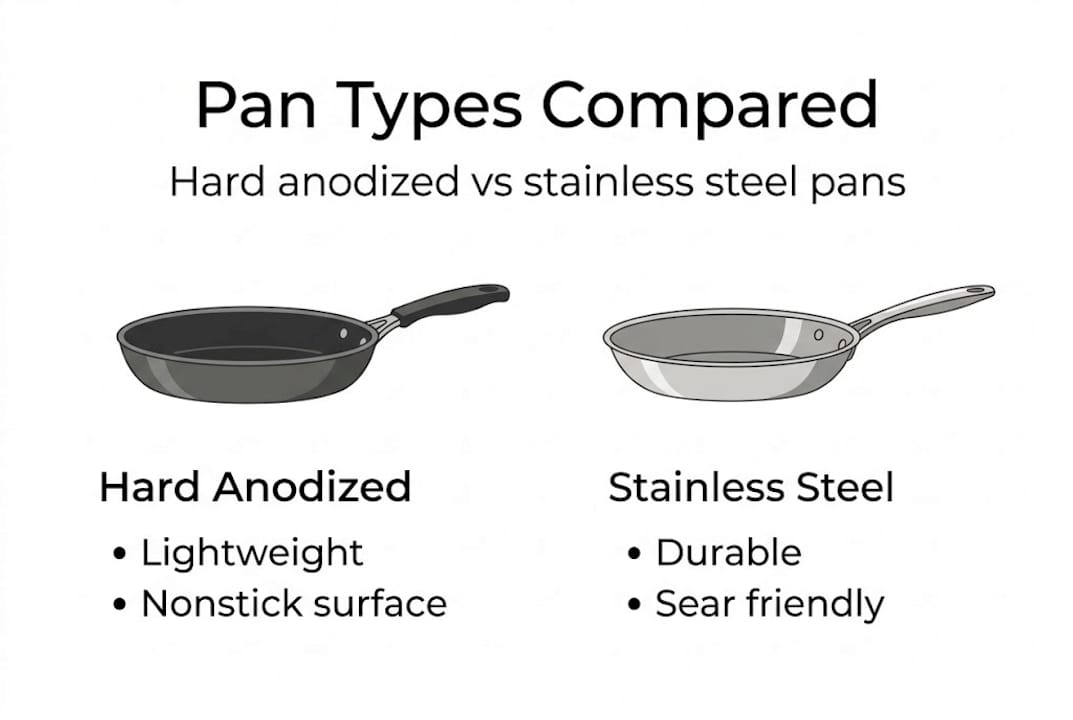
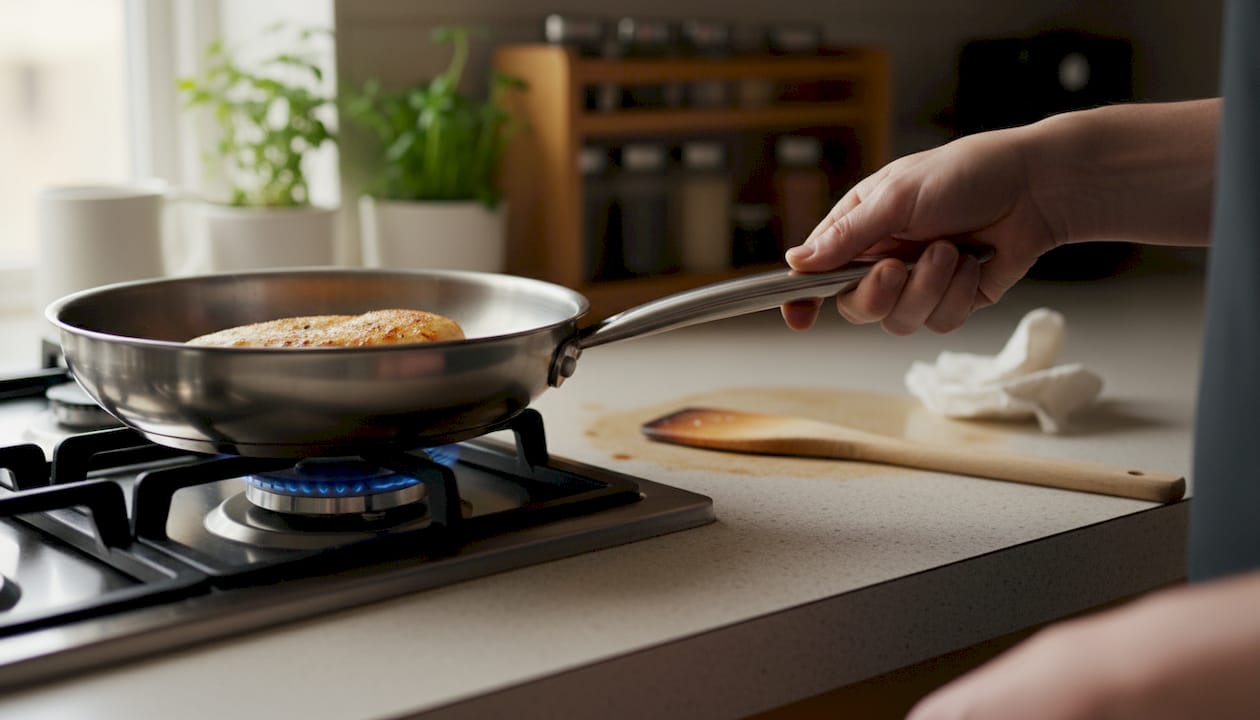
In practice, the sensory differences are immediate. Stainless steel feels heavier in the hand and develops the golden, sticky residue on the pan base (called fond) that is essential for making sauces and gravies. Stainless steel provides better high-heat performance for searing and browning, which is the foundation of most savoury cooking. Hard anodized, on the other hand, is lighter and more naturally nonstick but less suited for fond, which makes it better suited to eggs, fish, and delicate foods.
For more detail on how these materials behave differently, read our guide on comparing cookware materials as well as the deeper breakdown of stainless steel advantages.
Key differences to remember:
- Hard anodized suits lighter, gentler cooking tasks
- Stainless steel suits high-heat, searing, and sauce work
- Multi-ply stainless corrects the heat distribution weakness
- Anodised pans are usually lighter, which matters for daily use
Pro Tip: When testing a pan in a shop, press your palm flat on the base and feel for flex. A quality stainless pan should feel completely rigid. Any give in the base indicates thin construction that will warp under high heat.
Performance in real kitchens: heat, induction, and everyday cooking
Understanding material differences helps, but what actually happens when you cook with each option?
Induction hobs are now the most common cooktop type in new European homes, and this matters enormously for your buying decision. Most hard anodized cookware is not magnetic and therefore will not work on induction unless the manufacturer has added a stainless steel base plate. Stainless steel is naturally magnetic and offers better high-heat performance and induction compatibility across every cooktop type without any modification.
As induction is increasingly common in Europe, favouring stainless steel is a practical, future-proof decision for most households.
“In independent testing, top-rated stainless steel pans consistently score highest for browning evenness and searing results, while hard anodized pans lead on nonstick release for delicate foods such as eggs and pancakes.”
For a high heat pan comparison across different materials, or a full walkthrough on using induction cookware, our guides cover both in detail.
Here is a simple at-home test to understand how your current pan handles heat:
- Place the pan on a medium hob and add a thin layer of water.
- Watch where the first bubbles appear. Uneven bubbling means uneven heat distribution.
- Drop a small cube of butter into the centre. It should melt outward evenly rather than pooling to one side.
- For a sear test, add a small piece of bread. It should colour evenly across the surface without pale patches.
- Check the pan base after cooling. Warping shows as a slight rocking motion on a flat surface.
| Cooking task | Hard anodized | Stainless steel |
|---|---|---|
| Searing steak | Acceptable | Excellent |
| Frying eggs | Excellent | Needs practice |
| Deglazing for sauce | Poor | Excellent |
| Fish fillets | Very good | Good with fat |
| High-heat stir fry | Good | Very good |
The honest truth is that neither pan is universally better. Stainless steel rewards cooks who understand heat control and want serious browning results. Hard anodized makes everyday meals easier and more forgiving, especially for cooks still building confidence.
Durability, longevity, and maintenance: how long will they last?
While performance is key, few things matter more than how long a pan will serve you well.
This is where stainless steel has a decisive advantage. Stainless steel lasts decades and is dishwasher-safe, while hard anodized typically lasts 5-10 years and performs better with hand washing. That lifespan gap is enormous when you consider the cost per year of ownership. A quality stainless pan bought for €80 and used for 25 years costs far less per use than an anodised pan replaced every seven years.
Stainless steel maintenance:
- Hand wash with a mild abrasive like Bar Keepers Friend to remove discolouration
- Avoid soaking in water for extended periods to prevent water marks
- Dishwasher safe, but occasional hand washing keeps the finish sharper
- Never use steel wool, which leaves fine scratches that trap grease
Hard anodized maintenance:
- Hand wash only; dishwashers degrade the anodised layer and the nonstick coating
- Avoid metal utensils, which scratch and remove the coating over time
- Replace when coating shows visible flaking, peeling, or deep scratches
- Store with a cloth or liner between pans to prevent surface damage
For guidance on cookware safety and materials and what to look for when buying, our 2026 guide covers the key questions European cooks are asking.
Stainless steel cookware, properly maintained, is often considered a once-in-a-generation purchase. Hard anodized cookware, by contrast, has a built-in expiry point the moment its coating begins to wear.
Pro Tip: Regardless of pan type, always preheat your pan before adding oil or food. A properly preheated stainless pan becomes significantly more nonstick, reducing the perceived advantage of anodised surfaces for everyday cooking.
Health, safety, and food compatibility
Of course, performance and durability lose meaning if safety is unsure.
Both hard anodized and stainless steel cookware are considered safe for everyday home cooking. Both are non-reactive and safe for acidic foods when high-quality, and stainless steel has no coating that can wear out or degrade over time. This is a meaningful distinction. Stainless steel offers long-term safety by design, not by maintenance standard.
The risk with hard anodized cookware comes when the surface is damaged. Once the nonstick coating is scratched, chipped, or flaking, it is no longer a sealed surface. While modern nonstick coatings on quality pans are free of PFOA, a damaged surface raises legitimate questions about what is entering your food. Replacing a pan before the coating deteriorates fully is not excessive caution; it is basic kitchen hygiene.
“Both stainless steel and hard anodized cookware are considered safe for home use and professional kitchens when pans are undamaged and used correctly.”
Stainless steel safety dos and don’ts:
- Do use metal utensils freely; the surface handles it without concern
- Do cook acidic dishes like tomato sauce without worry
- Don’t let salty water sit in the pan for long periods, as it can pit the surface
- Don’t assume cheap stainless steel is equivalent to quality multi-ply construction
Hard anodized safety dos and don’ts:
- Do use wooden, silicone, or nylon utensils only
- Do replace the pan when coating shows visible damage
- Don’t cook highly acidic foods in a scratched anodised pan
- Don’t assume the base metal is safe to cook on once the coating has worn away
For further reading on coatings and alternatives, our guide on ceramic cookware health benefits explores the wider picture.
Why the best cookware for you is all about context (and what most guides miss)
Most comparison articles declare a winner. This one will not. Because the honest answer is that the right pan depends entirely on who is cooking, on what cooktop, and how often they want to think about their equipment.
Stainless steel dominates professional kitchens across Europe for good reason. It handles everything: high heat, induction, deglazing, oven finishing. It rewards skill and lasts long enough to pass on. But it is unforgiving for beginners and genuinely frustrating for tasks like frying eggs without practice.
Hard anodized makes cooking less stressful. Eggs slide. Pancakes release cleanly. For someone cooking daily for a family on a gas or electric hob, that ease has real value. The trade-off is a finite lifespan and induction limitations.
What most guides miss entirely is this: the best kitchen has more than one pan. A stainless steel sauté pan for searing and sauces, and a seasoned nonstick or carbon steel option for eggs and delicate foods, covers every cooking situation without compromise. Our list of top cookware picks for high-heat European kitchens is a useful starting point for building that collection thoughtfully.
Pro Tip: Do not buy a full set of any single cookware type. A deliberately chosen mix of two or three pans, each suited to specific tasks, will outperform an expensive matching set every time.
Explore top cookware options for your style
Ready to see what the right pan could add to your kitchen? Whether you are moving towards stainless steel for its longevity and heat performance or exploring nonstick alternatives that handle daily cooking without compromise, the right guidance makes all the difference.
At Brass & Steel, we work with serious home cooks across Europe who want cookware built to last, not replaced on a cycle. Our resources cover everything from material comparisons to heat performance guides, all grounded in real kitchen experience. Explore the full Brass & Steel cookware range and find the pan that fits how you actually cook, not just how you cook in theory.
Frequently asked questions
Which lasts longer, hard anodized or stainless steel cookware?
Stainless steel offers greater durability and typically lasts several decades with proper care, while hard anodized cookware generally needs replacing after 5-10 years as the coating wears.
Is hard anodized cookware safe for acidic foods?
Both are non-reactive and safe for acidic foods when the pan is undamaged and of good quality. Avoid using a hard anodized pan if its coating is visibly scratched or flaking.
Can hard anodized cookware be used on induction?
Most hard anodized cookware is not induction-compatible unless the manufacturer specifically notes otherwise, as aluminium is not magnetic. Always check the product specification before buying for an induction hob.
Do chefs prefer stainless steel over hard anodized cookware?
Professional chefs generally favour stainless steel for its durability, high-heat responsiveness, and versatility. European brands like Demeyere and Fissler favour multi-ply stainless for precision cooking across induction and gas cooktops.