Carbon steel purity: a guide for serious cooks
TL;DR:
- High-purity carbon steel contains minimal impurities and is essential for consistent seasoning and durability in cookware.
- Steel meeting EN 10130 DC01 standards, with low phosphorus and sulfur, ensures a reliable, long-lasting pan.
Most cooks choose a carbon steel pan based on looks, weight, or price. Very few stop to ask what is carbon steel purity, and that single oversight explains why some pans build a flawless non-stick patina within weeks while others flake, warp, or season unevenly after months of care. The answer lies not in how the pan looks, but in what the steel is actually made of at a chemical level. Understanding carbon steel purity gives you a genuine edge when selecting cookware that will last a lifetime rather than a season.
Table of Contents
- Understanding carbon steel purity and composition
- The impact of purity on cookware performance and seasoning
- How carbon steel purity compares with cast iron and other steels
- Practical tips for choosing and recognising high-purity carbon steel pans
- Why carbon steel purity is often overlooked but critical for cooks
- Discover high-purity carbon steel pans at Brass & Steel
- Frequently asked questions
Key Takeaways
| Point | Details |
|---|---|
| Carbon steel purity basics | Purity means tightly controlled low carbon and impurities for strong, ductile steel ideal for pans. |
| Purity impacts performance | Higher purity yields lighter, faster-heating, durable pans that season better and resist cracking. |
| Compare with cast iron | Carbon steel’s lower carbon makes it less brittle and more responsive than cast iron for cooking. |
| Check certifications | Look for EN 10130 DC01 grade and mill test certificates for guaranteed high-purity cookware. |
| Care and seasoning | High purity helps seasoning layers bond well, so proper care extends pan lifespan and performance. |
Understanding carbon steel purity and composition
Carbon steel is not simply iron and carbon thrown together. The carbon steel grades used in serious European cookware are defined by precise limits on every element in the alloy, because even trace amounts of the wrong substance change how the pan behaves on a hot burner.
The DC01 European standard (EN 10130) specifies the purity levels considered acceptable for high-quality cold-rolled steel used in cookware manufacturing. In plain terms, over 99% of the material is iron. Everything else, including carbon, manganese, phosphorus, and sulfur, is tightly controlled in small fractions.
Here is what the EN 10130 DC01 standard actually permits:
| Element | Maximum permitted | Why it matters for cookware |
|---|---|---|
| Carbon © | ≤0.12% | Ensures ductility, prevents brittleness |
| Manganese (Mn) | ≤0.60% | Adds toughness without hardening excessively |
| Phosphorus (P) | ≤0.045% | Keeps grain structure even for seasoning adhesion |
| Sulfur (S) | ≤0.045% | Prevents brittleness and surface defects |
What does this mean for your pan? A low carbon content of 0.12% or below keeps the steel flexible enough to be pressed or forged into shape without cracking. Phosphorus and sulfur both degrade toughness and surface uniformity if they exceed their limits, which is precisely why the purity of carbon steel is such a critical specification rather than a marketing claim.
Key composition facts worth knowing:
- The iron base exceeds 99%, giving the pan its characteristic grey colour and magnetic properties that make it induction-compatible
- Low carbon content is what separates carbon steel from cast iron and allows thinner, lighter pans
- Phosphorus and sulfur impurities are the hidden culprits behind seasoning that cracks or peels away from the surface
- Manganese contributes strength without significantly raising brittleness, unlike carbon
Now that you know what purity means chemically, let’s explore why these small percentages matter so much in practice.
The impact of purity on cookware performance and seasoning
Carbon steel quality is not an abstract specification. It shows up directly in how your pan performs the first time you sear a duck breast at 220°C or flip eggs every morning for five years.
America’s Test Kitchen explains that carbon steel’s higher purity, roughly 99% iron compared to cast iron’s 97 to 98%, creates a more uniform grain structure through the rolling process. That uniformity makes the steel stronger and more ductile, so thin pans respond faster to heat changes. In a professional kitchen, where you need to drop the heat fast to protect a delicate sauce, that responsiveness is the difference between a perfect result and an overcooked one.
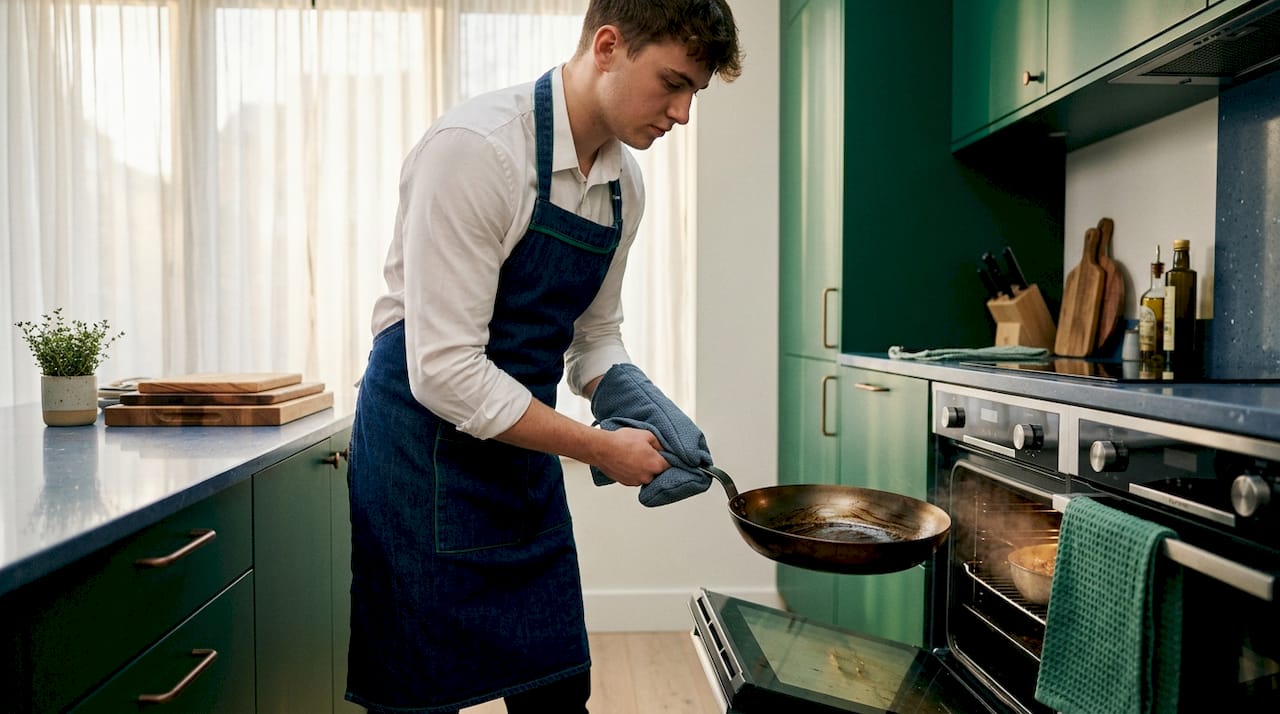
The influence on seasoning is equally significant. When you apply oil to a pan and heat it above its smoke point, the oil polymerises and bonds to the steel surface. Low impurity levels, specifically phosphorus and sulfur below 0.045%, ensure the steel achieves an elongation of at least 28%, which means the surface stays even and without micro-cracks during rapid heating. Seasoning bonds to an even surface. On an impure surface riddled with micro-defects, seasoning finds nowhere consistent to grip.
“High-purity carbon steel does not just season faster. It seasons more permanently, because there is nothing in the grain structure working against the bond.”
Here is how purity affects the four pillars of pan performance:
- Strength: Uniform grain structure resists deformation under repeated heat cycling
- Heat response: Lower carbon content means thinner walls and faster reaction to burner adjustments
- Seasoning adhesion: Clean surface chemistry allows oil to polymerise without interruption
- Lifespan: Fewer impurities equal fewer internal stress points, so the pan resists warping over years of use
Pro Tip: When you first season a high-purity carbon steel pan, you should need no more than three oven cycles to build a solid base layer. If seasoning is peeling after your first few sessions, impure steel is the most likely culprit, not your technique.
Understanding purity’s effects on pan behaviour lets us now compare carbon steel to cast iron to see why cooks often prefer it.
How carbon steel purity compares with cast iron and other steels
The difference between carbon steel and cast iron is fundamentally a story about carbon content and what that single variable does to a pan’s character.
Carbon steel cookware contains roughly 99% iron and 1% carbon by weight. Cast iron typically carries 2 to 3% carbon. That extra carbon makes cast iron significantly more brittle, which is why cast iron pans are thick and heavy. They need that bulk to compensate for reduced ductility. Carbon steel, being more ductile, can be made thinner and still hold its shape, weighing roughly half as much as a comparable cast iron piece.
| Property | Carbon steel (DC01 grade) | Cast iron | Stainless steel |
|---|---|---|---|
| Carbon content | ~1% | 2 to 3% | Minimal (alloying elements dominate) |
| Weight for same size | Lighter | Heavier | Similar to carbon steel |
| Heat-up speed | Fast | Slow | Fast |
| Seasoning ability | Excellent | Good | Poor (requires coating) |
| Brittleness risk | Low | Higher | Very low |
| Impurity sensitivity | High (purity critical) | Moderate | Low (alloying compensates) |
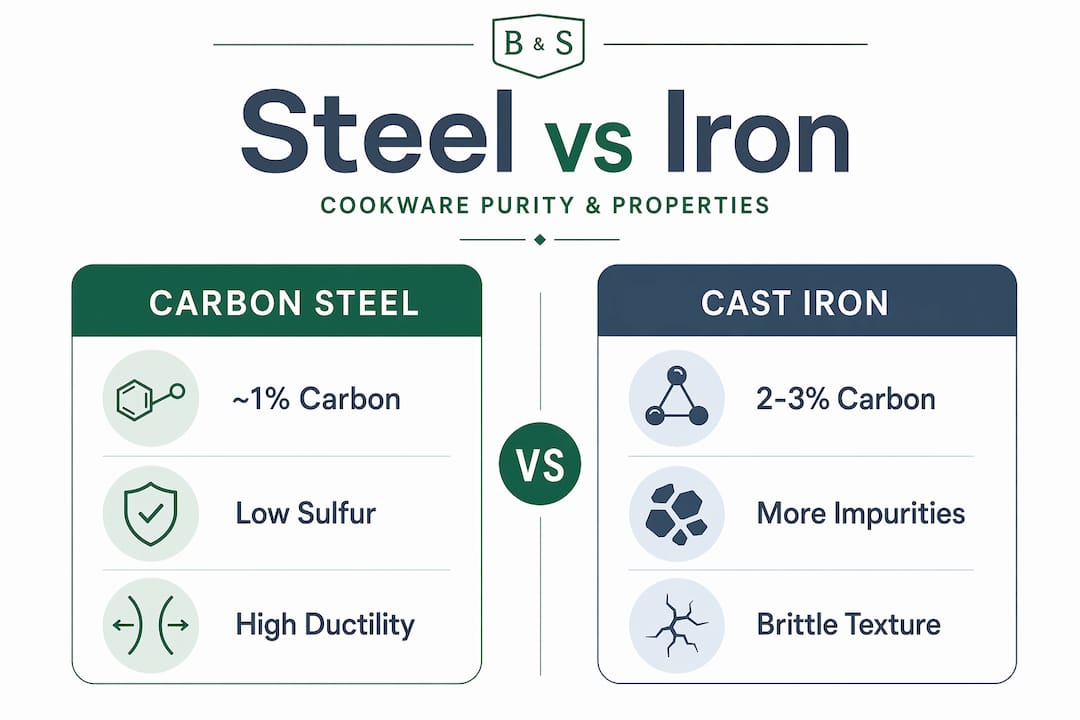
Stainless steel introduces chromium and nickel as alloying elements, per AISI standards, which give it corrosion resistance but eliminate the ability to season naturally. Carbon steel’s value comes precisely from its purity and simplicity: iron, a small amount of carbon, and tightly controlled trace elements. Nothing to interfere with the seasoning process.
Key comparisons to remember:
- Cast iron is more brittle, slower to heat, and harder to manoeuvre; its thickness is a structural necessity, not a quality feature
- Stainless steel does not season; its alloying elements prevent the chemical bonding that creates a natural non-stick surface
- High-purity carbon steel sits at a sweet spot, strong enough to last generations, light enough for daily use, and chemically suited to building a reliable patina
Pro Tip: If a carbon steel pan is advertised as significantly cheaper than comparable European-standard options, ask about the steel grade. Lower-grade steels with higher impurity tolerances often reach the market without EN 10130 certification, and that gap in quality shows within the first year of cooking.
With these comparisons clear, you can better appreciate purity’s role when choosing cookware.
Practical tips for choosing and recognising high-purity carbon steel pans
Knowing what affects carbon steel purity is only useful if you can apply that knowledge when you are actually buying a pan. Here is a practical process for making the right call.
- Ask for EN 10130 DC01 certification. This is the European standard that defines maximum limits for carbon, manganese, phosphorus, and sulfur. If a manufacturer cannot confirm this grade, the steel composition is unknown.
- Request a mill test certificate (MTC). An MTC is a document issued by the steel producer confirming the exact chemical composition of the batch. Look for phosphorus at or below 0.04% and sulfur at or below 0.05%. Without verified MTC data, uneven seasoning can fail within 6 to 12 months of regular use.
- Check pan thickness and weight. High-purity steel can be formed into consistently thin, uniform sheets. Uneven thickness across the pan base often indicates lower-grade material that has not been rolled to tight tolerances.
- Look at how the pan is formed. Single-piece construction, forged from one sheet without rivets or welded handles, is only achievable with sufficiently ductile, high-purity steel. A riveted handle is not just a design compromise; it can signal lower-grade material.
- Understand how carbon steel pans are made. Manufacturing method and steel grade are inseparable. A pan forged to high tolerances from DC01 steel will season more evenly and warp less than one pressed from an unspecified grade.
Once you have chosen a quality pan, consistent care is what locks in the performance. Expert care guidance for carbon steel cookware always emphasises the same fundamentals: thin oil layers, full drying before storage, and cooking fatty foods regularly in the early stages to reinforce the patina.
Pro Tip: A pan from high-purity steel will show an even, dark bronze colour across the entire cooking surface after two or three seasoning cycles. Patchy, inconsistent colouring suggests surface impurities or non-uniform thickness in the steel itself.
Knowing how to choose pure carbon steel lets you maximise your cooking and pan care experience.
Why carbon steel purity is often overlooked but critical for cooks
There is a tendency in cookware marketing to make purity sound like a technical footnote. It is not. It is the single most consequential decision made before a pan ever reaches your kitchen, and most buyers never see it.
The DC01 grade specification requires a deep-drawability r-value of at least 1.8 alongside its low carbon and impurity limits. That r-value tells you the steel can be formed into complex shapes without tearing or developing stress fractures in the grain. Those same micro-fractures, if present, are where seasoning breaks down first: the oil polymerises, the pan flexes slightly during heating, and the seasoning cracks along those invisible fault lines. You blame your technique. The steel was the problem.
Impure steels with sulfur above 0.05% also carry a real risk at forging temperatures. This is the phenomenon known as red-short brittleness, where sulfur causes the steel to become brittle at high heat. In a cookware context, this translates into warped handles, uneven bases, and pans that rock on a flat surface after their first high-heat session. These are not defects you would attribute to steel purity. Most cooks blame shipping damage or rough handling. But the failure was built into the material before the pan was even pressed.
Professional kitchens that rely on carbon steel day after day are quietly selecting for purity even when they do not use that word. They choose pans that hold seasoning, season in two initial layers, resist warping after repeated high-heat use, and feel identical to cook on after three years of service. That consistency is a purity story. And if you are serious about your cooking, it should be your story too.
Explore the essentials of carbon steel pans to see how material quality translates into daily cooking performance.
Discover high-purity carbon steel pans at Brass & Steel
At Brass & Steel, every pan starts with a single sheet of high-purity carbon steel, forged in one piece in Jarocin, Poland. No rivets, no welds, no guessing about what grade of steel is underneath the handle. The steel composition is chosen for its EN 10130 DC01 compliance, which means you get a pan that seasons consistently, holds its shape under high heat, and improves every time you cook with it.
Whether you are equipping a professional kitchen or investing in cookware you want to use for the next twenty years, the material behind the pan matters as much as the design. Read about how our pans are made to understand the manufacturing process behind the purity standards, and explore our expert care tips to get the most from your investment from the very first season.
Frequently asked questions
What does carbon steel purity mean for cookware?
Carbon steel purity refers to the controlled levels of carbon and impurities such as phosphorus and sulfur within the steel alloy. The EN 10130 DC01 standard specifies a maximum of 0.12% carbon, 0.045% phosphorus, and 0.045% sulfur, ensuring the steel base exceeds 99% iron and delivers consistent seasoning and pan strength.
How does carbon steel differ from cast iron in purity and performance?
Carbon steel contains roughly 1% carbon and 99% iron, making it lighter and more ductile than cast iron. Cast iron’s 2 to 3% carbon content increases brittleness and forces thicker, heavier construction, which slows heat response compared to carbon steel.
Why is controlling phosphorus and sulfur important in carbon steel pans?
Phosphorus and sulfur, when present above permitted limits, reduce toughness and create surface inconsistencies that prevent seasoning from bonding firmly. Keeping both below 0.05% ensures the steel surface is even enough to build a durable, natural non-stick patina.
What should I check to confirm my carbon steel pan is high purity?
Look for EN 10130 DC01 certification and request the mill test certificate confirming phosphorus and sulfur are both below 0.05%. Without that verification, uneven seasoning can degrade within 6 to 12 months of regular use.
How does carbon steel purity affect seasoning build-up?
High-purity steel has a uniform surface structure with no micro-cracks, allowing oil to polymerise and bond evenly during seasoning. Low impurity levels, particularly phosphorus and sulfur, are what enable carbon steel to achieve an elongation of at least 28%, which keeps the surface stable under repeated high-heat seasoning cycles.