How pans retain heat: a guide for home cooks
TL;DR:
- Pans with higher thermal mass, like cast iron and carbon steel, retain heat longer and recover faster during cooking.
- Carbon steel strikes a balance between responsiveness and heat retention, making it ideal for versatile, quick-adjust cooking styles.
- Proper preheating and understanding stove-specific heat distribution are essential for achieving optimal results with different cookware materials.
Most home cooks notice that some pans stay scorching hot long after the burner goes off, while others cool down almost immediately. Understanding how pans retain heat, the property that scientists call thermal mass or heat capacity, is one of the most practical things you can learn about cookware. It directly affects how well you sear a steak, how evenly you cook an omelette, and how much control you have when things are moving fast on the hob. This guide breaks it all down, with a focus on carbon steel and what it means for your everyday cooking.
Key takeaways
| Point | Details |
|---|---|
| Thermal mass drives retention | Thicker, denser pans store more heat energy and recover faster when cold food is added. |
| Carbon steel balances retention and speed | It preheats quickly and responds to heat changes faster than cast iron, making it ideal for agile cooking. |
| Preheating method matters | Gradual, even preheating prevents hot spots and protects the pan from warping. |
| Stove type affects heat distribution | Gas, electric, and induction each deliver heat differently, changing how your pan performs. |
| Match pan to cooking task | Cast iron suits long, steady sears; carbon steel suits quick, responsive cooking like stir-fries and delicate proteins. |
How heat retention in cookware actually works
Before comparing materials, it helps to separate two concepts that often get muddled: heat distribution and heat retention. They are not the same thing, and confusing them leads to poor pan choices.
Heat distribution refers to how evenly heat spreads across the cooking surface. Heat retention refers to how long the pan holds onto that heat once the energy source is reduced or removed. A pan can distribute heat beautifully but cool down in seconds. Another can hold heat for minutes but create scorching hot spots in the centre.
The key factor behind retention is thermal mass, sometimes called heat capacity. Simply put, it is the amount of heat energy a material can store per degree of temperature rise. A pan with high thermal mass absorbs a large amount of energy before its surface temperature changes noticeably. That is why thicker pan bases buffer temperature swings so well. When you drop a cold steak onto a thick pan, the surface temperature dips less dramatically, which means you get a better sear.
Heat input and heat loss are always working against each other. Your burner adds energy; the air, your food, and the pan’s own mass all absorb it. The balance between those forces determines what temperature you are actually cooking at.
- Material density affects how much energy a given weight of metal can store.
- Thickness determines how much material there is to store that energy.
- Surface area influences how quickly heat escapes into the air.
- Pan geometry plays a role too. Flat, thick bases maximise contact with the heat source and help retain edge heat in the sidewalls.
Pro Tip: If your pan feels like it is losing heat the moment food hits it, the issue is usually insufficient preheating rather than a poor-quality pan. Give it more time before adding anything.
Comparing materials: cast iron, carbon steel, and the rest
Understanding cooking pans heat properties across different metals is where things get genuinely interesting. The differences are not subtle.
| Material | Heat retention | Heat-up speed | Responsiveness | Weight |
|---|---|---|---|---|
| Cast iron | Very high | Slow | Low | Heavy |
| Carbon steel | Moderate to high | Fast | High | Medium |
| Stainless steel | Low to moderate | Fast | High | Medium |
| Aluminium (clad) | Low | Very fast | Very high | Light |
| Copper | Low | Very fast | Very high | Medium/heavy |
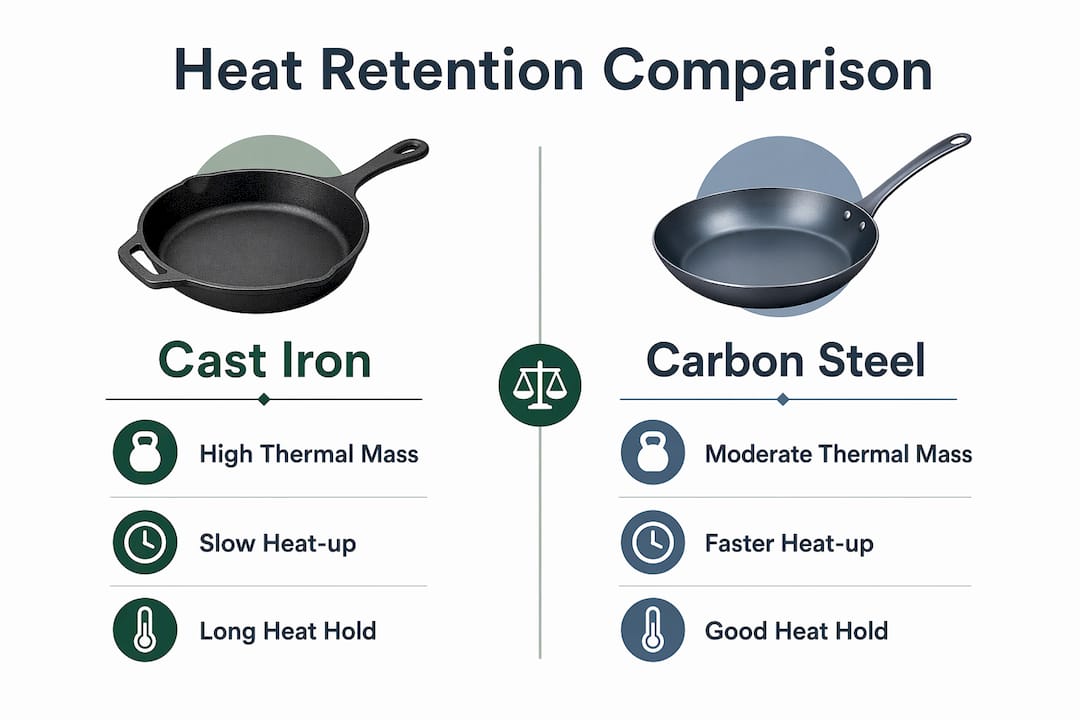
Cast iron’s high thermal mass means it stays hot long after you turn the heat down. That is brilliant for a thick ribeye that needs a long, steady sear or a pan sauce that needs to keep simmering. The trade-off is that cast iron is slow to preheat and sluggish to adjust. If you turn the heat down, the pan barely notices for a while.
Carbon steel sits in a genuinely useful middle ground. Carbon steel preheats faster and responds to heat changes more quickly than cast iron, while still offering meaningful retention. That quicker thermal response is what makes it a favourite in professional kitchens for sautéing, stir-frying, and cooking proteins that need precise temperature management.
Stainless steel and aluminium heat up fast but hold less energy. They are responsive, which suits delicate tasks, but they struggle to maintain temperature when loaded with food. Clad or multi-ply construction, where aluminium or copper is sandwiched between steel layers, improves heat spread significantly without changing the fundamental retention limits of the outer material.
- Best materials for heat retention: cast iron first, carbon steel second, then clad stainless.
- Best for responsiveness: aluminium, copper, carbon steel.
- Best all-round balance: carbon steel, particularly in thicknesses of 3mm to 4mm.
Pro Tip: When comparing carbon steel vs cast iron for everyday home cooking, carbon steel wins on versatility. Cast iron wins on sheer heat stamina.
Preheating and technique: getting the most from your pan
Knowing how pans heat up is only half the picture. How you heat them up matters just as much for real cooking results.
-
Start low and build up. Place your pan on a medium-low heat and let it warm gradually for two to three minutes before raising the temperature. This is especially important for carbon steel and cast iron, which need time for heat to travel evenly across the base and up the sidewalls.
-
Test before you add anything. A drop of water should dance and evaporate quickly on a properly preheated carbon steel pan. If it just sits there and steams, the pan is not ready.
-
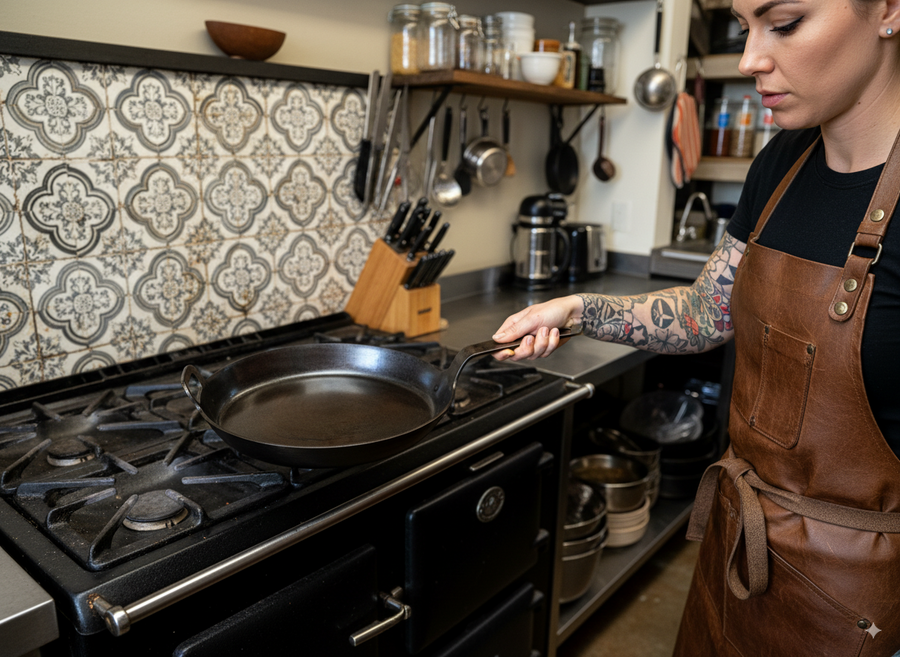
Rotate on gas burners. Gas burners create a ring heat pattern that leaves the centre of the pan cooler than the ring area. Rotating the pan a quarter turn every minute or two during preheating evens this out noticeably.
-
Add fat at the right moment. Add your cooking oil or butter once the pan is preheated. It should shimmer or foam almost immediately. This tells you the surface is at the right temperature and helps you maintain it when food goes in.
-
Avoid thermal shock. Rapid temperature changes like running a hot pan under cold water can warp the base, which permanently damages how the pan sits on the hob and how evenly it heats. Always let your pan cool naturally before washing.
-
Do not overcrowd the pan. Adding too much food at once drops the surface temperature dramatically. Cook in batches if needed and let the pan recover between them.
Pro Tip: The biggest preheating mistake with carbon steel is rushing it. A pan that has been properly warmed for three minutes will give you a noticeably better sear than one you throw food into after thirty seconds.
Carbon steel or cast iron: choosing the right pan
Both materials are excellent, but they suit different cooking styles and different kitchens. Here is how to think through the choice.
Choose cast iron when you:
- Cook thick cuts of meat that need long, uninterrupted searing.
- Use the pan in the oven frequently for braising or finishing dishes.
- Want a pan that holds heat through a long service, especially for entertaining.
- Do not mind the extra weight and slower heat-up time.
Choose carbon steel when you:
- Stir-fry regularly and need the pan to respond instantly to heat changes.
- Cook delicate proteins like fish or eggs that need precise, controllable heat.
- Want a lighter pan you can toss and manoeuvre easily.
- Cook on induction, gas, and electric, and need a pan that performs equally well on all three.
Carbon steel is preferred in professional kitchens precisely because it balances retention with agility. You get enough heat storage to sear properly, without the sluggishness of cast iron. For guidance on how the two materials compare in everyday kitchen scenarios, it is worth reading through a detailed breakdown before you commit.
One consideration that often gets overlooked is construction quality. Not all carbon steel pans are built the same way. Riveted handles can trap food and rust over time. A pan forged from a single piece of steel is stronger, easier to clean, and behaves more consistently under heat because there are no weak points at the join.
| Cooking task | Best choice | Why |
|---|---|---|
| Thick steak sear | Cast iron | High thermal mass holds temperature through the sear |
| Stir-fry | Carbon steel | Quick heat response suits fast, high-heat tossing |
| Fish fillet | Carbon steel | Precise temperature control prevents overcooking |
| Oven braise | Cast iron | Sustained heat retention suits long cooking times |
| Everyday sauté | Carbon steel | Lighter, faster, and more versatile for daily use |
Stove type and its effect on pan heat
How your cooktop delivers heat changes how your pan behaves, regardless of the material.
| Stove type | Heat delivery | Best pan match | Notes |
|---|---|---|---|
| Gas | Flame ring, uneven | Carbon steel, cast iron | Rotate pan during preheating to even out hot spots |
| Electric (coil or ceramic) | Slower, broader | Any flat-based pan | Flat base contact is critical for even heating |
| Induction | Direct, magnetic | Carbon steel, cast iron, clad steel | Fastest and most efficient for responsive pans |
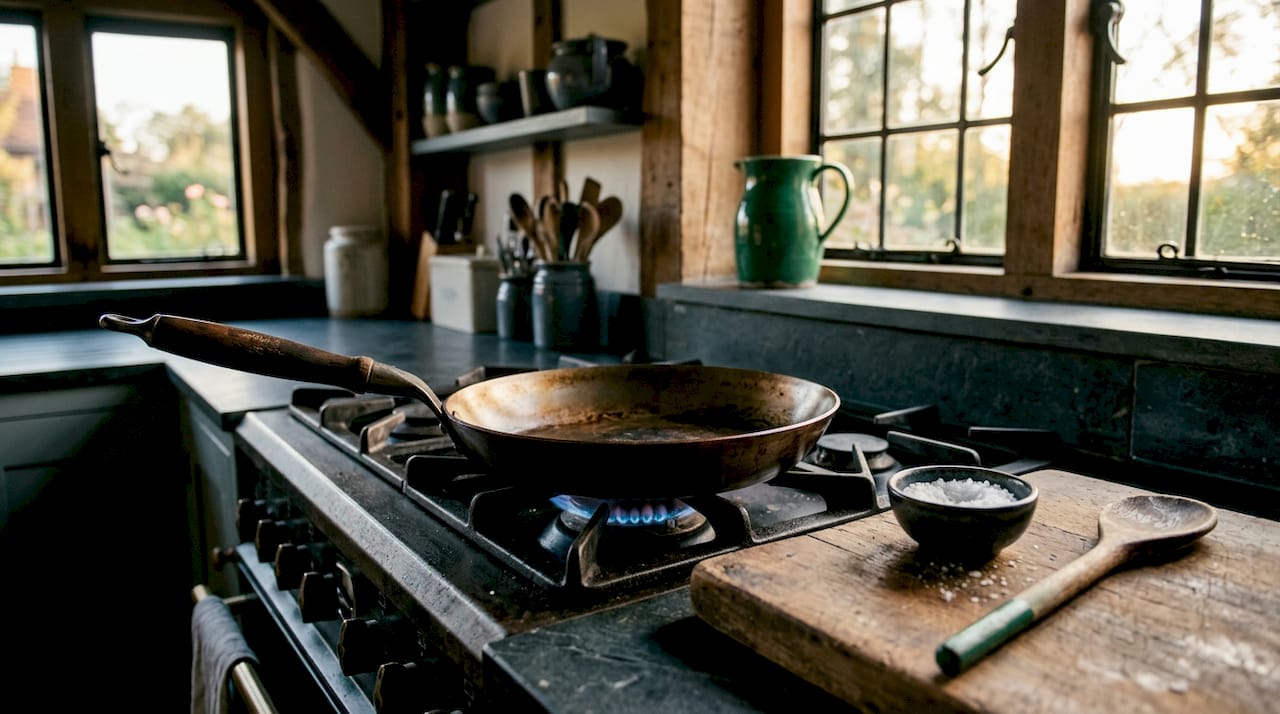
Gas burners are the most common source of uneven heating in home kitchens. The flame ring heats the outer ring of the pan base more than the centre, which can leave a noticeably cooler spot in the middle. This is where the heat ring phenomenon you sometimes see on cast iron comes from: the heat loads unevenly because cast iron is slow to spread it outward.
Carbon steel, being thinner and having a slightly quicker thermal diffusivity, spreads that ring heat more efficiently across the surface. On induction hobs, carbon steel performs particularly well because the magnetic field heats the base directly and evenly, and the pan’s responsiveness means temperature adjustments happen almost instantly.
- On electric hobs, make sure the pan base is completely flat. Even slight warping reduces contact and creates cold spots.
- On induction, start at moderate power when the pan is cold. Ramping up too fast on an empty pan can cause warping or seasoning damage.
- On gas, keep the flame within the footprint of the pan base. Flames licking up the sides waste energy and heat unevenly.
My honest take on heat retention and carbon steel
I used to overcomplicate this. I spent time reading about thermal diffusivity numbers and specific heat capacity figures, and then I’d go back to my kitchen and things still came out wrong because my preheating was sloppy.
What actually changed my cooking was understanding one simple thing: carbon steel does not forgive a cold start, but it rewards a patient one. When I started giving my pan a proper three-minute warm-up on medium heat before cranking it up, the results were immediately better. Sears had more colour. Fish did not stick. Eggs released cleanly.
The comparison with cast iron is something I think about a lot. I have used both extensively, and cast iron’s heat stamina is genuinely impressive. But for everyday cooking, the weight and slowness of cast iron started to feel like a liability. I found myself reaching for carbon steel almost every time because I could adjust the heat and actually have the pan respond within a few seconds.
The mistake I see most often is people adding food to a pan that has only been on the heat for thirty seconds. They then blame the pan for poor results when the real issue is technique. Gradual preheating is not optional with these materials. It is the entire foundation of getting them to perform.
My favourite use for carbon steel is searing chicken thighs, skin side down, starting in a cold pan that I bring up slowly. The skin renders beautifully without burning because the heat builds gradually and evenly. No other pan material gives me that level of control so reliably.
— Davide
Brass-steel carbon steel pans: built for real heat performance
If you have read this far and you are thinking about upgrading your cookware, the principles covered here translate directly into what Brass-steel makes. The Brass-steel carbon steel sauté pans are forged from a single piece of steel, with no rivets or welds, which means there are no weak points and no places for residue to build up. The 27 cm pan comes in 3mm carbon steel, giving you that quick, responsive heat performance ideal for everyday searing and sautéing. The 30 cm version steps up to 4mm, adding more thermal mass for larger cooks and family meals.
Both pans build a natural, non-toxic seasoning over time that improves with every use. They work on all cooktops, including induction, and go straight from hob to oven. Brass-steel cookware is designed for cooks who want performance without compromise and a pan that genuinely lasts.
FAQ
What does thermal mass mean in a cooking pan?
Thermal mass refers to how much heat energy a pan can store per degree of temperature rise. A high thermal mass pan, like cast iron, holds more energy and loses it more slowly, which keeps cooking temperatures steadier when food is added.
Why do some pans cool down so quickly?
Pans with low thermal mass, such as thin aluminium or stainless steel, store less heat energy and lose it rapidly when cold food is introduced. Thicker pans made from denser materials, like carbon steel or cast iron, buffer this temperature drop far more effectively.
Is carbon steel good at retaining heat?
Carbon steel offers moderate to high heat retention, sitting between aluminium and cast iron. It preheats faster than cast iron and responds more quickly to temperature changes, making it a practical choice for most home cooking tasks.
How does preheating affect heat retention?
A properly preheated pan stores heat more evenly throughout its base and sidewalls, which means it recovers faster when food is added. Skipping or rushing the preheat results in uneven cooking and unnecessary sticking, regardless of pan material.
Does stove type affect how a pan holds heat?
Yes. Induction hobs deliver heat directly and evenly into the pan base, which suits carbon steel particularly well. Gas burners create a ring heat pattern that can leave cool spots, especially in cast iron. Rotating the pan during preheating on gas helps to even out the heat distribution.