Factors in choosing restaurant pans: a practical guide
TL;DR:
- Choosing the right restaurant pans depends on material, size, and construction, which impact performance and longevity. Proper selection based on kitchen tasks ensures faster service, longer-lasting cookware, and safer handling, while mistakes lead to higher costs and slower workflows. Regular inspection of handles and verifying standard dimensions prevent safety issues and ensure equipment compatibility.
The most critical factors in choosing restaurant pans are material, size, pan type, handle construction, and compatibility with standardised kitchen equipment. Get these right and your kitchen runs faster, your pans last longer, and your chefs work with less frustration. Get them wrong and you spend more money replacing worn-out cookware while your team battles with pans that slow service down. This guide covers each factor directly, with the practical detail European restaurant owners and chefs need to make confident purchasing decisions.
What are the key factors in choosing restaurant pans?
Pan selection in professional kitchens is a discipline, not a shopping exercise. The industry term for this process is commercial cookware specification, and it covers material, construction, sizing, and operational fit. Each factor affects a different part of your kitchen’s performance, so skipping any one of them creates problems you will only notice after service has already suffered.
Material determines how quickly a pan heats, how evenly it cooks, and how long it survives daily abuse. Size and pan type must match your menu tasks and station throughput. Handle construction affects safety and how long the pan stays serviceable. Standardised dimensions, particularly Gastronorm sizing, determine whether your pans fit your ovens, fridges, and storage racks without guesswork.
Starting from kitchen tasks and menu needs is the most effective way to specify cookware. That means resisting the urge to buy by brand reputation or material alone, and instead asking what each pan needs to do before you spend a single euro.
How does pan material influence cooking performance and lifespan?
Material is the single biggest driver of cooking performance and long-term cost in restaurant cookware. Stainless steel offers corrosion resistance and durability at high heat, making it the default choice for most European commercial kitchens. Aluminium heats faster and weighs less, which suits high-volume sauté stations, but it dents more easily and degrades faster under heavy use.
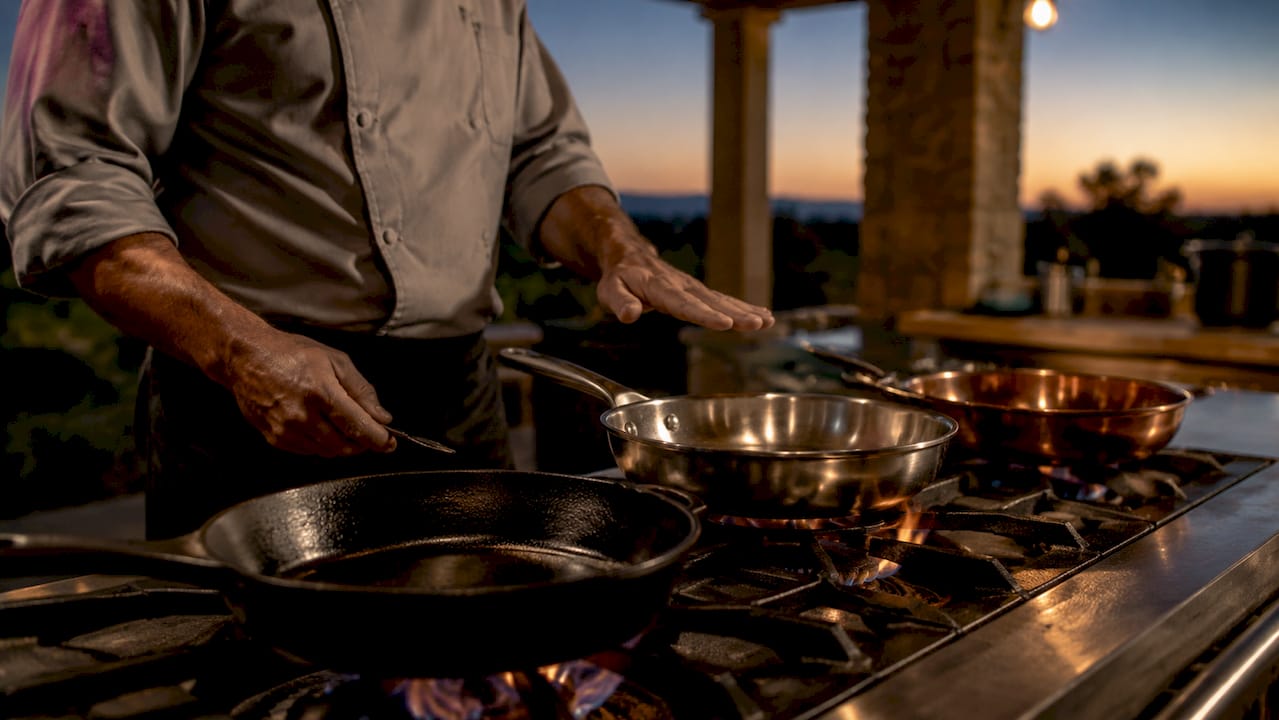
Copper and copper-core hybrids deliver the most responsive heat control available, which matters for sauces and delicate proteins. The trade-off is cost. A quality copper sauté pan costs several times more than its stainless steel equivalent, and it requires more careful maintenance. Most kitchens reserve copper for specific stations rather than using it across the board.
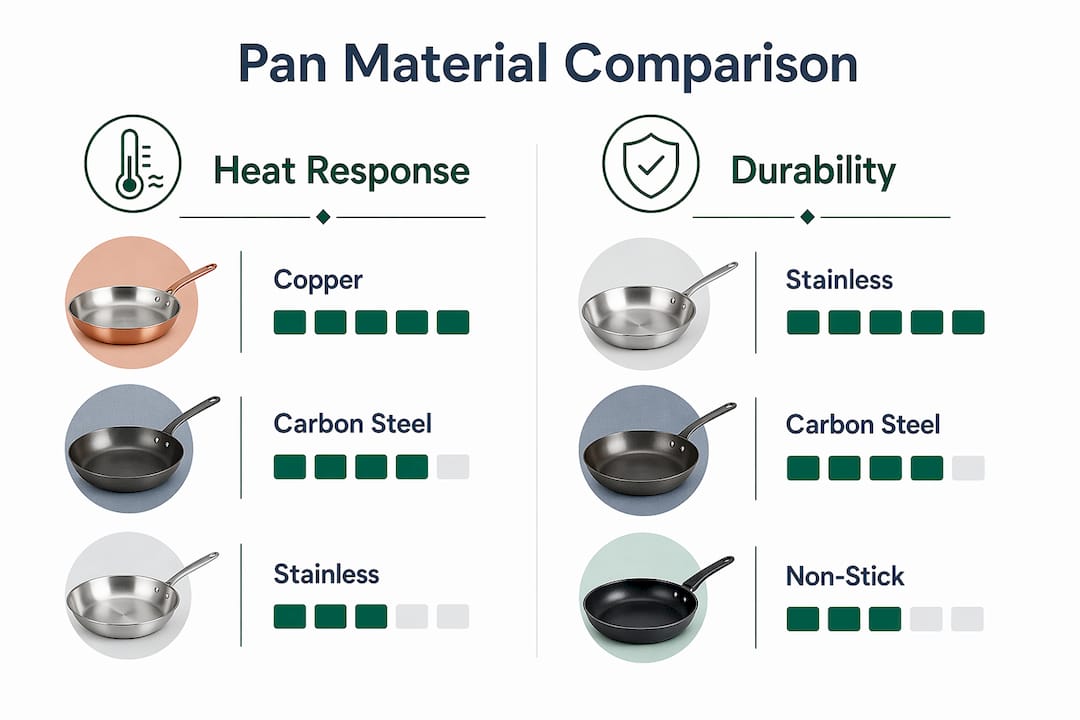
Carbon steel sits between cast iron and stainless steel in terms of weight and heat retention. It responds quickly to temperature changes, builds a natural nonstick surface through seasoning, and survives decades of professional use when maintained correctly. Brass-steel manufactures carbon steel sauté pans forged from a single piece of steel, which eliminates the weak points created by rivets or welds. Their forged carbon steel construction means the pan body and handle are one continuous piece, with no joints to fail under repeated thermal stress.
Non-stick coatings deserve a specific mention because they are widely used but often misunderstood. Non-stick surfaces reduce cleaning time but wear significantly faster under commercial conditions. High heat, metal utensils, and industrial dishwashers all degrade coatings quickly. Non-stick is suitable for specific applications, such as egg cookery or delicate fish, but it is not a long-term default for a high-volume kitchen. For a detailed breakdown of pan material performance, the differences between stainless steel, aluminium, and carbon steel are worth understanding before you commit to a purchase.
| Material | Heat response | Durability | Best use |
|---|---|---|---|
| Stainless steel | Medium | Very high | General purpose, all stations |
| Aluminium | Fast | Medium | High-volume sauté, frying |
| Carbon steel | Fast | Very high | Searing, sautéing, oven use |
| Copper/hybrid | Very fast | Medium | Sauces, precision cooking |
| Non-stick coated | Medium | Low to medium | Eggs, delicate proteins |
Pro Tip: If your kitchen runs two or three sauté stations simultaneously, carbon steel or heavy-gauge aluminium pans give you the best balance of heat response and durability at a manageable cost per unit.
What pan sizes and types best suit different restaurant kitchen needs?
Choosing the pan family first is the correct sequence. Match the cookware type to your repeated kitchen tasks before you think about size or material. Stockpots handle stocks, soups, and pasta water. Sauté pans cover the widest range of daily tasks. Saucepans manage reductions, sauces, and small-batch cooking. Rondeaus handle braises, large proteins, and oven-to-stovetop work.
Once you have identified the right pan families for your menu, size selection becomes straightforward. A 10-inch sauté pan is the practical workhorse for most high-volume restaurant kitchens. An 8-inch pan suits smaller portions and single-serve tasks. A 12-inch pan handles larger batches where you need more surface area without moving to a rondeau.
Oversized pans create real problems. Pans larger than 14 inches tend to be bulky, slow workflow, and harder to store. They also place more stress on handles and wrists during service. Matching pan size to your plating rhythm matters more than most chefs realise. An undersized pan forces multiple batches. An oversized pan adds unnecessary handling burden and slows the pace of a busy station.
Key pan types every European restaurant kitchen should stock:
- Sauté pan (27–30 cm): the daily workhorse for searing, sautéing, and oven finishing
- Saucepan (16–20 cm): sauces, reductions, and small-batch cooking
- Stockpot (20–40 litre): stocks, soups, pasta, and blanching
- Rondeau/braiser (28–36 cm): braises, large proteins, and oven-to-stovetop dishes
- Frying pan (24–28 cm): eggs, pancakes, and delicate proteins requiring non-stick or seasoned surfaces
Build your core set around the tasks your kitchen repeats every service. Add specialist pans only when a specific dish genuinely requires them.
How do handle designs affect pan durability and kitchen safety?
Handle construction is one of the most overlooked factors when buying restaurant pans, and it is often the first thing to fail. Riveted handles show warning signs through movement and loosening before they fail completely, which gives you time to remove the pan from service. Welded handles rely entirely on weld quality. A poor weld fails without warning, which is a safety risk in a busy kitchen.
Durability depends on material thickness, construction quality, and heat exposure rather than on the attachment method alone. A well-executed weld on a thick-gauge pan will outlast a poorly riveted handle on a thin one. The key is evaluating the overall build quality, not just whether the handle is riveted or welded.
Practical points for handle inspection and selection:
- Check for handle movement on any riveted pan before purchasing or returning to service
- Avoid pans where the handle material differs significantly from the pan body, as thermal expansion differences cause stress over time
- Long or large pans place more leverage stress on handles; heavier pans need thicker handle attachments
- Inspect handles monthly in high-volume kitchens and remove any pan showing movement or cracking immediately
Pro Tip: Single-piece forged pans eliminate handle attachment entirely. The handle and pan body are one continuous piece of metal, which removes the most common failure point in commercial cookware.
For a closer look at riveted pan drawbacks in professional settings, the practical consequences go beyond safety and affect cleaning time and hygiene too.
Why do standardised pan dimensions like Gastronorm matter?
Gastronorm (GN) sizing is the European standard for commercial kitchen equipment compatibility. GN pans conform to fixed external dimensions set by EN 631, which means a GN 1/1 pan fits the same oven, fridge, and steam table regardless of which manufacturer made it. Internal volume varies depending on wall thickness and depth, so you need to check both the external fit and the internal capacity before ordering.
The most common buying mistake is focusing only on internal volume. Buyers who neglect external GN dimensions end up with pans that do not fit their oven runners or require awkward stacking in the fridge. Incorrect pan depth is a particular problem. A pan that is too deep for your oven runner spacing forces you to remove a shelf, which disrupts workflow and reduces oven capacity during service.
| GN size | External dimensions (mm) | Typical use |
|---|---|---|
| GN 1/1 | 530 × 325 | Full oven trays, large batches |
| GN 1/2 | 265 × 325 | Half trays, medium batches |
| GN 1/3 | 176 × 325 | Thirds, buffet inserts |
| GN 2/3 | 354 × 325 | Larger inserts, roasting |
| GN 1/6 | 176 × 162 | Small inserts, garnishes |
Consistent brands and verified EN 631 compliance avoid costly fitting problems. Mixing GN pans from multiple manufacturers with inconsistent tolerances creates gaps in storage racks and uneven heat distribution in ovens. Stick to one or two trusted suppliers for your GN range and verify compliance before ordering in bulk.
What operational factors should influence your restaurant pan selection?
Operational fit is where pan selection becomes a financial decision, not just a technical one. A pan that performs well in isolation but slows your kitchen’s rhythm costs you more in labour and service quality than its purchase price suggests.
Key operational factors to evaluate before buying:
- Workflow match: choose pans sized to your most common batch volumes, not your largest possible batch
- Cleaning ease: heavy-gauge stainless steel and seasoned carbon steel clean faster in commercial settings than worn non-stick surfaces
- Cost versus lifespan: a higher upfront cost for quality carbon steel or heavy stainless steel pays back over years of service; cheap thin-gauge pans need replacing far sooner
- Cooktop compatibility: verify induction compatibility if your kitchen uses induction hobs, as not all materials work across all heat sources
- Future volume: if you are planning to scale covers or add stations, buy pans that fit your target volume, not just your current one
Non-stick coatings trade cleaning ease for shorter lifespan in high-volume settings. Stainless steel is the preferred long-term default for most stations because it tolerates industrial cleaning, high heat, and heavy use without degradation. Carbon steel with a built-up seasoning offers similar durability with the added benefit of a natural nonstick surface that improves with use rather than wearing away.
Key takeaways
The most effective approach to restaurant pan selection is to start from kitchen tasks and menu needs, then match material, size, and construction to those specific demands.
| Point | Details |
|---|---|
| Start with pan type, not material | Match cookware family to repeated kitchen tasks before choosing material or size. |
| Material drives long-term cost | Carbon steel and heavy stainless steel outlast thin-gauge or non-stick pans in commercial use. |
| Size to your plating rhythm | A 10-inch sauté pan suits most high-volume stations; oversized pans slow workflow. |
| Handle construction affects safety | Single-piece or high-quality welded handles reduce failure risk in heavy commercial use. |
| Verify GN external dimensions | Check EN 631 compliance and external fit, not just internal volume, before ordering. |
Why I stopped buying pans by material first
Most chefs I know, myself included at the start, walk into a cookware decision thinking about material. Stainless or carbon? Coated or uncoated? That is the wrong starting point. The question that actually matters is: what does this pan need to do, fifty times a service, five days a week?
I have seen kitchens buy beautiful copper saucepans for a sauce station and then watch them sit unused because the team found them too heavy and too fussy to maintain during a busy service. I have seen cheap non-stick pans bought to save money, replaced three times in a year, and costing more in total than a single quality carbon steel pan would have. The buying mistake is almost always the same. Chefs prioritise material or price over operational fit.
The other thing I would push hard on is handle inspection. Most kitchens do not have a formal process for checking pan handles. They wait until something fails. A loose rivet or a stressed weld is easy to spot if you check monthly. It is a safety incident if you do not. Build a simple monthly inspection into your kitchen maintenance routine and remove any pan that shows movement or cracking immediately.
My honest recommendation for European restaurant kitchens is to build your core set around carbon steel sauté pans and heavy stainless steel saucepans and stockpots. Use non-stick only where it genuinely earns its place, and replace it on a schedule rather than waiting for the coating to fail. Buy to your current volume, verify your GN dimensions before ordering, and audit your pan set every time your menu changes significantly.
— Davide
Brass-steel carbon steel pans for professional kitchens
Brass-steel manufactures carbon steel sauté pans built specifically for the demands of professional cooking. Each pan is forged from a single piece of carbon steel, which means no rivets, no welds, and no handle joints to fail under repeated thermal stress.
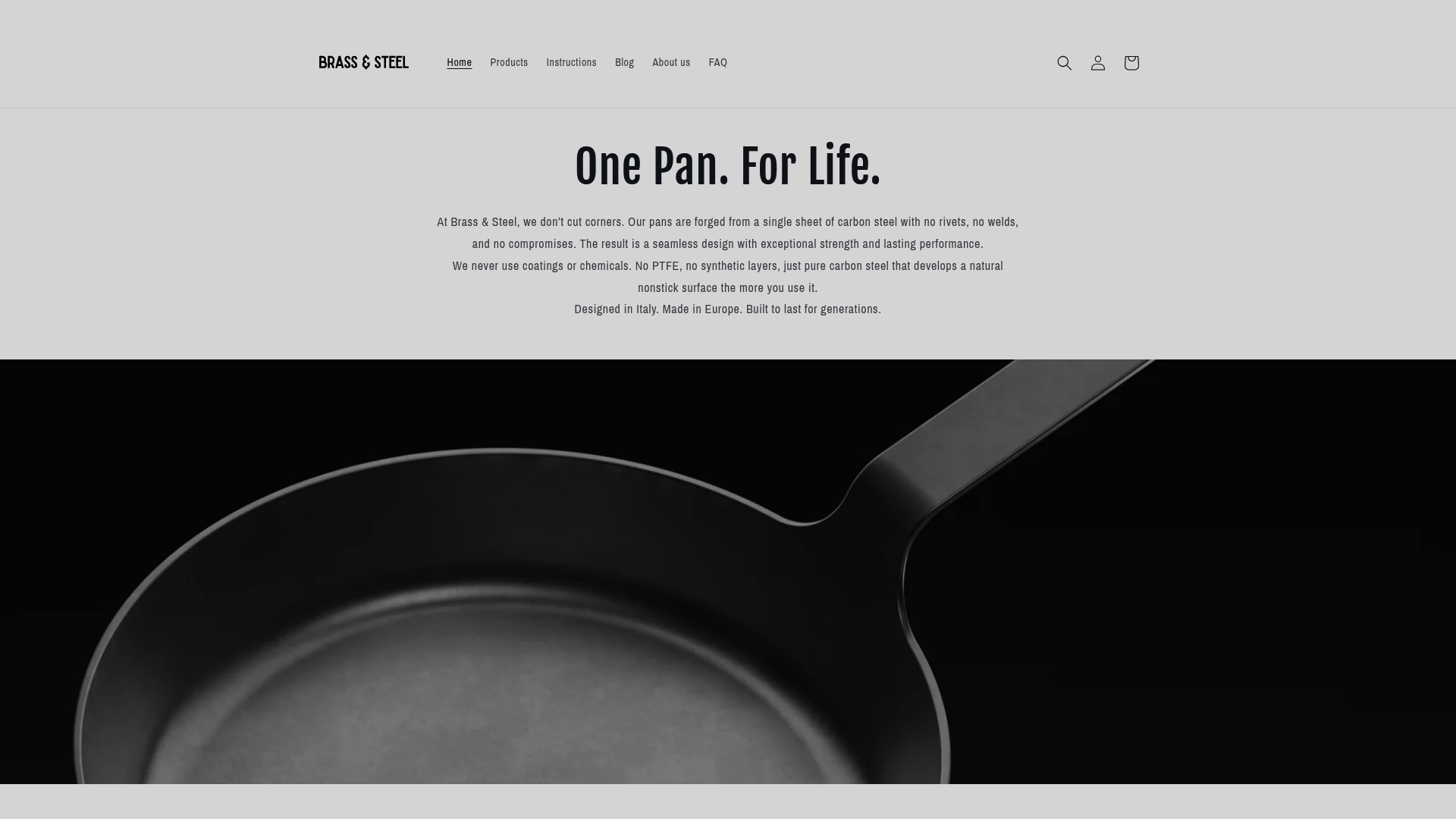
The 27 cm sauté pan (3 mm carbon steel, €99.00) suits everyday searing and sautéing tasks. The 30 cm version (4 mm carbon steel, €119.00) handles larger batches and fits high-volume professional stations. Both are free from PTFE and PFOA, work on all cooktops including induction, and build a natural nonstick surface through seasoning that improves with use. For chefs evaluating best cookware for restaurants, Brass-steel’s single-piece construction addresses the durability and hygiene requirements that matter most in commercial kitchens.
FAQ
What material is best for restaurant pans?
Stainless steel is the most widely used material in European commercial kitchens because of its corrosion resistance and durability. Carbon steel is preferred for searing and sautéing tasks where heat responsiveness and a natural nonstick surface matter.
How do I choose the right pan size for my restaurant?
Match pan size to your most common batch volume and plating rhythm. A 10-inch (approximately 27 cm) sauté pan suits most high-volume stations, with 8-inch for smaller tasks and 12-inch for larger batches.
What is Gastronorm and why does it matter?
Gastronorm (GN) is the European standard for commercial kitchen equipment sizing, governed by EN 631. GN pans have fixed external dimensions that ensure compatibility with ovens, fridges, and steam tables across different manufacturers.
Are non-stick pans suitable for commercial kitchens?
Non-stick coatings suit specific applications such as egg cookery and delicate fish, but they wear quickly under high heat, metal utensils, and industrial cleaning. Stainless steel or seasoned carbon steel is a more durable long-term choice for most commercial stations.
How often should restaurant pan handles be inspected?
Handle inspection should be part of a monthly kitchen maintenance routine. Remove any pan showing handle movement, loose rivets, or visible stress cracks from service immediately to avoid safety incidents during service.