Why avoid riveted pans: drawbacks every cook should know

TL;DR:
- Riveted pans often loosen over time and contain crevices that trap food, grease, and bacteria, impacting safety and hygiene. Welded or rivetless cookware offers more durability, easier cleaning, and eliminates hidden contamination risks. Choosing handle construction and pan material thickness carefully can significantly extend cookware lifespan and maintain cooking confidence.
Riveted pans are best avoided because their handle attachment method creates two serious problems: handles that loosen over time and crevices that trap food, grease, and bacteria. These are not minor inconveniences. They affect safety, hygiene, and how long your cookware actually lasts. Whether you cook on carbon steel, aluminium, or stainless steel, understanding the problems with riveted cookware helps you make a smarter purchase the first time.
Why avoid riveted pans: the handle loosening problem
The core mechanical issue with riveted handles is straightforward. A rivet passes through the pan wall and is hammered flat on both sides to hold the handle in place. Over time, the repeated stress of lifting, stirring, and thermal expansion causes the pan material around the rivet to wear down. Handle loosening is hard to stop once it begins, and once a handle wobbles, it rarely tightens back up permanently. That means a pan you paid good money for becomes a safety risk.
The problem is worse on thinner pans. Riveted handles loosen faster on thin lightweight pans such as aluminium or carbon steel, because the pan material wears faster than the rivet itself. The rivet stays rigid while the hole around it gradually enlarges. Think of it like a screw in soft wood: the screw holds, but the wood gives way.
The risks are real. A handle that detaches mid-use while you are carrying a hot pan is a burn risk and a spill risk. Professional cooks inspect riveted handles regularly for early wobble, but most home cooks do not. By the time the problem is obvious, the pan is already compromised.
Here is what to watch for if you already own riveted cookware:
- Grip the handle firmly and try to move it side to side. Any play at all is a warning sign.
- Look at the rivet heads on the inside of the pan. If they sit unevenly or show gaps around the base, loosening has begun.
- Check for discolouration or residue buildup directly around each rivet, which signals heat stress and grease accumulation.
- If the handle wobbles, stop using the pan for high-heat tasks or heavy loads immediately.
Pro Tip: If you are buying a riveted pan, choose one with a thicker gauge, at least 3mm. Thicker pan walls give rivets more material to grip, slowing the loosening process significantly.
The interaction between rivet size and pan thickness under real cooking stresses is the key variable most buyers overlook. A pan that feels solid in the shop can develop a wobbly handle within a year of regular use if the gauge is too thin.
How rivet crevices make cleaning a real problem
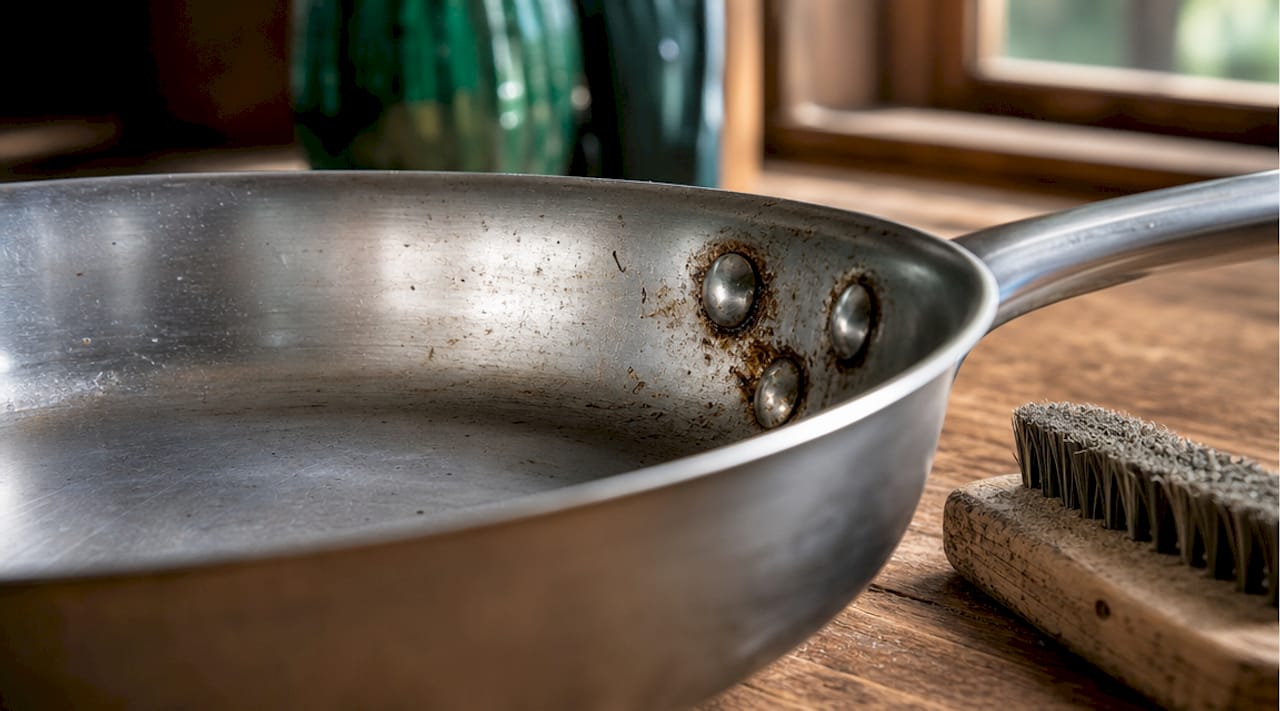
Every rivet head on the inside of your pan creates a small gap between the metal and the handle base. That gap is invisible to the naked eye but large enough to trap food particles, grease, and moisture after every single cook. Rivet crevices are flagged as contamination risks by health inspectors in professional kitchens, which is why most commercial operations have moved away from riveted cookware entirely.
The buildup that forms around rivets is not ordinary grease. Polymerised grease hardens around rivets into a varnish-like layer that resists normal washing. It carbonises with heat, turns dark and crusty, and sits right at the junction between handle and pan wall. This residue is the most common rivet-related maintenance problem in everyday cooking, and it is also a hidden cause of coating failure near the handle junction on non-stick pans.
“Rivet heads are microscopic contamination zones. Professional kitchens avoid them by opting for welded handles.” The Culinary Gene
Here is why cleaning riveted pans is harder than it looks:
- Standard sponges cannot reach into the gap between the rivet head and the pan surface.
- Dishwashers do not fully clean rivet crevices, even on pans labelled “dishwasher safe.” Rivet crevices rarely get fully clean in a dishwasher cycle and require extra manual effort over the cookware’s lifespan.
- You need a dedicated brush, such as a bottle brush or a stiff-bristled detail brush, to reach the grime properly.
- Moisture trapped in those gaps after washing accelerates rust on carbon steel and staining on stainless steel.
- Repeated scrubbing around rivet heads can damage non-stick coatings on the surrounding surface.
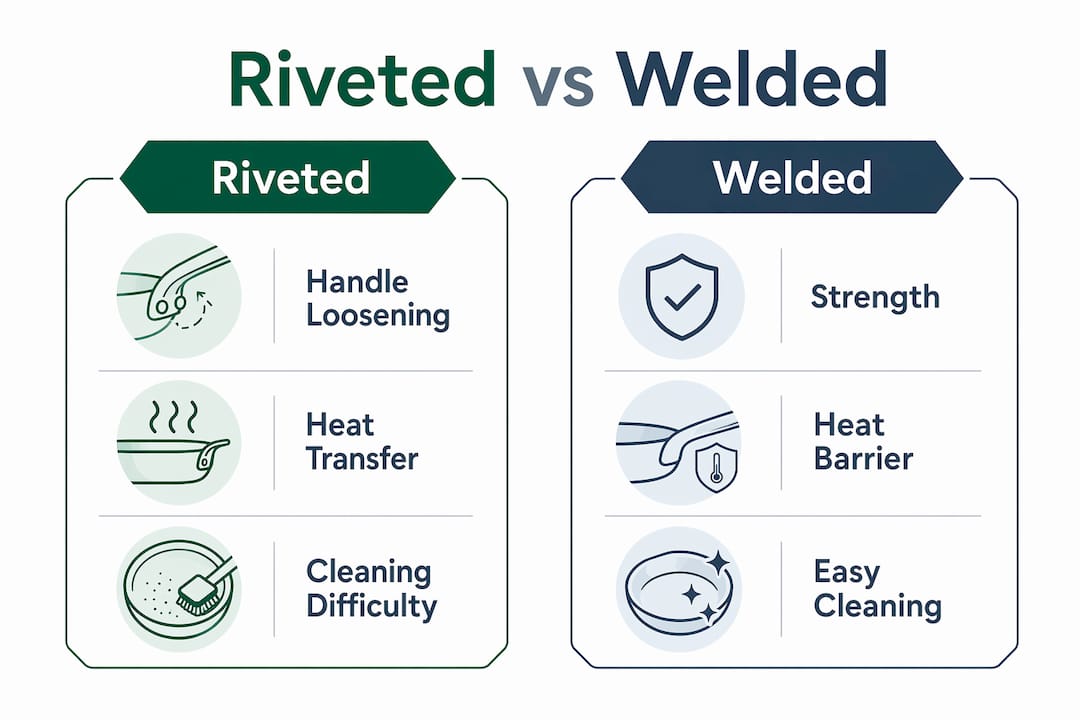
Switching to rivetless welded designs can reduce cleaning time by 70% and eliminate these hidden food traps entirely. That figure reflects how much extra effort riveted cookware genuinely demands over its lifetime.
Riveted vs welded pans: which actually lasts longer?
The durability question is more nuanced than most cookware guides admit. Riveted handles do offer one genuine advantage: they fail gradually. Riveted handles loosen with a detectable wobble before they fail completely, giving you a warning. Welded handles, by contrast, can crack or break suddenly without obvious prior signs. That is a real consideration, particularly for heavy-use kitchens.
However, that advantage does not outweigh the cumulative problems. The table below summarises the key differences:
| Feature | Riveted handles | Welded handles |
|---|---|---|
| Handle failure mode | Gradual loosening, detectable early | Sudden crack or break, less warning |
| Cleaning difficulty | High, due to crevices and gaps | Low, smooth surface throughout |
| Hygiene risk | Significant, food and moisture trap | Minimal, no crevices to harbour bacteria |
| Heat transfer to handle | Higher, rivets conduct heat directly | Lower, no metal rivets to bridge heat |
| Longevity on thin pans | Poor, pan material wears around rivet | Good, no penetration points in pan wall |
| Maintenance required | Regular inspection and deep cleaning | Standard washing, no special attention |
Riveted handles conduct heat through the metal, creating thermal bridging that transfers warmth to the handle during longer cooking sessions. Welded handles avoid this by eliminating the metal rivet entirely, which keeps the grip cooler and more comfortable. This matters most during oven use or open-flame cooking.
Modern welded handles can match riveted handles in strength, with German welding technologies producing bonds that endure years of heavy use without loosening. The old assumption that rivets are inherently stronger than welds no longer holds. High-quality welded construction is now the preferred choice for both durability and cleanliness.
Pro Tip: When evaluating a welded-handle pan, check the weld joint for smoothness and continuity. A clean, even weld with no visible gaps or rough edges is a sign of quality manufacturing.
The ergonomic and engineering principles behind handle attachment matter as much as the attachment method itself. A well-designed welded handle distributes load evenly and stays secure across thousands of uses.
How to choose cookware that avoids these problems
Choosing cookware that sidesteps the drawbacks of riveted frying pans comes down to a few clear priorities. Here is what to look for:
- Prioritise rivetless or welded handle construction. For hygiene and long-term durability, a welded or fully forged handle is the better choice. The benefits of a carbon steel pan with no rivets include easier cleaning, no food traps, and a handle that does not loosen over time.
- Match handle type to pan material. Thin aluminium and carbon steel pans are most vulnerable to rivet loosening. If you cook on these materials, a welded or single-piece forged construction is especially important.
- Check pan thickness before buying. A minimum of 3mm for carbon steel gives the pan wall enough mass to resist wear. Thinner pans with riveted handles are the highest-risk combination.
- Consider how you handle your pans. If you hang pans, carry them frequently, or use them in the oven, handle attachment points take more stress. Welded handles cope better with varied handling.
- Think about your cleaning routine. If you prefer quick washes rather than detailed scrubbing sessions, riveted cookware will frustrate you. Rivetless pans wipe clean in seconds.
Handle attachment alongside pan material thickness and cooking style are the three variables that determine how quickly a riveted handle fails. Buying a heavier, thicker pan with a welded handle removes all three risk factors at once.
If you already own riveted pans and are not ready to replace them, inspect the handles monthly, use a detail brush to clean around every rivet after each cook, and dry the pan immediately to prevent moisture sitting in the gaps.
Key takeaways
Riveted pans create avoidable problems in hygiene and durability that rivetless or welded alternatives solve entirely.
| Point | Details |
|---|---|
| Handle loosening is progressive | Rivets loosen gradually on thin pans, eventually becoming a safety risk if ignored. |
| Rivet crevices trap contamination | Food, grease, and moisture accumulate around every rivet head after each use. |
| Welded handles are now equally strong | Modern welding technology matches rivet strength while eliminating crevices and heat bridging. |
| Thin pans carry the highest risk | Aluminium and carbon steel pans under 3mm are most vulnerable to rivet-related loosening. |
| Rivetless pans save cleaning time | Switching to welded or forged construction can cut cleaning effort significantly over a pan’s lifetime. |
My honest view on rivets and what they cost you in the kitchen
I have cooked on both riveted and rivetless pans for years, and the difference in day-to-day experience is more significant than most people expect before they switch.
The cleaning issue is the one that gets to me most. With riveted pans, I found myself spending extra minutes after every cook trying to get a brush into those gaps around the handle. Even when the pan looked clean, I knew there was carbonised grease sitting in the crevices I could not reach. That is not a pleasant thought when you are cooking for family.
The handle wobble issue crept up on me too. I had a decent aluminium pan that felt solid for about eighteen months, then started to develop a slight movement in the handle. I kept using it, thinking it was minor. It got worse. The pan became genuinely uncomfortable to use with anything heavy in it, and I eventually retired it earlier than I should have needed to.
What I have found is that cooks tend to underestimate how much the construction of a pan affects their confidence at the stove. A pan that feels uncertain in your hand changes how you cook. You hesitate on the flip, you grip tighter, you second-guess the sear. A solid, rivetless pan removes all of that. You just cook.
The investment in better construction pays back over years, not months. A forged, rivetless pan that you can clean in thirty seconds and trust completely is worth considerably more than a cheaper riveted alternative that demands constant attention and eventually lets you down.
— Davide
Cook with confidence: Brass-steel rivetless carbon steel pans
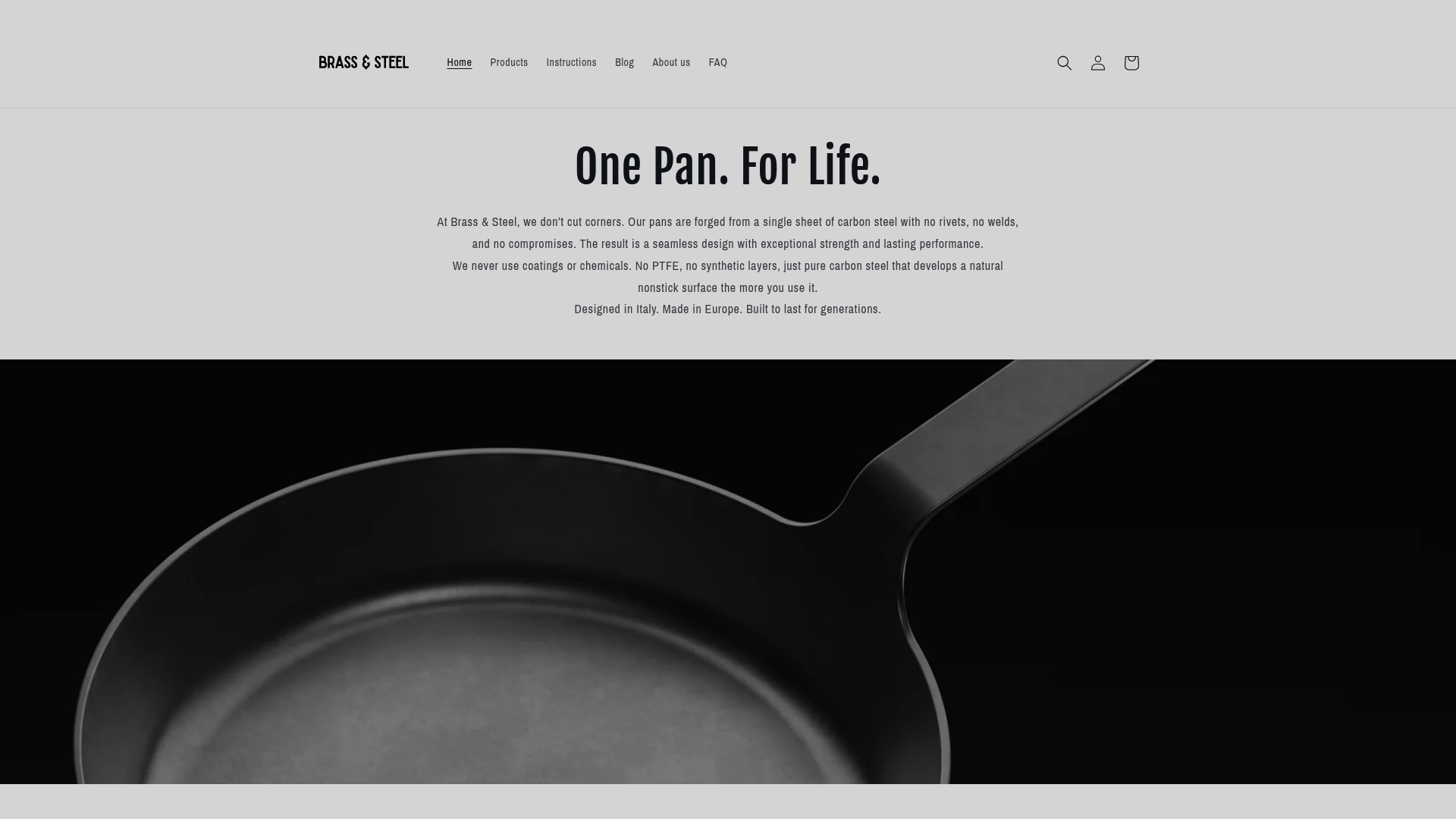
Brass-steel pans are forged from a single sheet of carbon steel, which means there are no rivets, no welds, and no crevices anywhere on the pan. The handle is part of the pan itself. You get a completely smooth surface that wipes clean after every cook and a handle that will never loosen because it was never attached separately in the first place.
The 27 cm carbon steel sauté pan at €99 and the 30 cm version at €119 are both built to 3mm and 4mm thickness respectively, giving you the pan wall mass that keeps cooking stable and the handle attachment secure. Both work on induction, gas, and in the oven, and both build a natural non-stick patina over time without any PTFE or PFOA coatings.
If you are ready to move away from riveted cookware for good, explore the Brass-steel range and see what a truly rivetless pan feels like in practice.
FAQ
Why do riveted pan handles loosen over time?
Rivets pass through the pan wall, and the pan material around each rivet wears down under repeated heat and mechanical stress. On thinner pans, this process accelerates because the pan material gives way faster than the rivet itself.
Are riveted pans safe to use?
Riveted pans are safe when the handles are fully secure, but a loose riveted handle becomes a genuine safety risk. Inspect the handle regularly for any wobble, and retire the pan if movement develops and cannot be corrected.
Why are riveted pans harder to clean than welded ones?
Each rivet head creates a small gap that traps food particles, grease, and moisture. These crevices resist dishwasher cycles and require a detail brush to clean properly, adding time and effort to every wash.
What is the best alternative to riveted cookware?
Welded-handle pans and fully forged single-piece pans eliminate rivet crevices entirely. Modern welding technology produces handle bonds as strong as rivets, with the added benefit of a smooth, easy-to-clean surface and no thermal bridging to the grip.
Do riveted pans conduct more heat through the handle?
Yes. Metal rivets create a thermal bridge between the pan wall and the handle, transferring heat during longer cooking sessions. Welded or forged handles without rivets avoid this, keeping the grip cooler and more comfortable to hold.