Copper cookware: Performance, maintenance, and chef insights

TL;DR:
- Copper’s high thermal conductivity and responsiveness enhance precision in delicate cooking tasks.
- It requires careful maintenance and proper lining to ensure safety and longevity.
- For everyday versatility and ease of use, materials like carbon steel often outperform copper.
Copper cookware carries a reputation built on gleaming kitchen aesthetics and professional prestige. But strip away the shine, and you find something far more interesting: a material with genuine scientific advantages that change how food actually cooks. The thermal responsiveness of copper is not a marketing claim — it is measurable physics. This guide cuts through the glamour to give you honest answers about copper’s real strengths, its genuine weaknesses, and exactly when it earns its place in a serious kitchen versus when another material simply does the job better.
Table of Contents
- Why copper cookware stands out in the kitchen
- Comparing copper, carbon steel, and stainless steel cookware
- Caring for and maintaining copper cookware
- Choosing the best copper cookware for your kitchen
- The real value of copper cookware: A practical perspective
- Find the perfect cookware for your needs
- Frequently asked questions
Key Takeaways
| Point | Details |
|---|---|
| Rapid heat control | Copper cookware offers exceptional responsiveness for precise cooking. |
| Maintenance required | Regular hand-washing and polishing are needed to keep copper looking and performing its best. |
| Choose by task | Select copper for delicate tasks, but consider carbon steel or stainless for everyday durability. |
| Top brands matter | Reputable European makers like Mauviel and Falk Culinair ensure high performance and quality. |
Why copper cookware stands out in the kitchen
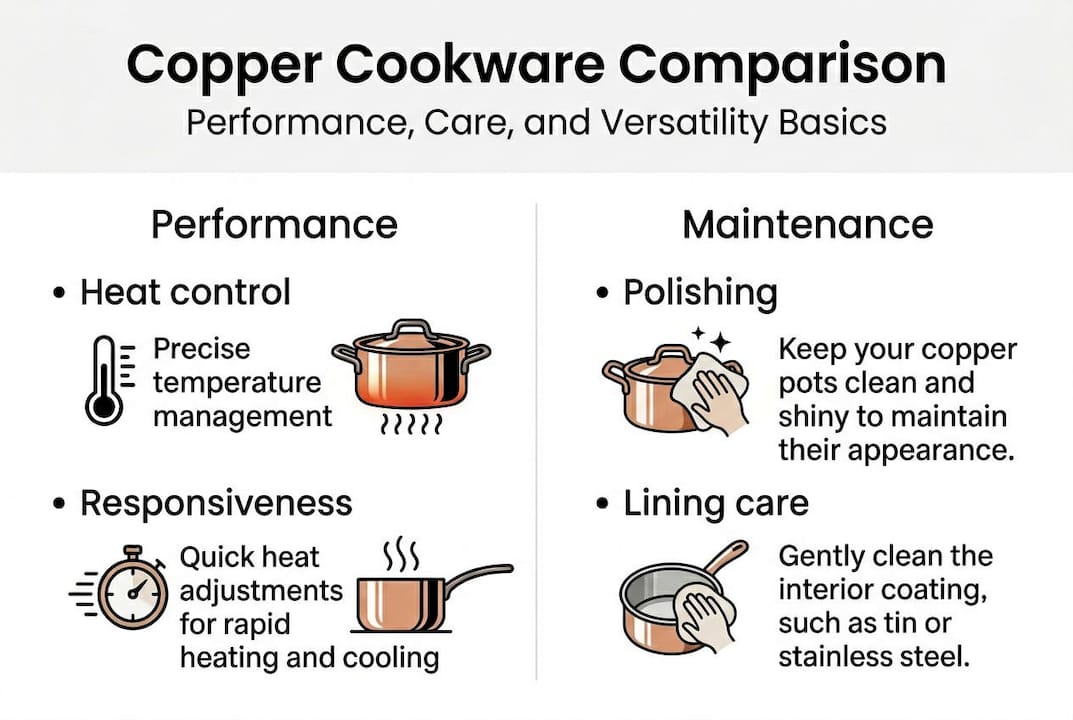
Most kitchen metals conduct heat adequately. Copper does something different. It responds. When you turn the heat down under a delicate beurre blanc, a copper pan adjusts almost instantly. That snap of responsiveness is what separates copper from nearly every other material available to home cooks and professionals alike.
The science behind this is straightforward. Copper’s thermal conductivity reaches 401 W/m·K, making it the most thermally conductive common cookware metal by a considerable margin. Aluminium sits around 205 W/m·K. Stainless steel manages roughly 16 W/m·K. The practical consequence of these numbers shows up in temperature consistency across a pan’s surface.
A quality copper pan typically holds a temperature variation of just 2 to 5°C from centre to edge during cooking. Compare that to stainless steel, which can swing 20 to 40°C across the same surface. That difference is enormous when you are making caramel, reducing a wine sauce, or cooking fish that punishes uneven heat immediately.
Here is what this means in practice:
- Precise sauce work: Copper reacts to heat changes in seconds, not minutes. You can pull it off the flame and watch the bubbling stop almost immediately.
- Even browning: Minimal hot spots mean food colours uniformly rather than burning at the centre.
- Delicate proteins: Eggs, fish, and foie gras respond well to the controlled temperature environment copper creates.
- Confectionery tasks: Sugar work and caramel demand exact temperatures. Copper’s responsiveness makes it the professional’s choice for these tasks.
“Copper is not just fast — it is the most honest pan in the kitchen. It shows you exactly what the heat is doing, and it responds the moment you change your mind.”
Pro Tip: If you are new to professional cookware and considering copper for sauce work, start with a smaller saucier shape rather than a large sauté pan. The benefits are most apparent in smaller, reactive cooking tasks where temperature swings matter most.
Copper’s performance edge is real and measurable. But it comes with trade-offs in cost, maintenance, and practical versatility that deserve equal attention before you spend accordingly.
Comparing copper, carbon steel, and stainless steel cookware
Knowing what copper does brilliantly is only half the decision. Understanding where it falls short compared to more practical everyday materials is just as important. The table below gives you a direct, honest comparison.
| Feature | Copper | Carbon steel | Stainless steel |
|---|---|---|---|
| Thermal conductivity | Excellent (401 W/m·K) | Good | Poor (16 W/m·K) |
| Heat responsiveness | Outstanding | Good | Moderate |
| Searing retention | Poor to moderate | Excellent | Good |
| Natural nonstick | No | Yes (seasoned) | No |
| Maintenance effort | High | Moderate | Low |
| Induction compatible | Only with added base | Yes | Yes |
| Cost | Very high | Low to moderate | Moderate |
| Durability | Moderate (lining wears) | Very high | Very high |
As empirical test results consistently show, copper offers superior responsiveness for sauces and delicate tasks but lacks carbon steel’s searing retention and nonstick properties. This is a genuine limitation, not a minor footnote.
There are also meaningful differences within copper cookware itself. Pure copper pans are rare and largely decorative. Most functional copper cookware falls into one of three categories:
- Tin-lined copper: Traditional and highly regarded. Tin has a low melting point, so you must avoid very high heat. Requires re-tinning over time.
- Stainless steel-lined copper: More durable than tin and safer at higher temperatures. Slightly less responsive due to the steel layer, but far more practical for everyday use.
- Copper-clad pans: A base of stainless or aluminium with a copper outer layer. Primarily aesthetic. These offer little of copper’s true thermal advantage.
Pro Tip: When comparing cookware materials, do not confuse copper-clad with genuine copper pans. The copper layer in clad products is often cosmetic rather than functional. Check the gauge — genuine performance copper pans are typically 2 to 3mm thick.
For everyday high-heat cooking, searing steaks, or building a seasoned nonstick surface over time, carbon steel versus copper is rarely a contest. Carbon steel wins on durability, versatility, and value. Copper wins on precision and responsiveness for specific tasks.
Caring for and maintaining copper cookware
Copper’s performance comes with a care commitment. Ignore it, and the pan tarnishes, the lining degrades, and the investment fades quickly. Respect it, and a quality copper pan can last generations.

Daily cleaning is straightforward but must be done correctly. As any copper pan maintenance guide will confirm, copper cookware demands hand-washing, immediate drying, and periodic polishing to stay in top condition.
Here is a practical cleaning routine:
- After each use: Wash by hand with warm water and a mild washing-up liquid. No abrasive scrubbers.
- Dry immediately: Never leave copper to air-dry or sit in water. Moisture causes tarnish rapidly.
- Polish regularly: A paste of lemon juice and salt, or white vinegar and salt, removes tarnish naturally and effectively. Apply, rinse, dry.
- Avoid the dishwasher entirely: The combination of heat, harsh detergent, and prolonged moisture will damage both the copper exterior and the lining.
| Action | Recommended | Avoid |
|---|---|---|
| Washing method | Hand-wash, mild soap | Dishwasher, abrasive pads |
| Drying | Immediate, with a cloth | Air-drying, leaving wet |
| Heat level (tin-lined) | Low to medium | High heat above 230°C |
| Induction use | Only with compatible base | Direct use on induction |
| Storage | Dry, hung or padded | Stacking without protection |
For tin-lined pans specifically, the lining will eventually wear and require professional re-tinning. This is not a defect — it is part of owning traditional copper cookware. Most good tinsmiths can re-tin a pan for a fraction of its replacement cost, effectively restoring it completely.
Pro Tip: Store copper pans hung on a rack rather than stacked. Stacking scratches the exterior and can dent the lining. If you must stack, place a folded cloth between each pan. Browse guides from leading European copper cookware brands for brand-specific storage advice.
Choosing the best copper cookware for your kitchen
Not all copper cookware is equal. The market contains everything from genuine performance pans used in Michelin-starred kitchens to decorative pieces with a thin copper wash that offer no thermal advantage at all. Knowing what to look for protects your investment.
Start with gauge. A performance copper pan should be at least 2mm thick, with 2.5 to 3mm being ideal for home use. Thinner copper heats unevenly and dents easily. The lining should be stainless steel for easier maintenance, or tin if you prefer the traditional feel and are willing to manage the lower heat limits.
Key features to prioritise when buying:
- Solid riveted handles made from brass or cast iron (both stay cooler on the hob than steel)
- Consistent gauge throughout, not just at the base
- Clear lining specification from the manufacturer (tin vs. stainless vs. none)
- Country of origin: Genuine European manufacture typically signals better quality control
When it comes to brands, the top European copper cookware leaders are Mauviel, based in France, and Falk Culinair from Belgium. Both produce bimetal copper pans with stainless steel linings in the 2 to 2.5mm range. Mauviel’s M’heritage line and Falk’s signature series are consistently rated at the top of independent tests for heat distribution and build quality.
“Invest in fewer, better pieces. One authentic 24cm copper saucier will serve you better than a full set of decorative pans that look the part but perform no better than a supermarket stainless steel pan.”
Avoid any copper cookware described as “decorative” or sold primarily as a gift set at a low price point. These are almost always thin, unlined, and unsuited to actual cooking. If the product description does not state the thickness and lining material clearly, treat that as a warning sign. The European copper cookware leaders are transparent about specifications precisely because their products can withstand that scrutiny.
The real value of copper cookware: A practical perspective
Here is what most copper cookware articles will not tell you plainly: for the majority of everyday cooking tasks, copper is not actually the best choice. It excels in a specific niche — precision, responsiveness, temperature-sensitive recipes — and it does so brilliantly. But the combination of high cost and ongoing maintenance means it is a luxury that earns its value only when used for the right tasks.
Independent testing has shown repeatedly that well-made aluminium-core or carbon steel pans can match or exceed copper’s practical performance in everyday scenarios. As balanced assessments note, copper’s high cost and maintenance make it a luxury rather than an everyday essential for most cooks. That is not a criticism — it is simply an honest framing of where the value actually lies.
The mistake most home cooks make is buying copper to feel professional rather than to solve a specific cooking problem. If you regularly make delicate sauces, sugar work, or confectionery, copper is a legitimate investment. If you mainly sear meat, cook pasta, and roast vegetables, a well-seasoned carbon steel pan or a quality stainless steel piece will serve you better with far less fuss.
For those who want genuine culinary performance without the copper upkeep, exploring professional cookware essentials will show you where other materials close the gap considerably. Smart value buying is not about compromise. It is about matching the tool to the actual task.
Find the perfect cookware for your needs
Copper cookware rewards those who understand its strengths and cook within them. But it is only one part of a well-equipped kitchen. For everyday searing, sautéing, and versatile performance without the maintenance overhead, carbon steel deserves serious attention alongside copper in any serious cook’s collection.
At Brass & Steel, we craft single-piece carbon steel pans built for cooks who want real performance and genuine durability without the fragility of lined copper. Our pans are free from PTFE and PFOA, work on all cooktops including induction, and build a natural nonstick patina over time. If you are building or upgrading your kitchen setup, explore top brands and find the material that genuinely fits how you cook every day.
Frequently asked questions
Is copper cookware safe to use?
Yes, provided the pan is properly lined with tin or stainless steel and maintained in good condition. Unlined copper should not be used with acidic foods, as lined copper is the standard for safe everyday cooking.
Does copper cookware work on induction stoves?
Pure copper pans are not induction-compatible due to their non-magnetic composition. A pan requires a compatible base for induction use, such as a bonded stainless or iron disc.
How often should I polish copper pans?
Polish whenever visible tarnish appears, which for regular users is typically every few weeks. Consistent periodic polishing prevents tarnish from building up into a stubborn layer that requires more aggressive treatment.
Is copper better than carbon steel for searing?
No. Carbon steel retains heat far more effectively under a cold piece of meat, producing a better crust. Copper outperforms carbon steel only in tasks requiring rapid, precise temperature adjustment rather than sustained high-heat retention.