One-sheet forged cookware: definition and benefits
TL;DR:
- Forged cookware is made from a single metal sheet shaped under high pressure, creating a dense and durable cooking surface. This construction eliminates weak points like rivets and welds, resulting in warp resistance, even heat distribution, and improved performance over time. It is available mainly in carbon steel and forged aluminum variants suited for various cooking needs and is highly valued for its longevity and reliability.
One-sheet forged cookware is defined as a pan or pot formed from a single solid metal sheet that is heated to high temperatures and compressed under extreme pressure into its final shape. The industry term for this process is drop forging or die forging, and it produces a denser, stronger cooking surface than stamped or cast alternatives. Brass-steel specialises in this exact construction, forging carbon steel pans in one piece to eliminate rivets, welds, and weak points entirely. The result is cookware that heats evenly, resists warping, and improves with every use.
What is the one-sheet forged cookware definition?
One-sheet forged cookware is made by compressing a single solid metal sheet under high pressure after heating it to a workable temperature. The metal grains are forced together during this process, which increases the density and structural integrity of the finished pan. No separate pieces are joined, no welds are added, and no rivets hold the handle in place. The entire pan, from base to handle, comes from one continuous piece of metal.
This matters because joins and rivets are the first places cookware fails. A stamped pan with a riveted handle will eventually loosen. A welded base can separate under repeated thermal stress. With single-piece construction, those failure points simply do not exist.
The term “one-sheet” is a descriptive phrase used in cookware marketing to highlight this single-piece origin. The recognised manufacturing term is forging, and the cookware category is forged cookware. Both phrases refer to the same thing: a pan built from one piece of metal shaped entirely by pressure.
How is forged cookware made, and what makes it different?
The forging process follows a clear sequence. A solid disc or sheet of metal is heated until it reaches a malleable state. It is then placed between two dies and pressed under thousands of kilogrammes of force. The metal flows into the shape of the die, forming the pan body, walls, and handle in a single operation. After pressing, the pan is cooled, trimmed, and finished.
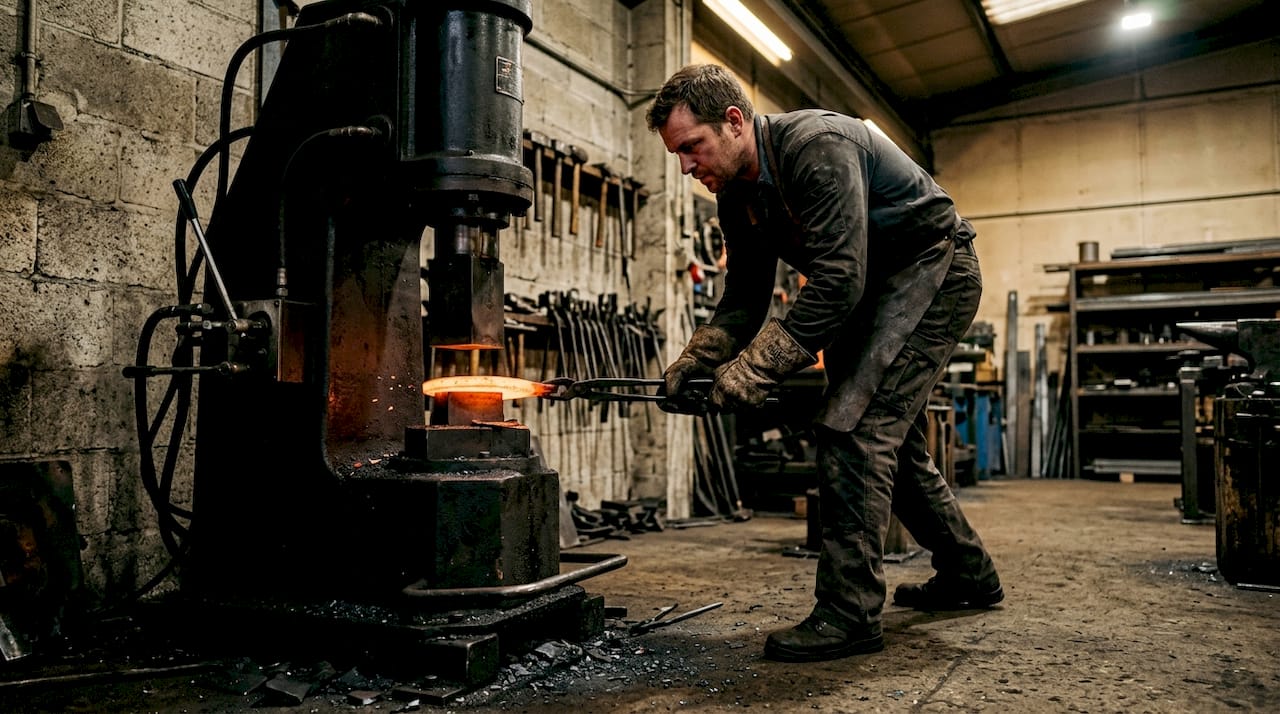
This is fundamentally different from stamping and casting. Stamped pans are cut from thin sheet metal and pressed cold into shape. They are faster and cheaper to produce, but the metal is not compressed, so the grain structure remains loose. Forged pans resist warping far better than stamped alternatives because the forging process compresses the metal grains and improves structural integrity.
Cast pans, including traditional cast iron, are made by pouring molten metal into a mould. Casting can produce complex shapes, but it also introduces air pockets and uneven density. Forged cookware has no air pockets, which means heat travels through the metal more uniformly and cooking results are more consistent.
Key differences at a glance:
- Stamped cookware: thin, light, prone to warping, lower cost
- Cast cookware: heavy, can have air pockets, slower to heat, brittle if dropped
- Forged cookware: dense, uniform thickness, warp-resistant, excellent heat conduction
Pro Tip: When comparing pans in a shop, press your thumb firmly on the base of a stamped pan and a forged pan. The forged pan will feel noticeably more solid and rigid, even if the two pans look similar from the outside.
The industrial forging process behind quality cookware is more precise than most home cooks realise. Brass-steel’s carbon steel pans are forged to 3mm and 4mm thickness, which gives them the thermal mass to hold heat during a sear without the brittleness of cast iron.
What types of one-sheet forged cookware are available?
Forged cookware types are defined primarily by their base metal. The two most common are carbon steel and forged aluminium, each with distinct cooking characteristics.
| Material | Weight | Heat-Up Speed | Heat Retention | Best For |
|---|---|---|---|---|
| Carbon steel | Medium | Fast | High | Searing, frying, oven use |
| Forged aluminium | Light | Very fast | Moderate | Everyday cooking, sautéing |
| Forged stainless steel | Medium to heavy | Moderate | High | Acidic foods, long braises |
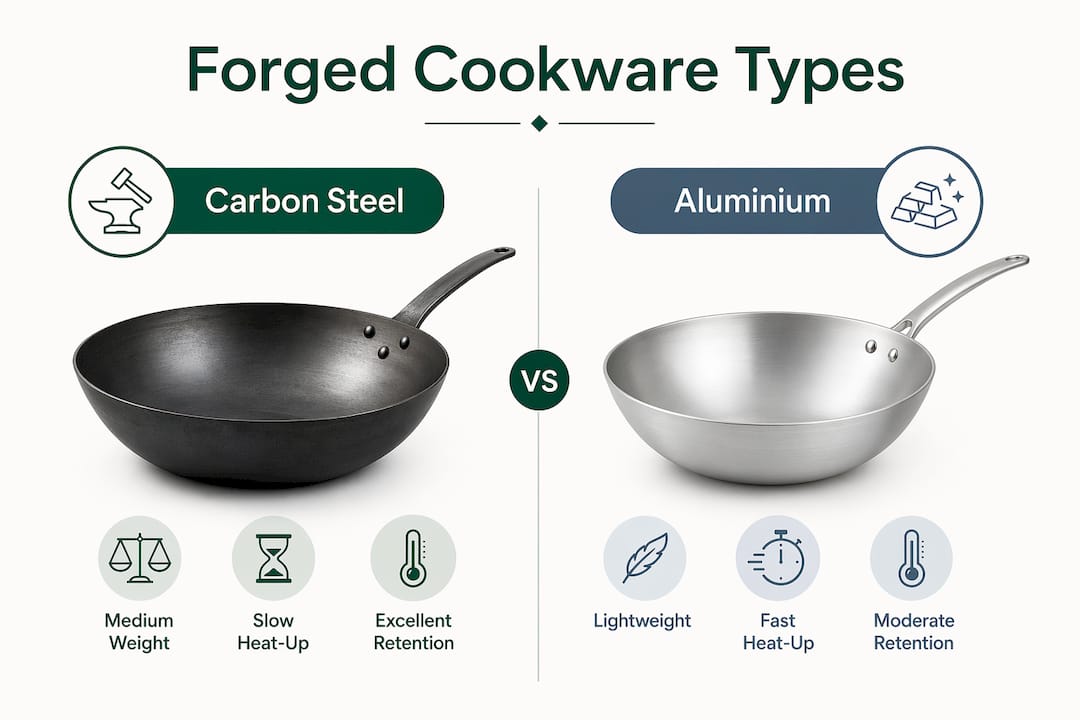
Carbon steel forged pans are the choice of professional kitchens worldwide. Carbon steel pans consist of approximately 90% iron and 10% carbon, with typical thicknesses ranging between 1.8mm and 3mm for hand-forged versions and up to 4mm for heavier production models. The slightly rough, hammered texture common on forged carbon steel assists heat circulation and reduces hotspots. Carbon steel also develops a natural patina through seasoning, which builds a non-stick cooking surface without any synthetic coating.
Forged aluminium pans take a different approach. Forged aluminium heats rapidly and evenly and is considerably lighter than cast iron, making it practical for cooks who want performance without weight. The forging process makes aluminium pans denser and more warp-resistant than their cast or stamped counterparts. Most forged aluminium pans come with a non-stick coating applied to the surface, which means they do not require seasoning but also do not develop the same long-term cooking character as carbon steel.
Forged stainless steel is less common in single-piece construction but exists in premium cookware lines. It handles acidic ingredients without reactivity and does not require seasoning, though it lacks the natural non-stick properties of a well-seasoned carbon steel pan.
For serious home cooks, carbon steel forged pans offer the best combination of performance, longevity, and cooking character. The forged vs stamped comparison consistently favours forged construction for daily use.
What are the key benefits of one-sheet forged cookware?
The benefits of single-piece forged construction are practical and measurable, not just marketing language.
-
Warp resistance. Forging compresses metal grains, which makes the pan structurally stable under high heat. A stamped pan can warp after repeated high-heat cooking. A forged pan holds its shape for decades.
-
Even heat distribution. Forged pans heat more evenly than stamped or cast options, with no air pockets to create cold spots. This means you get consistent browning across the entire cooking surface, not just in the centre.
-
Natural non-stick surface. Carbon steel forged pans build a patina through seasoning. Seasoning creates a durable layer that reduces sticking, prevents rust, and improves flavour development over time. The pan genuinely gets better the more you cook with it.
-
No synthetic coatings. Brass-steel pans are free from PTFE and PFOA. There is no coating to chip, flake, or degrade at high temperatures. This matters for cooks who want to sear at 250°C or finish a pan in a hot oven.
-
Versatility across heat sources. Forged pans perform well on induction and gas stovetops when the base is flat and magnetic. Brass-steel’s carbon steel pans work on all cooktop types, including induction, and go straight from hob to oven.
-
Long-term value. Forged cookware is preferred by professional chefs for its thermal stability and reliability under daily kitchen stress. A well-maintained forged carbon steel pan can last a lifetime.
Pro Tip: The first few months of cooking with a forged carbon steel pan are the most important. Cook fatty foods like bacon, sausages, and fried eggs regularly during this period. Each cook adds to the patina and builds the non-stick surface faster than seasoning alone.
How do you care for and cook with forged carbon steel pans?
Getting the best from a forged carbon steel pan starts before you cook anything. The pan needs to be seasoned first, and that process is straightforward.
Initial seasoning steps:
- Wash the new pan with warm, soapy water to remove the protective oil applied during shipping.
- Dry it completely, then place it in an oven preheated to 250°C for 10 minutes to drive off any remaining moisture.
- Apply a very thin coat of a high-smoke-point oil such as grapeseed, avocado, sunflower, or canola oil.
- Wipe off nearly all the oil so the pan looks almost dry.
- Bake the pan upside down for 30 minutes, then repeat this process two or three times to build a solid base seasoning.
Ongoing care is simple:
- Clean with warm water after each use. Avoid soaking the pan or leaving it wet.
- Dry immediately and apply a light coat of oil before storing.
- Cook fatty foods regularly to strengthen the patina over time.
- If the surface becomes sticky or dull, scrub it back and re-season from scratch.
- Avoid sudden temperature changes, such as running a hot pan under cold water, as this can cause warping.
For cooking technique, forged carbon steel responds quickly to heat changes. Start on a medium heat and let the pan warm gradually before adding oil. This prevents thermal shock and helps the pan heat evenly across the base. Once the oil shimmers, the pan is ready. Searing works best at high heat with a dry surface on the food. Sautéing works well at medium to high heat with a small amount of oil or fat.
The patina on a carbon steel pan is not just cosmetic. It is a functional cooking surface that develops flavour and reduces sticking with every use. Treat it well and it will outlast any non-stick coating on the market.
Key takeaways
One-sheet forged cookware outperforms stamped and cast alternatives because the forging process creates a denser, more uniform metal structure that resists warping, distributes heat evenly, and improves with use.
| Point | Details |
|---|---|
| Single-piece construction | No rivets or welds means no weak points and easier cleaning. |
| Superior heat distribution | Forged pans have no air pockets, so heat spreads evenly across the entire surface. |
| Natural non-stick patina | Carbon steel builds a durable cooking layer through seasoning that improves over time. |
| Warp resistance | Compressed metal grains from forging make the pan structurally stable under high heat. |
| Versatile compatibility | Forged carbon steel works on all cooktops, including induction, and in the oven. |
Why i think forged carbon steel is the most honest cookware you can buy
I have cooked on non-stick pans, cast iron, stainless steel, and forged carbon steel. The honest truth is that most non-stick pans are a short-term convenience that eventually lets you down. The coating degrades, you replace the pan, and the cycle repeats. Cast iron is wonderful but unforgiving. It is heavy, slow to heat, and cracks if you drop it.
Forged carbon steel sits in a different category entirely. The first month with a new pan can feel awkward. Eggs stick, the surface looks patchy, and you wonder if you made a mistake. Push through that period and the pan transforms. By month three, you are cooking eggs with almost no oil. By month six, the pan is the one you reach for every single day.
What I find most compelling about single-piece forged construction is that it removes every compromise. There is no handle that wobbles, no coating that chips, and no base that warps. The pan you buy is the pan you will still be using in twenty years, and it will cook better then than it does now. That is a genuinely rare thing in a market full of disposable cookware.
The advantages of forged pans for professional chefs are the same advantages that matter at home: reliability, consistency, and a pan that rewards you for using it properly.
— Davide
Explore forged carbon steel pans from Brass-steel
If you are ready to move away from coated pans and invest in something that genuinely lasts, Brass-steel’s forged carbon steel sauté pans are worth a close look.
Brass-steel forges each pan in one piece from carbon steel in Jarocin, Poland, with no rivets, no welds, and no synthetic coatings. The 27 cm pan at €99 suits everyday cooking, and the 30 cm pan at €119 handles larger meals and family cooking with ease. Both are induction compatible and oven safe. Browse the full range and find detailed care guides at Brass-steel’s cookware shop. If you want to go deeper on the science, the forged cookware benefits guide covers everything from heat distribution to patina development.
FAQ
What does “one-sheet forged cookware” mean?
One-sheet forged cookware is a pan or pot formed from a single solid piece of metal that is shaped under high pressure, with no welds, rivets, or joined parts. The industry term for this manufacturing method is forging or die forging.
How does forged cookware differ from cast iron?
Forged cookware is shaped by pressing solid metal under pressure, while cast iron is made by pouring molten metal into a mould. Forged carbon steel is lighter, heats faster, and is less brittle than cast iron, though both develop a natural non-stick surface through seasoning.
Do forged carbon steel pans work on induction hobs?
Yes. Forged carbon steel pans with a flat magnetic base are fully compatible with induction hobs. Brass-steel’s pans work on all cooktop types, including induction, gas, and electric.
How long does it take to season a forged carbon steel pan?
The initial seasoning takes around two hours and requires two to three rounds of oiling and baking at 250°C. A strong, functional patina develops over the first few weeks of regular cooking.
Is forged cookware worth the higher price compared to stamped pans?
Forged cookware costs more upfront because the manufacturing process is more involved, but it lasts significantly longer and performs more consistently. A quality forged carbon steel pan can last decades, making the cost per use far lower than replacing stamped pans every few years.