Industrial forging process: how cookware is really made
TL;DR:
- Forged cookware undergoes a complex metal restructuring process that enhances durability, heat distribution, and warp resistance. Understanding the manufacturing steps reveals that forging creates thicker, denser pans with aligned grain structures, offering superior performance over pressed alternatives. Choosing forged cookware ensures more consistent cooking results and longer-lasting kitchen tools.
Most cooks assume a pan’s quality comes down to its coating or material. Few think about what happens to the metal before it ever reaches a kitchen. The industrial forging process for cookware, more precisely known as drop forging or closed-die forging in manufacturing terms, is far more than a shaping step. It reorganises the metal at a molecular level, producing cookware that heats more evenly, resists warping, and lasts decades rather than years. Understanding how this works changes the way you select, use, and maintain every pan in your kitchen.
Table of Contents
- Key takeaways
- The industrial forging process in cookware manufacturing
- How forging transforms a blank into a finished pan
- Forged vs pressed cookware: what actually differs
- Practical benefits of forged cookware in the kitchen
- Why forging knowledge changes how you cook
- Brass-steel: forged cookware built for serious cooking
- FAQ
Key takeaways
| Point | Details |
|---|---|
| Forging changes the metal’s structure | Compression under high force densifies the grain, improving heat distribution and warp resistance. |
| Pre-forging prep is critical | Casting, rolling, and annealing the blank before forging determines the final pan’s quality and formability. |
| Forged outperforms pressed | Forged cookware typically has walls of 3 to 6 mm versus 2 to 3 mm in pressed pans, yielding superior durability. |
| Quality checks prevent downstream failure | Rim control and thickness consistency during forging prevent defects that affect coating and lid fit later. |
| The process justifies the price | Forged cookware costs more to produce but delivers longevity and cooking consistency that pressed pans cannot match. |
The industrial forging process in cookware manufacturing
To understand why forging matters, you first need to understand what happens to aluminium or carbon steel long before the press ever touches it. The metallurgical preparation of a blank involves casting, homogenisation, hot rolling between 400 and 500°C, cold rolling with annealing cycles, and precision blanking. Each stage has a direct effect on the final pan you cook with.
Casting produces an aluminium ingot, but that ingot is far from uniform. Homogenisation at high temperature redistributes alloying elements and eliminates chemical segregation. Hot rolling then reduces the ingot to sheet form while also refining the grain structure. Cold rolling brings the sheet to its final thickness with tight dimensional tolerances. Annealing between cold rolling passes relieves internal stress and keeps the metal soft enough to form without cracking.
- Casting: Produces the initial ingot from molten aluminium alloy.
- Homogenisation: Equalises the microstructure and reduces segregation.
- Hot rolling: Refines grain and reduces thickness at 400 to 500°C.
- Cold rolling and annealing: Achieves final sheet thickness with controlled residual stress.
- Blanking: Precision-cuts circular discs ready for the forging press.
Grain structure at the blanking stage is everything. If the grains are coarse or the residual stress is too high, the blank will crack or warp during forging. Managing these microstructure properties through disciplined rolling and annealing is what separates reliable production from inconsistent results.
Pro Tip: When evaluating cookware quality, ask manufacturers about their blank specification. A consistent blank thickness with controlled grain structure is a strong indicator of a well-run forging process.
How forging transforms a blank into a finished pan
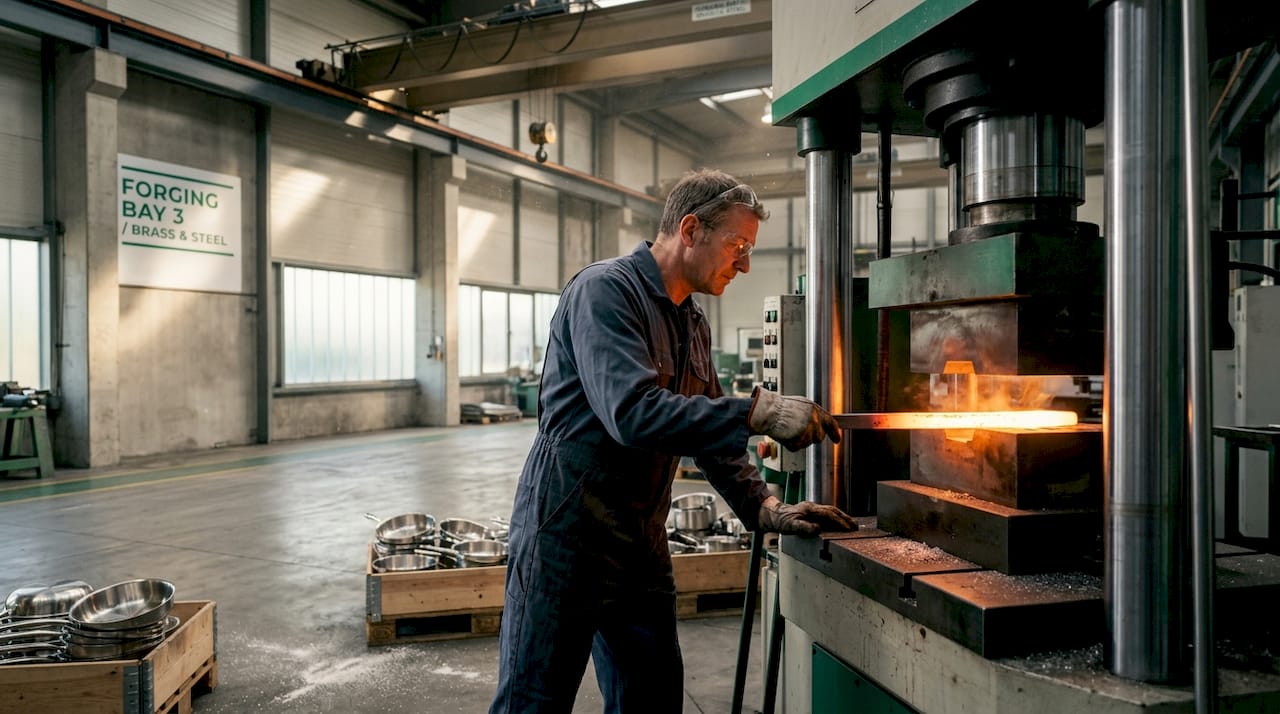
The forging press is where the real transformation happens. A solid aluminium or carbon steel disc is placed into a die set, and the press closes with thousands of tons of force, compressing the metal into the exact shape of the die cavity. This is closed-die forging, and it is nothing like pressing or stamping.
Here is how the process unfolds step by step:
- Blank placement: The pre-heated blank is positioned centrally in the lower die.
- Press closure: The upper die descends, applying massive compressive force. The metal flows to fill the die cavity completely.
- Grain realignment: Under pressure, the aluminium’s crystalline grain structure aligns along the pan’s contours rather than being cut across, as happens with machining.
- Densification: Air pockets and micro-voids in the original blank are eliminated. The resulting metal is denser and less porous, which directly improves heat conductivity.
- Flash removal: Excess material squeezed out at the die parting line is trimmed off.
- Trimming and correction: Edge and rim geometry are corrected immediately post-forging to prevent shape defects from compounding in later stages.
- Quality inspection: Wall thickness, base flatness, and rim condition are checked before the pan moves to machining and finishing.
The difference between forging and stamping is not subtle. Stamping cuts and bends sheet metal into shape, which severs the grain structure and leaves the metal’s internal organisation essentially random. Forging compresses and flows the metal, keeping grain continuity intact. That intact grain is why forged aluminium conducts heat more evenly and holds its shape under repeated thermal cycling.
Pro Tip: A pan that warps after a few months of heavy use was almost certainly stamped, not forged. Base flatness is one of the first things to check when buying: a forged pan sits dead flat on any hob, including induction.
The quality checkpoints at step six and seven are not optional. Thickness consistency and rim control at the forming stage prevent defects from propagating into polishing, coating, and assembly. A defect caught at forging costs almost nothing to fix. A defect discovered at final assembly costs significantly more, and one that reaches the customer costs most of all.
Forged vs pressed cookware: what actually differs
The comparison between forged and pressed aluminium cookware comes down to five characteristics that matter directly to how you cook.
| Feature | Forged aluminium | Pressed aluminium |
|---|---|---|
| Wall thickness | 3 to 6 mm | 2 to 3 mm |
| Internal grain structure | Continuous, aligned | Random, cut |
| Heat distribution | Even, fewer hotspots | More variable |
| Warp resistance | High | Lower |
| Typical cost | Higher | Lower |
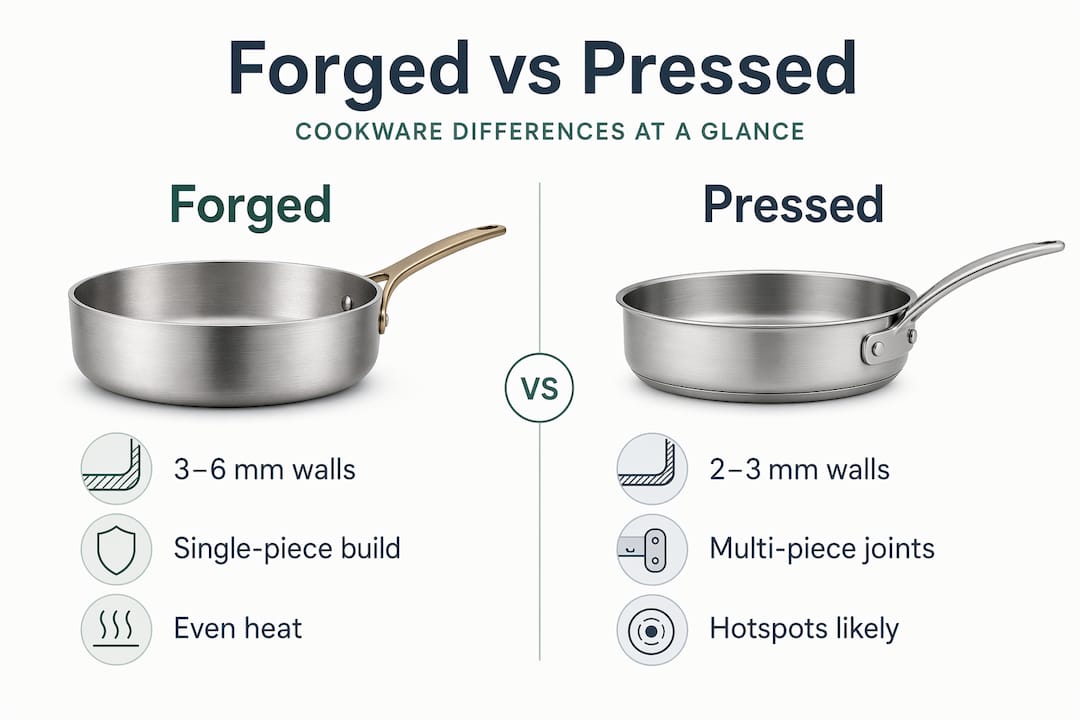
Forged pans are thicker and denser by design, not by accident. The extra thickness comes directly from the volume of metal displaced and compressed during forging. Pressed pans are made from sheet stock of a set thickness, and that thickness is the ceiling. Forged pans can achieve wall uniformity across the base and sides because the metal flows to fill the die, rather than being stretched.
In practice, this matters in the following ways:
- Even heat means proteins cook consistently across the whole pan surface, not just in the centre.
- Warp resistance means the pan continues to sit flat on the hob after years of thermal cycling between cold and high heat.
- Thicker walls provide greater thermal resilience under intensive use, which is why professional kitchens favour forged pans.
- The higher purchase price of forged cookware is justified by longevity. A well-made forged pan will outlast several generations of pressed alternatives.
For a deeper breakdown of forged versus stamped pans, the differences extend into how each type performs over years of use, not just in the first few months.
Practical benefits of forged cookware in the kitchen
Knowing how forged cookware is made is interesting. Understanding what it means when you are standing at the stove is useful. Here is where the manufacturing process connects directly to your cooking results.
Forged cookware’s denser microstructure produces more even heat conduction, which reduces the hotspots that cause uneven browning or scorched sauces. When you sear a piece of fish, the whole base needs to be at the right temperature. A pan with variable thickness or a compromised grain structure will betray you at the edges or around the handle junction.
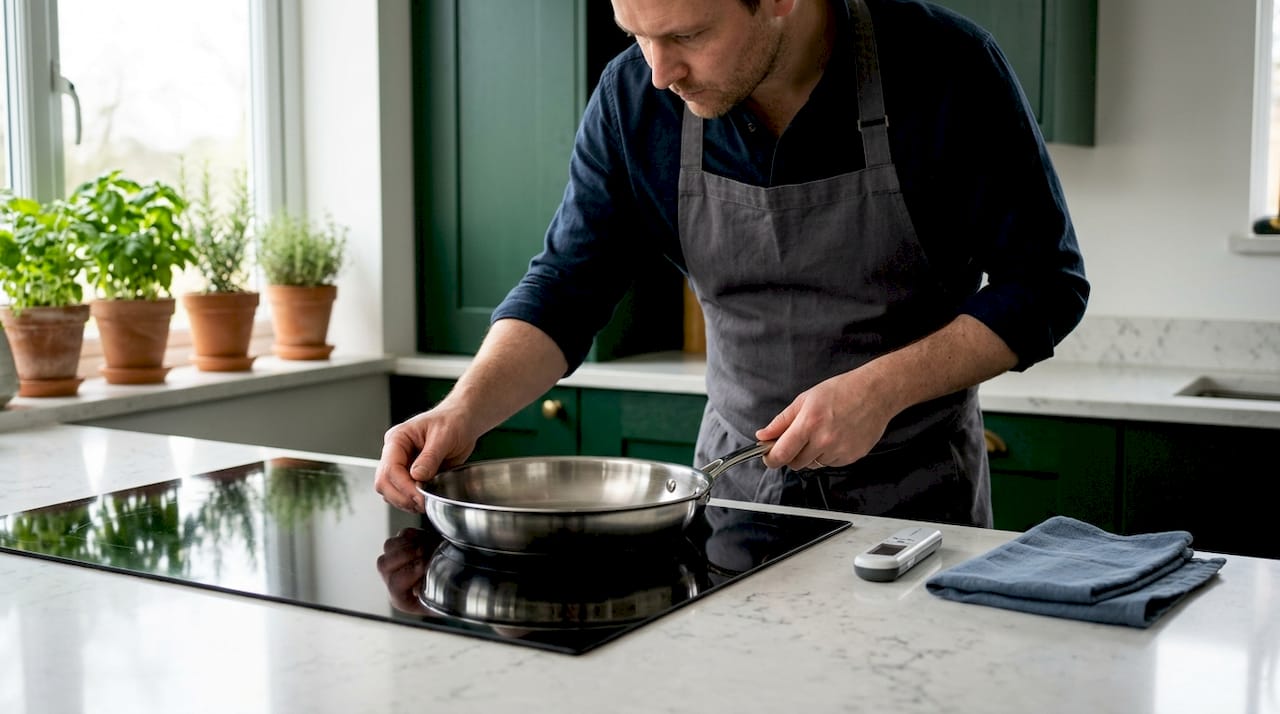
Shape stability is another advantage that cooks often overlook until they lose it. A warped pan loses contact with the hob surface. On induction, this causes flickering power delivery. On gas, you get uneven heat. On a flat ceramic hob, a warped pan becomes genuinely dangerous. Forging’s resistance to thermal deformation keeps the base geometry consistent even after thousands of heating and cooling cycles.
In commercial kitchens, pans live a brutal life. They go from cold storage into high heat, from hob to oven to cold water, often within minutes. Forged cookware withstands this kind of thermal shock because its denser structure absorbs and distributes stress more effectively. Forged cookware’s geometry also affects how lids fit, how pans stack, and how consistently they perform service after service.
A few practical points worth keeping in mind:
- Season forged carbon steel pans correctly from the start. The dense base holds seasoning more uniformly than thinner alternatives.
- Avoid sudden temperature changes where possible. Even forged metal benefits from gradual heating, especially from cold.
- Clean forged carbon steel with warm water and a brush. The dense surface does not need aggressive scrubbing.
- Re-season whenever the surface looks dull. The benefits of forged cookware compound over time as the seasoning layer builds on a stable base.
Why forging knowledge changes how you cook
I have spent years watching how cooks choose and use their pans, and the pattern is almost always the same. A cook buys a pan based on brand recognition or marketing, struggles with uneven cooking or warping after a year, and assumes it is their technique at fault. It rarely is. It is the pan.
What I have learned from visiting manufacturers and working with culinary professionals is that forging quality correlates directly with cooking consistency over time. A forged pan does not just perform better on day one. It performs more consistently on day five hundred. That is the real value, and it is invisible on the shop shelf.
The misconception I encounter most often is that all heavy pans are the same. Weight alone tells you nothing about whether a pan was forged or pressed. A pressed pan can be made heavy by simply using thicker sheet stock, but the grain structure remains cut and random. The result is still variable heat distribution and premature warping. What you are looking for is weight combined with verified forging, which you can confirm by asking the manufacturer or checking the product specification directly.
My advice: look past the coating and the colour. Ask how the pan was made. If a brand cannot tell you clearly that their pans are forged under pressure in a closed die, they probably were not. The forging process behind quality cookware is something reputable manufacturers are proud to explain in detail. That transparency is itself a quality signal.
— Davide
Brass-steel: forged cookware built for serious cooking
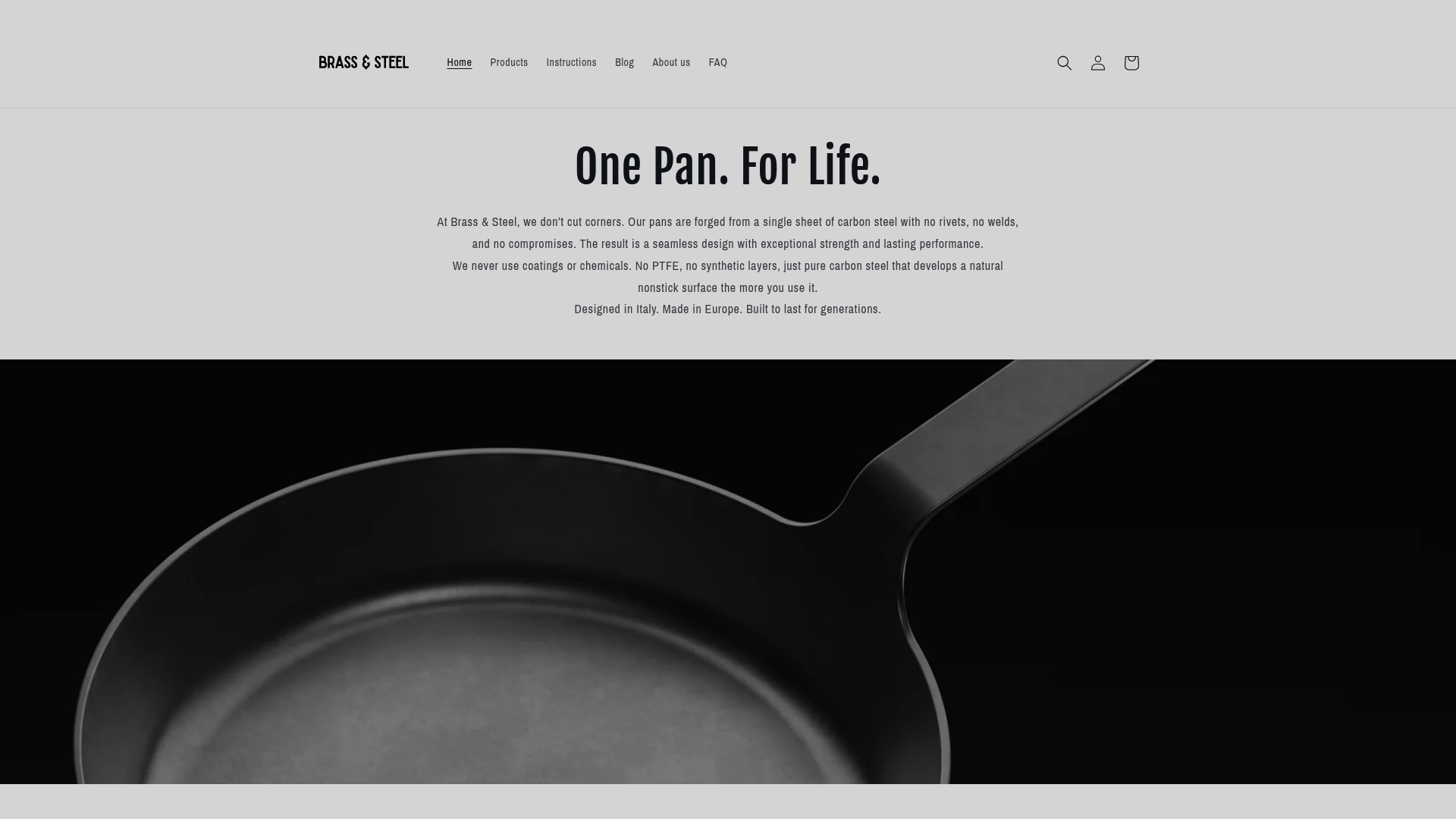
Brass-steel builds its carbon steel pans using single-piece forging in Jarocin, Poland, which eliminates rivets, welds, and weak points entirely. Each pan is forged from one carbon steel sheet, producing a dense, stable base that heats evenly and holds seasoning reliably over years of heavy use. The 27 cm sauté pan at 3 mm thickness and the 30 cm version at 4 mm cover the range from daily home cooking to professional kitchen demands. Both are free from PTFE, PFOA, and synthetic coatings, and both work on every hob including induction. If you want cookware where the manufacturing process is the quality guarantee, explore the Brass-steel range and see how forging translates into real cooking performance.
FAQ
What is the industrial forging process for cookware?
Closed-die forging applies thousands of tons of compressive force to a metal blank, which densifies the grain structure, eliminates internal voids, and produces cookware with even heat distribution and strong warp resistance.
How does forging differ from pressing or stamping in cookware production?
Stamping cuts and bends sheet metal, leaving the grain structure random and interrupted. Forging compresses and flows the metal under pressure, maintaining grain continuity and creating a denser, more durable final product.
Why does forged cookware resist warping better than pressed alternatives?
The denser microstructure produced by forging distributes thermal stress more evenly across the pan base, preventing the distortion that occurs when thinner, less dense pressed metal heats and cools repeatedly.
What wall thickness should I look for in a forged pan?
Forged cookware typically has walls between 3 and 6 mm. Anything below 3 mm in a pan claiming to be forged warrants closer inspection, as pressed pans often fall in the 2 to 3 mm range.
Does the pre-forging metallurgical preparation affect cooking performance?
Yes. Precise control of hot rolling, annealing, and blanking determines grain uniformity before the press ever closes. A blank with coarse or stressed grain structure will produce inconsistent cookware regardless of how well the forging step itself is performed.