

Forged aluminium cookware: strength, safety, and real benefits
TL;DR:
- Forged aluminium has a denser, more uniform structure that resists warping and flatters cooking performance.
- It offers better durability, even heat distribution, and safety compared to cast or stamped aluminium pans.
- Proper care extends the lifespan of forged aluminium cookware, making it a cost-effective choice over time.
Aluminium pans have a reputation problem. Mention them to a serious home cook and you’ll often hear the same complaints: warping, uneven heating, flimsy construction. Yet this view misses something important. Not all aluminium cookware is built the same way, and forged aluminium sits in an entirely different category from the thin, pressed pans sold in supermarkets. Understanding the difference between manufacturing methods reveals why forged aluminium has quietly become one of the most practical, health-conscious choices for modern European kitchens, and why dismissing it based on outdated assumptions means missing out on a genuinely capable cooking tool.
Table of Contents
- What does ‘forged aluminium’ mean?
- Forged vs other cookware types: what really makes a difference?
- Is forged aluminium cookware safe and healthy?
- Choosing and caring for forged aluminium cookware
- Our perspective: why forged aluminium cookware deserves a second look
- Explore quality forged aluminium cookware with Brass & Steel
- Frequently asked questions
Key Takeaways
| Point | Details |
|---|---|
| Superior durability | Forged aluminium cookware is stronger and less likely to warp than cast options. |
| Even heat distribution | Its dense structure promotes uniform cooking for better meal results. |
| Enhanced safety | Fewer pores mean less risk of food residue, bacteria, or leaching into meals. |
| Low-maintenance care | Proper use and cleaning help forged aluminium pans last for years. |
What does ‘forged aluminium’ mean?
Once you know the problem with ordinary aluminium pans, it’s time to see why forged aluminium stands apart.
Forging is a manufacturing process in which raw aluminium is heated and then pressed or hammered under enormous pressure into a final shape. This is fundamentally different from casting, where molten metal is simply poured into a mould and left to solidify, or stamping, where flat sheets of aluminium are pressed into shape at room temperature. The pressure applied during forging compacts the metal’s internal grain structure, producing a material that is denser and more uniform throughout.
Understanding how forging works is useful because the physical differences translate directly into cooking performance. A forged pan is harder, less likely to flex under heat, and holds its shape far better over years of use. According to materials research, forging produces denser metal with fewer internal weaknesses compared to casting or stamping. For home cooks, this means a pan that heats evenly, sits flat on the hob, and does not develop annoying hot spots over time.
The forged cookware basics are worth knowing for anyone who has ever dealt with a cheap pan that rocks on the burner or scorches food in the centre while leaving the edges cold. Both problems stem from inconsistent metal density. Forging largely eliminates them.
Here is what differentiates forged aluminium from other methods:
- Cast aluminium is poured into moulds and tends to have a porous, less uniform structure that can weaken over time.
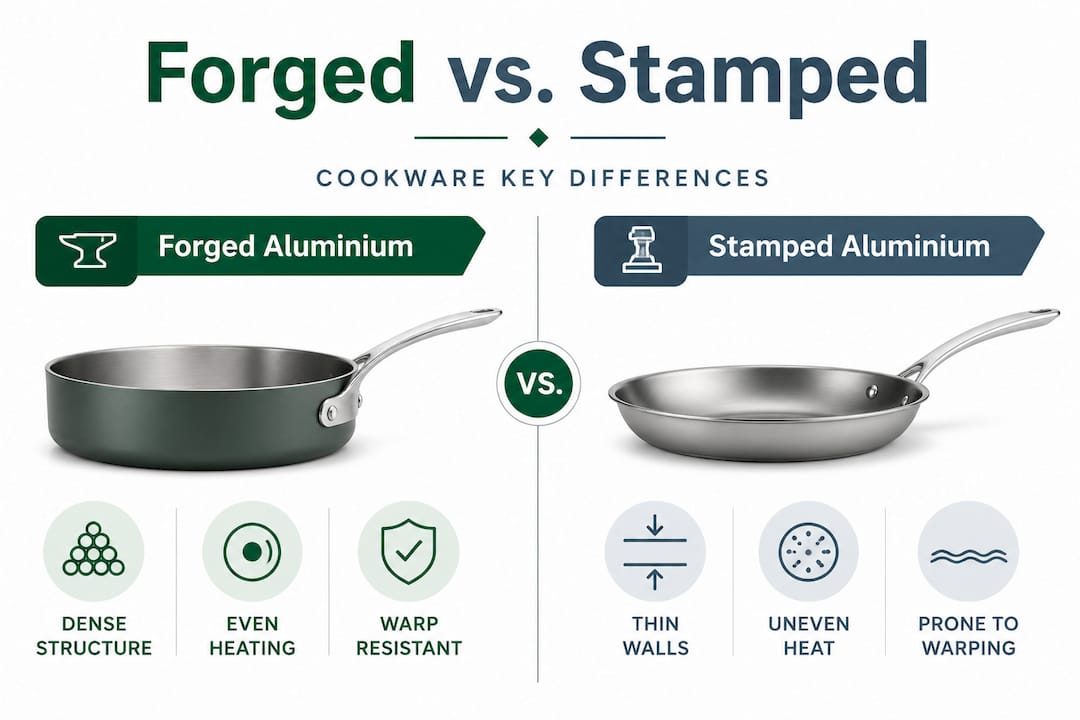
- Stamped aluminium is fast and cheap to produce but results in thin, flexible pans that warp easily under high heat.
- Forged aluminium is compacted under pressure, producing a denser, harder pan with superior structural integrity and flat, stable bases.
“Forging creates a denser, more uniform metal structure, reducing warping and improving overall durability compared to other manufacturing methods.”
This is not just engineering theory. In a practical kitchen context, it means you can preheat a forged aluminium pan confidently, use it at higher temperatures, and trust that it will sit flat on your hob whether you are using gas, ceramic, or electric.
Forged vs other cookware types: what really makes a difference?
Understanding different manufacturing methods makes it easier to judge why forged aluminium offers key advantages.
The cookware market is crowded, and it can be genuinely difficult to work out why one pan costs twice as much as another. The table below breaks down the key differences between the most common cookware types based on structure, durability, heat distribution, weight, price point, and health implications.
| Feature | Forged aluminium | Cast aluminium | Stamped aluminium | Stainless steel | Ceramic coated |
|---|---|---|---|---|---|
| Structure | Dense, uniform | Porous, heavier | Thin, inconsistent | Solid layers | Varies widely |
| Durability | High | Moderate | Low | Very high | Moderate |
| Heat distribution | Excellent | Good | Poor | Average | Good |
| Weight | Medium | Heavy | Light | Heavy | Light to medium |
| Price | Mid to high | Mid | Low | Mid to high | Low to mid |
| Health impact | Safe, stable surface | Generally safe | Risk of warping, leaching | Very safe | Coating can chip |
The aluminium vs stainless steel guide explores these differences in more detail, but for everyday cooking, forged aluminium’s combination of heat distribution and structural strength is hard to beat.
When comparing forged aluminium to stamped versions, the difference becomes even clearer. Research confirms that forged aluminium offers better strength and reduced warping because its internal grain structure is far more tightly packed. The forged vs stamped comparison shows that this structural advantage plays out in daily cooking, from how quickly the pan recovers heat after adding cold food to how evenly a sauce reduces around the edges.
Ceramic pans look appealing because they are lightweight and come in attractive colours. However, the coating is often the weak point. It chips, scratches, and degrades faster than many buyers expect, particularly if the pan is used at high temperatures regularly. Stainless steel is extremely durable and safe, but it requires fat or liquid to prevent sticking and does not match aluminium’s speed of heat uptake.
Pro Tip: If you frequently cook on a ceramic or electric hob where heat control is less precise, forged aluminium’s even distribution makes it much more forgiving than stainless steel, which can create hot spots without the conductivity boost that aluminium provides.
Is forged aluminium cookware safe and healthy?
With clarity on the physical and performance benefits, it’s natural to ask how this affects safety in real kitchens.
Health concerns about aluminium cookware have circulated for decades. Most of these concerns relate to thin, poorly made pans where the surface degrades under heat or acidic food, potentially releasing trace amounts of metal into meals. Forged aluminium addresses these concerns through its structural properties, not through chemical coatings or non-stick treatments.
Here are the three main safety advantages that forged aluminium offers:
-
Denser structure, fewer surface flaws. The forging process compresses the aluminium, leaving far fewer microscopic pores or voids in the metal. Research shows that denser forged aluminium has fewer pores that can trap bacteria or food residues, which is a meaningful hygiene advantage in a busy kitchen.
-
Greater resistance to warping. When a pan warps, its non-stick or protective coating is often the first casualty. Cracks and bubbles in the coating create areas where food residues collect and where the base metal is directly exposed. Forged aluminium’s resistance to warping means the cooking surface stays intact for far longer.
-
Stable coating adhesion. Because the surface is denser and more uniform, any coating applied to a forged aluminium pan adheres more consistently and durably. This means fewer risks of chipping or flaking into food over time.
The safe cookware advice for European kitchens consistently points toward choosing pans where the cooking surface is both hygienic and stable under heat. Forged aluminium delivers both when bought from a reputable manufacturer.
It is also worth knowing that aluminium is an excellent conductor of heat, roughly three times more efficient than stainless steel. This efficiency means you can often use lower heat settings to achieve the same cooking result, which reduces the risk of overheating any coating and extends the pan’s working life. For anyone comparing materials, the performance and health impact of different metals is a practical place to start.
One important caveat: forged aluminium pans with non-stick coatings should still be treated with care. Avoid using metal utensils, do not overheat an empty pan, and follow the manufacturer’s guidance on temperature limits. The forging process makes the pan more robust, but it does not make a coating indestructible.
Choosing and caring for forged aluminium cookware
Now, with safety and performance explained, let’s get into using and protecting your investment.
Buying a genuinely forged aluminium pan rather than a stamped pan with similar branding requires a little attention at the point of purchase. The benefits guide outlines what separates quality forged cookware from imitators, and the buyers’ tips are worth reading before you spend.
Research confirms that a denser, stronger pan is less likely to warp or suffer from uneven cooking. Here is what to look for when choosing a forged aluminium pan:
- Weight for its size. A forged pan should feel noticeably heavier than a stamped equivalent of the same dimensions, because the metal is denser throughout.
- Flat, stable base. Place it on a flat surface. There should be no rocking. Even a slight warp signals poor manufacturing or thin material.
- Uniform thickness. Run your fingers around the inside edge. The walls should taper very little from base to rim.
- Quality handle attachment. Look for handles that are part of the body or attached without rivets that can loosen over time.
- Clear manufacturer information. Reputable brands are transparent about the gauge of aluminium used and the type of coating applied.
Caring for forged aluminium correctly will extend its life significantly. The core principles are straightforward:
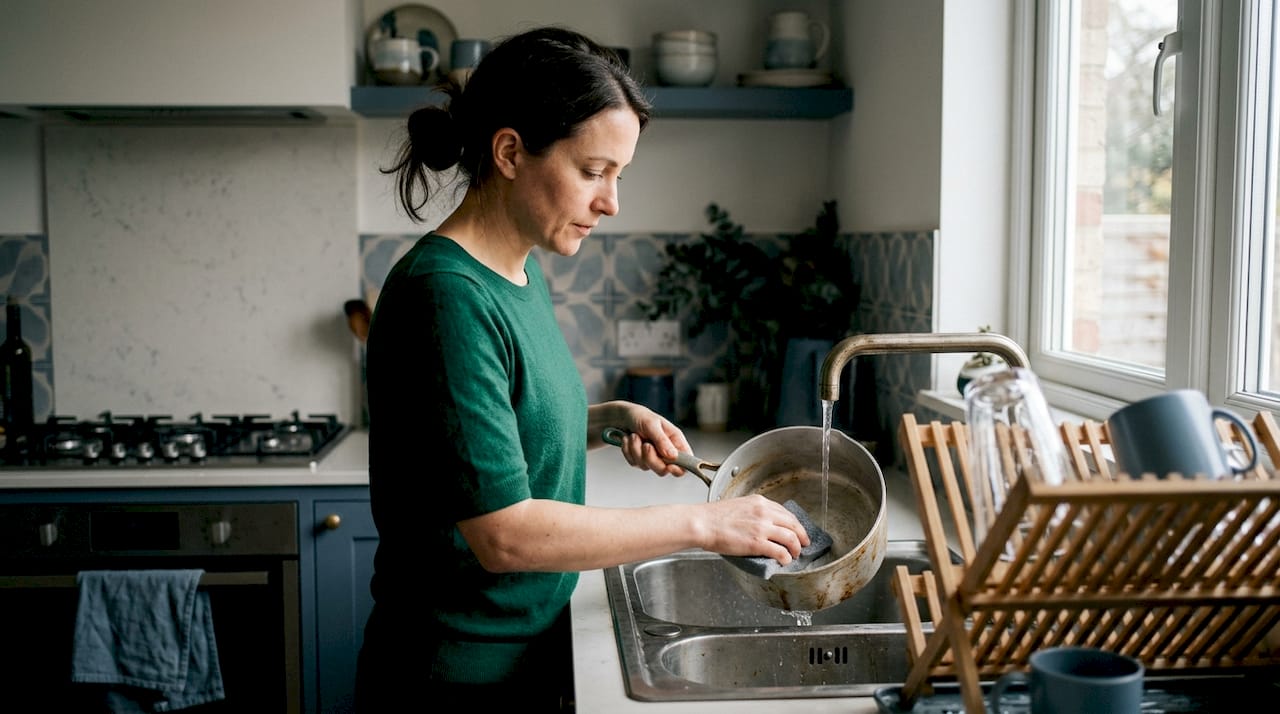
- Wash by hand with warm water and a mild detergent after each use. Dishwashers are harsher than they seem and can degrade both the coating and the metal surface over repeated cycles.
- Dry the pan immediately after washing to prevent water spots and mineral deposits.
- Store it carefully so the cooking surface is not scratched by other pans. A pan protector or a folded cloth between stacked pans works well.
- Avoid sudden temperature changes, such as placing a very hot pan directly under cold running water. This thermal shock can stress even a dense, well-made pan.
Pro Tip: Never use steel wool or abrasive scrubbing pads on a forged aluminium pan. If food is stuck, soak the pan in warm water for ten minutes, then use a soft brush or non-abrasive sponge. Abrasive cleaning removes the surface layer unevenly and shortens the coating’s lifespan dramatically.
One common mistake is assuming that a more expensive forged pan needs no extra care. In fact, the quality of maintenance matters as much as the quality of manufacture. A well-made forged aluminium pan that is cared for properly will outlast a cheaper alternative many times over, and it will continue to cook evenly from its first year to its tenth.
Our perspective: why forged aluminium cookware deserves a second look
Forged aluminium sits in an awkward position in the cookware market. It is neither the cheapest option nor as well-known as stainless steel or ceramic, which means it often gets passed over by buyers who rely on brand recognition rather than performance data. This is a missed opportunity, and we think it happens for a specific reason: most cookware marketing focuses on surface finish rather than structural quality.
When shoppers compare pans in a shop or online, they tend to judge by appearance: the colour of the coating, the finish of the handle, the look of the brand. Structural density is invisible. You cannot see the forging process in a product photograph, and most retailers do not explain it. As a result, a genuinely superior forged pan and a cheaper stamped pan can look almost identical side by side, even though their actual cooking performance and lifespan differ enormously.
The argument made by professional chefs’ perspectives about forged cookware consistently returns to one point: reliability. A pan that heats evenly, stays flat, and maintains its surface does not require constant compensation. You cook the food, not the equipment.
There is also a question of value that rarely gets discussed honestly. A well-made forged aluminium pan costs more upfront than a stamped equivalent, but it lasts far longer and performs better throughout its life. When you factor in the cost of replacing cheap pans every two or three years, forged aluminium often works out more economical over a decade. This is the kind of calculation that becomes second nature to anyone who has cooked seriously for years, but it is rarely presented clearly to buyers choosing their first quality pan.
Forged aluminium is not the right choice for every cook or every kitchen. If you cook primarily acidic dishes such as tomato sauces or citrus-based reductions in the same pan repeatedly, stainless steel may be a better fit. But for everyday sautéing, searing, and general hob work, few materials combine heat performance, structural durability, and manageable weight as effectively. The pan that seems unremarkable on a shelf is often the one that earns its place on the hob every single day.
Explore quality forged aluminium cookware with Brass & Steel
If this article has helped you see forged aluminium cookware differently, then you’re already thinking about cooking the way we do at Brass & Steel. We believe that the right pan changes not just how food tastes but how confident you feel in the kitchen. Quality construction should not be a luxury reserved for professional chefs.
At Brass & Steel, our expertise centres on forged, single-piece cookware that is built to perform and built to last. Whether you are exploring your first serious upgrade from a supermarket pan or looking to understand which construction method suits your cooking style, our range and buying guides are designed to give you honest, practical answers. Browse the collection and take the next step towards cookware that works as hard as you do.
Frequently asked questions
Is forged aluminium cookware better than cast aluminium?
Forged aluminium has a denser structure that usually offers greater strength and resistance to warping compared to cast aluminium. Research confirms that forged aluminium is denser and more durable, making it the better long-term choice for most home cooks.
Does forged aluminium cookware work on induction hobs?
Standard forged aluminium lacks the magnetic properties needed for induction cooking, but some manufacturers add a specialised steel base plate that makes the pan fully induction compatible. Always check the product specifications before buying if you cook on induction.
Can forged aluminium pans go in the dishwasher?
Many forged aluminium pans are labelled dishwasher safe, but hand washing consistently preserves the non-stick coating and overall surface quality for considerably longer. A quick wash with warm water and a soft sponge is all that is needed after most cooking tasks.
Is food cooked in forged aluminium healthy?
Forged aluminium pans are safe for everyday cooking when used correctly, as their dense internal structure prevents the surface degradation that can lead to metal contact with food. Research confirms that denser forged aluminium is less likely to harbour residue or allow leaching under normal cooking conditions.
How long does forged aluminium cookware last?
With consistent, careful maintenance, a quality forged aluminium pan can remain in excellent condition for ten years or more. Its warp-resistant structure means the cooking surface stays flat and even long after cheaper stamped pans would have been replaced.
Recommended
- Forged aluminium cookware: benefits, process & key facts – Brass & Steel
- What is Forged Cookware? Understanding its Benefits and Use – Brass & Steel
- Aluminium pans vs stainless steel: safe cookware in 2026 – Brass & Steel
- Forged Cookware Benefits: Complete Guide for Cooks – Brass & Steel
- Best non slip mat for kitchen counter safety 2026 – Mats4U USA