Choosing the best pan for healthy, versatile cooking
TL;DR:
- Choosing a carbon steel pan promotes health, natural nonstick performance, and quick, precise heat response. Regular use and proper care build a durable patina, making it ideal for everyday home cooking, especially for searing and delicate foods. Top European brands like de Buyer, Matfer, and Merten & Storck offer reliable options suitable for various cooking styles.
Walk into any kitchenware shop and you’ll find dozens of pans promising everything from perfect sears to effortless cleanup, yet most fall short in at least one critical area. Choosing the wrong pan affects not just the quality of your meals but potentially your health, particularly if chemical coatings are involved. Carbon steel cuts through this confusion by offering genuine versatility, natural nonstick performance without synthetic coatings, and a durability that compounds with use. This guide breaks down exactly what to look for, how leading brands compare, and how to make a confident, informed choice for your kitchen.
Table of Contents
- How to evaluate the best pan for healthy, everyday cooking
- Top carbon steel pan brands and models for European kitchens
- How does carbon steel compare to other popular pan types?
- Practical tips for seasoning, care, and daily use
- Why most home cooks overcomplicate choosing a pan
- Find your perfect carbon steel pan
- Frequently asked questions
Key Takeaways
| Point | Details |
|---|---|
| Healthier nonstick surface | Seasoning carbon steel naturally builds a nonstick coating without chemicals. |
| Versatility for all cooking | Carbon steel handles sautéing, searing, and oven use, making it truly multi-purpose. |
| Light and responsive | Easier to handle than cast iron and heats quickly for precise cooking. |
| Care improves results | With proper seasoning and maintenance, your pan’s performance only gets better. |
| Top European brands | De Buyer, Matfer Bourgeat, and Mauviel offer quality pans for all skill levels. |
How to evaluate the best pan for healthy, everyday cooking
The most important question to ask when choosing a pan is not “which brand is most popular?” but rather “what am I actually cooking, and what am I willing to put into contact with my food?” That question immediately narrows the field considerably.
Health comes first. Many conventional nonstick pans rely on PTFE coatings, commonly known as Teflon, which can degrade at high temperatures and release harmful compounds. Carbon steel sidesteps this entirely. It develops a natural nonstick patina through oil polymerisation, a process where thin layers of oil bond to the surface under heat, building up a safe, non-toxic cooking layer. There are no PFAS or PFOA concerns, and the pan only gets better as the seasoning deepens. Understanding how carbon steel pans are made helps clarify why this material is so well suited to this kind of natural surface development.
Heat performance matters enormously. A pan that heats unevenly or responds sluggishly will consistently undermine your cooking, no matter how good your technique. Look for a pan that heats quickly, responds to temperature changes fast, and can sustain intense heat for searing without warping. Carbon steel is ideal for health-conscious cooks because it withstands temperatures above 1,200°F without releasing toxins, a threshold that PTFE coatings cannot safely reach.
Weight and handling are often underestimated. A 3mm carbon steel pan weighs roughly 2kg, which is noticeably lighter than a comparable cast iron pan. For techniques like sautéing, tossing vegetables, or flipping crêpes, this makes a real difference over the course of an evening spent cooking.
Key criteria to prioritise when evaluating any pan:
- No synthetic coatings or chemical nonstick treatments
- Responsive heat for both delicate and high-heat cooking
- Manageable weight for confident handling
- Compatible with your cooktop, including induction if needed
- Builds a better cooking surface with regular use rather than degrading
“The best pan you own is often the one you use most consistently. A carbon steel pan rewards regular cooking in a way that coated pans simply cannot.”
Pro Tip: To build seasoning faster on a new carbon steel pan, start with fatty foods like bacon, sausages, or a simple fried egg. The fat penetrates the steel surface and accelerates patina development in a way that lean proteins or vegetables cannot.
Top carbon steel pan brands and models for European kitchens
With the key criteria in mind, let’s look at how top brands stack up, so you can zero in on a pan that matches your needs.
Several established brands dominate the European carbon steel market, each with a distinct character. Knowing their individual strengths helps you choose wisely rather than defaulting to whichever appears first in a search result.
Matfer Bourgeat is a French manufacturer that has been producing professional cookware for decades. In rigorous testing, the Matfer Bourgeat carbon steel pan demonstrated even heat distribution with a centre-to-edge temperature difference of just 9°F, which is impressively consistent for steel. It is fully oven-safe with no temperature limit, making it a natural choice for cooks who move between stovetop and oven regularly. It performs best on gas, though it works across all cooktops.
de Buyer Mineral B is arguably the most recognisable carbon steel pan in Europe, and for good reason. It produces a superb Maillard reaction for searing steaks and chicken, and it comes with a beeswax coating on the interior that provides initial rust protection. Once you wash that off and begin proper seasoning, the pan is capable of extraordinary results. It is particularly popular in the UK and across continental Europe.
Mauviel M’Steel stands out for its lighter weight and larger usable cooking surface. In Serious Eats testing, it performed as top pick for crêpes and eggs due to its naturally smooth surface out of the box. If you regularly cook delicate foods like omelettes or thin pancakes, the M’Steel is worth serious consideration.
Merten & Storck is pre-seasoned from the factory, making it the most beginner-friendly option. It is a bestseller in the UK and widely available across European retailers, which matters if you want to buy and replace quickly. The pre-seasoning means you can start cooking straight away, though the long-term patina from a raw, unseasoned pan is generally considered superior.
Good carbon steel cookware care practices apply across all these brands. Whichever you choose, the investment is only realised if you maintain the pan correctly from the first use.
Who benefits most from each:
- Gas cookers who want professional-grade control: Matfer Bourgeat
- Searing enthusiasts and those who cook a lot of meat: de Buyer Mineral B
- Crêpe and egg specialists who need lightweight precision: Mauviel M’Steel
- Complete beginners transitioning from nonstick: Merten & Storck
“The best carbon steel pan is not necessarily the most expensive one. It is the one whose weight, size, and finish match what you actually cook week in, week out.”
How does carbon steel compare to other popular pan types?
Understanding the unique personality of these leading brands, it helps to see how carbon steel stands out from other classic pan materials.
Carbon steel, stainless steel, and cast iron are the three serious contenders for anyone moving away from coated cookware. Each has genuine strengths, but they are not interchangeable.
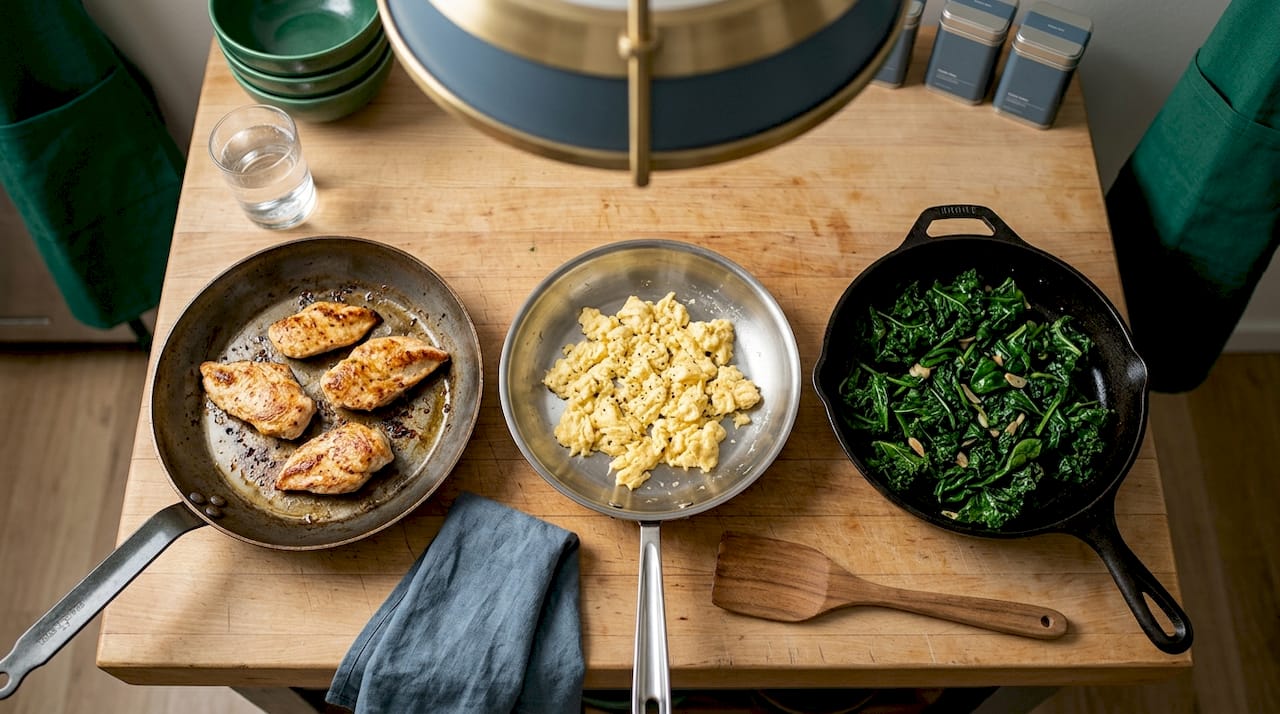
Carbon steel vs stainless steel: Carbon steel outperforms stainless at high-heat searing and develops a natural nonstick quality that stainless cannot replicate. Stainless steel is easier to clean and more resistant to damage from acids like tomato or wine, but food will stick without careful temperature management and the use of fat. Stainless is often the choice for braising and sauce work rather than searing.
Carbon steel vs cast iron: Cast iron has superior heat retention once up to temperature, making it excellent for tasks like deep frying or oven baking. Carbon steel, however, is significantly lighter, heats and cools more quickly, and responds better to temperature adjustments. In terms of heat responsiveness, carbon steel is the clear winner for stovetop cooking, particularly for anything involving tossing or quick adjustments.
The physics behind carbon steel pan performance explains why it sits so comfortably between these two extremes. With a
| Feature | Carbon steel | Stainless steel | Cast iron |
|---|---|---|---|
| Natural nonstick | Yes, builds with use | No | Yes, builds with use |
| Weight | Moderate | Light to moderate | Heavy |
| Heat responsiveness | Excellent | Good | Slow |
| Heat retention | Good | Moderate | Excellent |
| Induction compatible | Yes | Yes (most) | Yes |
| Oven safe | Yes, no limit | Yes | Yes |
| Maintenance required | Regular seasoning | Minimal | Regular seasoning |
| Best for | Searing, sautéing, eggs | Sauces, braising | Baking, frying |
The table above shows why carbon steel holds such a strong position for everyday home cooking. It covers the widest range of techniques without demanding specialist knowledge or accepting significant trade-offs.
Practical tips for seasoning, care, and daily use
With a clear sense of what sets carbon steel apart, your next step is mastering the basics of use and care for flawless results every time.
Proper care is not complicated, but it does require consistency. The good news is that every time you cook with a carbon steel pan, you are also maintaining it, as long as you use some fat in the process.
How to season your carbon steel pan from scratch:
- Wash the pan with warm, soapy water to remove any factory coating or protective oil
- Dry it completely, either with a cloth or briefly on a warm hob
- Preheat your oven to 250°C
- Place the pan in the oven for 10 minutes to ensure it is fully dry
- Apply a very thin coat of high-smoke-point oil such as grapeseed, avocado, sunflower, or canola
- Wipe away any excess so the pan looks almost dry, not shiny
- Bake the pan upside down for 30 minutes
- Allow it to cool and repeat the process two or three times for a strong base layer
The distinction between pre-seasoned and unseasoned pans matters here. Pre-seasoned pans from brands like Merten & Storck or OXO are ready to use immediately, which reduces the initial learning curve. However, pans you season yourself from raw steel can develop a deeper, more durable patina over time. It is a question of patience versus convenience.
For everyday maintenance and care, the rules are straightforward: hand wash only, dry immediately, and apply a very light coat of oil after each use. Never soak the pan or run it through a dishwasher. Avoid leaving it wet, as even brief exposure to standing water can cause surface rust.
Expert guidance also highlights that stovetop seasoning with oil only produces the best patina, and that cooking fatty meats first accelerates the process considerably. Bacon in a new pan is not just breakfast; it is a seasoning session.
Common mistakes to avoid:
- Using too much oil during seasoning, which creates a sticky residue rather than a smooth layer
- Cooking highly acidic foods like tomatoes before the patina is well established
- Leaving the pan on a gas burner without anything in it on very high heat for extended periods
- Forgetting to dry it thoroughly before storing, even for a few hours
Pro Tip: Follow the dedicated best practices for pan care guide and keep a dedicated carbon steel seasoning checklist on hand for the first few months until the routine becomes second nature.
Why most home cooks overcomplicate choosing a pan
Now that we have covered every angle of pan choice and care, it is worth pausing to rethink whether all the comparison is truly necessary.
The internet makes it easy to spend three weeks reading reviews, watching comparison videos, and debating millimetre differences in steel thickness before ever cooking a single meal. We understand the impulse. A pan feels like a serious purchase, and nobody wants to make the wrong call. But here is the honest truth: the vast majority of cooking decisions are made in the first thirty seconds of heating the pan, not during the purchasing process.
A straightforward carbon steel pan, seasoned correctly and used regularly, will outperform far more expensive and complex cookware in most everyday situations. The performance gap between a well-maintained carbon steel pan and a specialist alternative is almost always smaller than the gap between a well-maintained pan and a neglected one.
Professional cooks embrace carbon steel maintenance not because they enjoy extra work but because the resulting sear and nonstick quality rewards that effort with results that coated pans simply cannot match. Beginners tend to prefer pre-seasoned options, and that is a perfectly sensible place to start. What matters is that you start cooking.
Maintenance anxiety is overblown. Yes, you need to dry the pan and add a drop of oil. But this takes twenty seconds. Compare that to the cumulative cost and environmental impact of replacing coated pans every two or three years as the surface degrades. Carbon steel, cared for properly, lasts decades. Our upkeep tips for carbon steel make the routine straightforward even for complete beginners.
Choose the pan that matches your most common cooking tasks, buy once, cook often, and let the seasoning do the rest. You will spend far less time worrying about your pan and far more time enjoying what comes out of it.
Find your perfect carbon steel pan
Ready to put these tips into practice? The right pan and a consistent care routine make a measurable difference in your daily cooking, and choosing quality from the outset saves you from replacing inferior cookware down the line.
At Brass & Steel, we craft single-piece carbon steel pans forged without rivets or welds, designed for home cooks and professionals who want genuine performance without synthetic coatings. Our 27 cm and 30 cm carbon steel sauté pans are built to handle everything from delicate eggs to a full Sunday sear, and they work across all cooktops including induction. Pair your new pan with our expert carbon steel care resources, and you will be cooking with confidence from the very first session.
Frequently asked questions
What is the main advantage of carbon steel over stainless steel for cooking?
Carbon steel excels at high-heat searing and builds a natural nonstick surface over time, whereas stainless steel requires careful technique to prevent sticking and cannot develop the same nonstick quality.
How do I build a nonstick coating on a carbon steel pan?
Apply thin layers of oil and heat repeatedly, and cook fatty foods like bacon or eggs in the early weeks. This builds a natural nonstick patina through oil polymerisation without any synthetic coatings.
Are pre-seasoned carbon steel pans as good as unseasoned ones?
Pre-seasoned pans are ready to use immediately and suit beginners well, but unseasoned pans build a superior patina over time with proper care, resulting in a deeper and more durable nonstick layer.
What is the best way to clean and maintain a carbon steel pan?
Hand wash, dry immediately, and lightly oil after every use. Avoid dishwashers and prolonged soaking, which will damage the seasoning and encourage rust.
Which carbon steel pan brands are easy to buy in the UK and Europe?
De Buyer, Matfer, and Merten & Storck are all widely stocked across European and UK retailers, making them accessible choices for anyone looking to buy without waiting on international shipping.