Non-Toxic PFAS-Free Cookware: The Healthiest Pan
TL;DR: "Non-toxic" cookware is mostly a story about coatings. The chemicals people worry about, PFAS, PTFE (Teflon) and PFOA, live in the non-stick layer, and that layer wears, scratches and eventually sheds. The genuinely coating-free options are uncoated stainless, cast iron, carbon steel and true 100% ceramic. Carbon steel is the sweet spot: it becomes naturally non-stick through seasoning (polymerised oil, not chemistry), and a seamless, single-piece pan with nothing bonded on top is about as clean as a cooking surface gets. Season it, keep it dry, and it lasts a lifetime.
I get some version of this question almost every week: "Is my non-stick pan actually safe?" It's a fair thing to ask, and the honest answer is more nuanced than either the scare headlines or the marketing suggests. So let's do this properly: what the worrying chemicals actually are, how coated pans really fail, which "non-toxic" claims are traps, and why a coating-free carbon steel pan ends up being one of the cleanest choices you can make. I'll keep it balanced, because panic doesn't help anyone cook better dinners.
What PFAS, PTFE and PFOA actually are
These three acronyms get thrown around interchangeably, but they're not the same thing, and the difference matters.
PFAS is the big umbrella term: per- and polyfluoroalkyl substances. It covers thousands of synthetic chemicals built around very strong carbon–fluorine bonds. That bond is exactly what makes them useful (they repel water, oil and heat) and also exactly why they're a concern: they break down extremely slowly in the environment and in our bodies, which is where the nickname "forever chemicals" comes from.
PTFE (polytetrafluoroethylene) is one specific PFAS. It's the slippery polymer sold under brand names like Teflon, and it's the classic non-stick coating on a conventional frying pan.
PFOA (perfluorooctanoic acid) was historically a processing aid used to make PTFE. This is the one with the strongest health track record against it, and it has been largely phased out of cookware manufacturing for years.
Here's the balanced version: agencies like the U.S. EPA and consumer bodies such as Consumer Reports note that most well-documented PFAS exposure comes from contaminated water and industrial pollution, not from an intact non-stick pan used gently at normal temperatures. A PTFE coating in good condition isn't the villain of a horror film. The problem is that "in good condition" is a temporary state.
How coated non-stick actually fails
Every non-stick coating is a layer of something bonded onto metal. And every bonded layer has the same fundamental weakness: it's a coating, so it can wear, scratch, chip and eventually come off.
Three things degrade it:
- Heat. Push a PTFE pan much past its recommended temperature (easy to do on a hot burner with an empty pan or a hard sear) and the coating starts to break down and can release fumes. This is why every non-stick pan tells you to keep the heat moderate.
- Abrasion. Metal utensils, stacking pans, scrubbing pads. Those micro-scratches are the beginning of the end.
- Time. Even treated well, a non-stick coating is a consumable. Most last a few years before they start to release, flake and lose their slip.
Once the surface is worn or scratched, tiny particles of coating can shed, sometimes into the food. Swallowing a fleck of PTFE is generally considered low-toxicity, but the deeper issue is as much philosophical as chemical: you're eating off a surface that is actively disintegrating, and throwing the pan away every few years. For a lot of people, "non-toxic" isn't just about acute risk. It's about not wanting to cook on something designed to wear out.
The marketing traps to watch for
This is where "non-toxic cookware" shopping gets genuinely confusing, because the labels are engineered to reassure rather than inform.
"PFOA-free" does not mean PFAS-free
This is the big one. PFOA has been phased out industry-wide, so "PFOA-free" is close to meaningless as a differentiator: almost everything is. But a pan can be perfectly PFOA-free and still be coated in PTFE, which is a PFAS. Read "PFOA-free" as "we removed the old processing chemical," not "there are no forever chemicals here."
"Ceramic non-stick" still wears out
Ceramic-coated pans are usually a sol-gel silica layer sprayed onto metal, often (fairly) marketed as PFAS-free. The catch is durability: those coatings tend to lose their non-stick faster than PTFE, sometimes within a year or two. PFAS-free, yes, but still a coating, still a consumable.
"Non-toxic" and "green" have no fixed definition
Neither term is regulated in any strict sense for cookware. They're vibes. The only reliable way to know what you're cooking on is to ask a simpler question: is there a coating at all?
The genuinely coating-free options (honest pros and cons)
If you want to sidestep the coating question entirely, there are four real answers. None is perfect, so here's the honest rundown.
Uncoated stainless steel
Pros: practically indestructible, dishwasher-friendly, great for sauces, deglazing and anything acidic. Cons: not naturally non-stick: eggs and delicate fish need technique and patience. It's a workhorse, not a slick pan.
Cast iron
Pros: coating-free, builds a natural seasoning, holds heat beautifully, lasts generations. Cons: heavy, slow to change temperature, and the thick base can be clumsy for quick, responsive cooking. Wonderful for a steak or cornbread; less nimble for a fast weeknight sauté.
Carbon steel
Pros: like cast iron's lighter, faster cousin. Coating-free, becomes genuinely non-stick with seasoning, heats and responds quickly, and handles searing, sautéing, eggs and even a trip to the oven. Cons: you have to season and dry it (a small ritual, not a chore). It's the professional kitchen's quiet favourite for good reason.
100% ceramic (solid, not coated)
Pros: truly inert, no metal, no coating. Cons: can be brittle, prone to thermal shock, and less versatile across every heat source. A lovely thing, but a specialist.
If you want more help mapping these to an actual kit, our essential cookware guide for home cooks lays out what genuinely earns a spot on the hob.
Why carbon steel becomes naturally non-stick, without any chemistry
Here's the part that trips people up, because it sounds too good: how does a bare steel pan get non-stick if there's no coating?
The answer is seasoning, and it's simple chemistry you can watch happen. When you heat a thin layer of oil in the pan, the oil doesn't just dry: it polymerises. The heat drives the fat molecules to bond into a hard, smooth, carbon-rich layer that fuses to the steel. Do it a few times and those layers build into a slick, dark patina, and that patina is what releases your food.
The key distinction: this non-stick surface is grown, not applied. It's polymerised cooking oil (the same stuff you'd happily eat), not a synthetic polymer bonded on at a factory. There's no PFAS, no PTFE, nothing to shed as a foreign particle. And unlike a coating, which only ever gets worse, seasoning gets better the more you cook. Scratch it and you don't throw the pan away; you just re-season the spot. If you want the full mechanics, we go deep on how the layers form in our piece on seasoning build-up on cookware.
Why a seamless, single-piece carbon steel pan is one of the cleanest choices
This is where the way a pan is made starts to matter as much as the material.
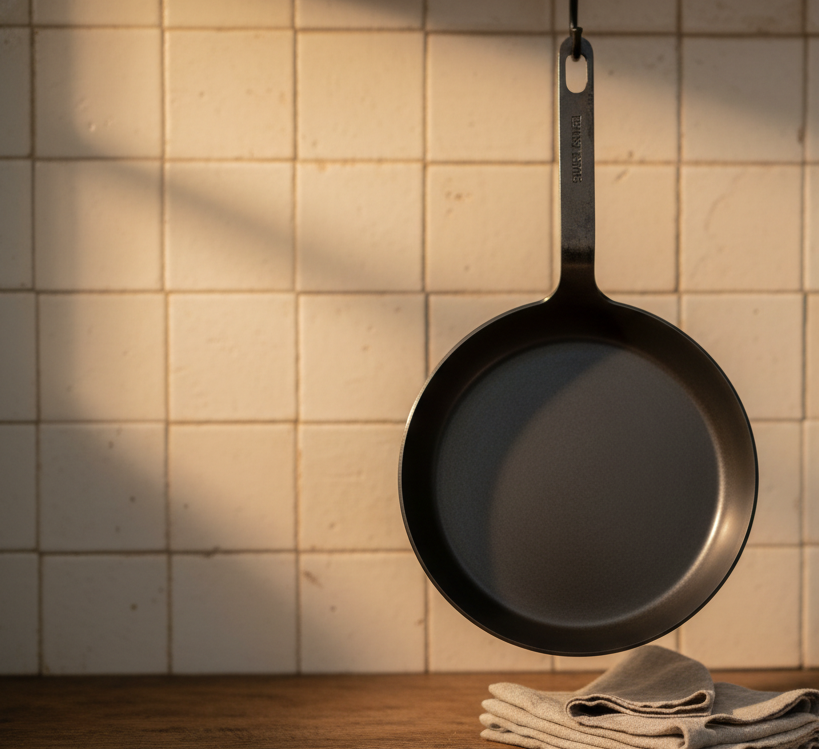
Our pans are forged from a single sheet of carbon steel: 3mm on the 27cm, 4mm on the 30cm. No rivets, no welds, no bonded handle, no coating. The whole pan, cooking surface and handle, is a single seamless piece of steel. When there are no rivets and no seams, there are no crevices for old oil, food or grime to hide and burn into: the surface you cook on and the surface you clean are the same continuous thing.
Then there's what we do to that raw steel. Bare carbon steel is beautiful but stubborn at the start: the first few seasonings can be finicky. Our proprietary Carbon Lock™ Surface is a heat-and-glass treatment that primes the raw steel to grip seasoning from the very first layer, so the pan turns naturally non-stick fast. It's a way of preparing the steel, not a coating added on top. The pan is still bare carbon steel: PFAS-free, PTFE-free, PFOA-free, no synthetic coatings of any kind. It works on induction, gas, electric, oven and open flame, and carries a lifetime guarantee, the opposite promise of a disposable non-stick pan.
So when you add it up (a coating-free material, a naturally grown non-stick surface, a single seamless piece with nowhere for gunk to hide, and no synthetic chemistry anywhere), you land on about the cleanest cooking surface you can put on a stove. If you're curious why the how-it's-made part matters so much, our note on why artisan pans matter for serious home cooks is worth a read.
How to care for it so the natural surface lasts
The trade-off for a coating-free pan is a small routine. It's genuinely easy once it's a habit, and it's the reason the pan outlives every non-stick you'll ever own.
- Season it before first use and let those first layers build. Thin oil, high heat, a little patience.
- Cook with a little fat, especially early on. It feeds the patina.
- Clean while warm with hot water and a brush. Mild soap is fine on a well-seasoned pan (the modern "never use soap" panic is overblown); just don't scour it back to bare metal.
- Dry it completely and immediately. This is the one non-negotiable: bare steel will rust if left wet. A quick wipe with a drop of oil after drying keeps it protected.
- If it rusts or sticks, don't panic. Scrub, re-season, carry on. Nothing about a carbon steel pan is permanently ruined: that's the whole point.
Our full care and seasoning guide walks through the first seasoning step by step if you want to get it right from day one.
Key takeaways
- PFAS is the umbrella; PTFE (Teflon) is the coating; PFOA is the old processing chemical, and the concern lives in the coating.
- Coated non-stick is a consumable that scratches, wears and eventually sheds, no matter how well you treat it.
- "PFOA-free" is not "PFAS-free," and "ceramic" coatings still wear out. Ask one question: is there a coating at all?
- Coating-free options are stainless, cast iron, carbon steel and solid ceramic. Carbon steel is the most versatile of the four.
- Carbon steel's non-stick is grown, not applied: polymerised oil, no chemistry, and it improves with use.
- A seamless, single-piece pan with no coating has nowhere for grime to hide and nothing to shed: one of the cleanest surfaces you can cook on.
Cook on nothing but steel
If you've been eyeing your scratched non-stick and quietly wondering whether it's time, this is the honest upgrade: a pan with no coating to wear out, no forever chemicals, and a surface that gets better the more you use it. The 27cm carbon steel sauté pan (€99) is the perfect everyday size for 2 to 3 people: eggs, sears, weeknight sautés. If you cook for 3 to 4 people or want more room to move, the 30cm carbon steel sauté pan (€119) gives you that extra surface. Both are forged from a single seamless sheet of carbon steel, primed with our Carbon Lock™ Surface, PFAS- and PTFE-free, and backed by a lifetime guarantee. Buy it once, season it, and cook on real steel for good.
FAQ
Is carbon steel really non-toxic and PFAS-free?
Yes. Carbon steel is just iron and a small amount of carbon: no synthetic coating, so no PFAS, no PTFE and no PFOA. Its non-stick quality comes from seasoning, which is polymerised cooking oil bonded to the steel, not an applied chemical layer. There's nothing on the surface that a coated pan has.
Is my old Teflon pan dangerous to keep using?
An intact PTFE coating used at moderate heat is generally considered low-risk by bodies like the EPA and Consumer Reports. The real trigger to replace it is wear: once the coating is scratched, flaking or overheating, it can shed particles and break down, and that's the point to retire it. If in doubt, and especially if the surface looks worn, it's reasonable to move on.
Does the Carbon Lock™ Surface count as a coating?
No. It's a heat-and-glass treatment that prepares the raw steel so it grips seasoning from the first layer (a way of priming the metal, not a layer added on top). The pan is still bare carbon steel: PFAS-free, PTFE-free and free of any synthetic coating.
How long does a carbon steel pan last compared to non-stick?
A non-stick pan is usually a few-year consumable. A well-cared-for carbon steel pan lasts decades, effectively a lifetime, which is why ours carries a lifetime guarantee. The seasoning improves with use rather than wearing out, so instead of replacing the pan you simply keep cooking on it.