

How to use an induction stove: a beginner's guide
TL;DR:
- Using an induction stove requires magnetic cookware like carbon steel or cast iron, confirmed by a magnet test. Proper technique involves placing the pan centrally, starting with low power, and adjusting settings quickly since induction heats almost instantaneously. When mastered, induction cooking offers faster, safer, and more precise results than gas, but choosing the right pan is essential for optimal performance.
Switching to an induction stove can feel like learning to drive a completely different car. The controls look foreign, your old pans suddenly do not work, and you are not sure why your water is not boiling. Knowing how to use an induction stove properly changes all of that. This guide walks you through everything from checking your cookware and powering on the hob, to cooking a proper sear and avoiding the most common beginner mistakes. By the end, you will cook with more confidence and less guesswork.
Table of Contents
- Key takeaways
- Getting your equipment ready
- How to use an induction stove, step by step
- Common mistakes and how to fix them
- What to expect when you get it right
- My honest take on making the switch
- The right pan makes induction cooking far easier
- FAQ
Key takeaways
| Point | Details |
|---|---|
| Cookware compatibility matters | Only magnetic pans work on induction. Run the magnet test before you start. |
| Pan size affects sensor detection | A pan too small for the cooking zone will not activate the hob at all. |
| Induction responds fast | Adjust power in small steps. The heat changes almost instantly. |
| The surface stays cool | Only the pan gets hot, so spills do not burn on and the glass wipes clean. |
| Carbon steel is ideal | It is magnetic, heats evenly, and seasons naturally for better cooking results. |
Getting your equipment ready
Before you turn anything on, you need to check that your cookware will actually work. Induction hobs heat pans using magnetic fields, so only cookware with a magnetic base will respond. Glass, copper, and most aluminium pans do not work at all. Cast iron, carbon steel, and some stainless steel pans do.
The quickest way to check is the magnet test. Hold a fridge magnet to the base of your pan. A firm magnetic pull means the pan is compatible. If the magnet slides off or barely sticks, that pan will not work on induction.
Here is a quick reference for common cookware materials:
| Material | Works on induction? | Notes |
|---|---|---|
| Carbon steel | Yes | Excellent choice. Heats evenly and seasons well. |
| Cast iron | Yes | Works well but slow to heat up. |
| Magnetic stainless steel | Yes | Check with magnet. Not all grades are magnetic. |
| Aluminium | No | Unless it has a magnetic base plate. |
| Copper | No | Decorative only on induction. |
| Glass or ceramic | No | Not compatible. |
Beyond material, the base of the pan needs to be flat. Flat-bottomed pans that match your cooking zone size perform best. A warped or rounded base causes uneven heating and can confuse the sensor.
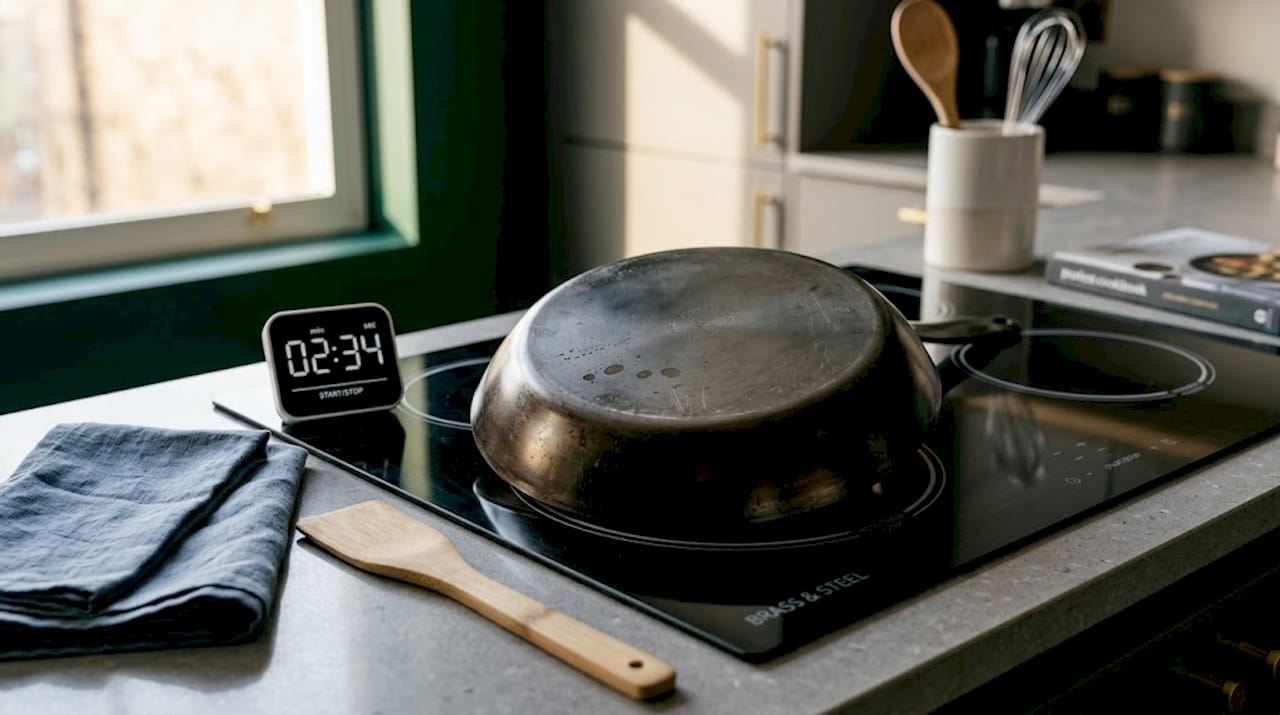
Pro Tip: Before your first cook, wipe the glass surface of the hob with a damp cloth and dry it thoroughly. A clean surface makes both cooking and cleanup far easier, and lets you spot any damage before you start.
You do not need any special tools beyond compatible pans and a flat, stable surface to place the hob on. If you are fitting a built-in induction range, check your home’s electrical supply first. Replacing a traditional stove with a full induction range can cost between $2,000 and $8,000 and may require electrical upgrades, depending on your setup.
How to use an induction stove, step by step
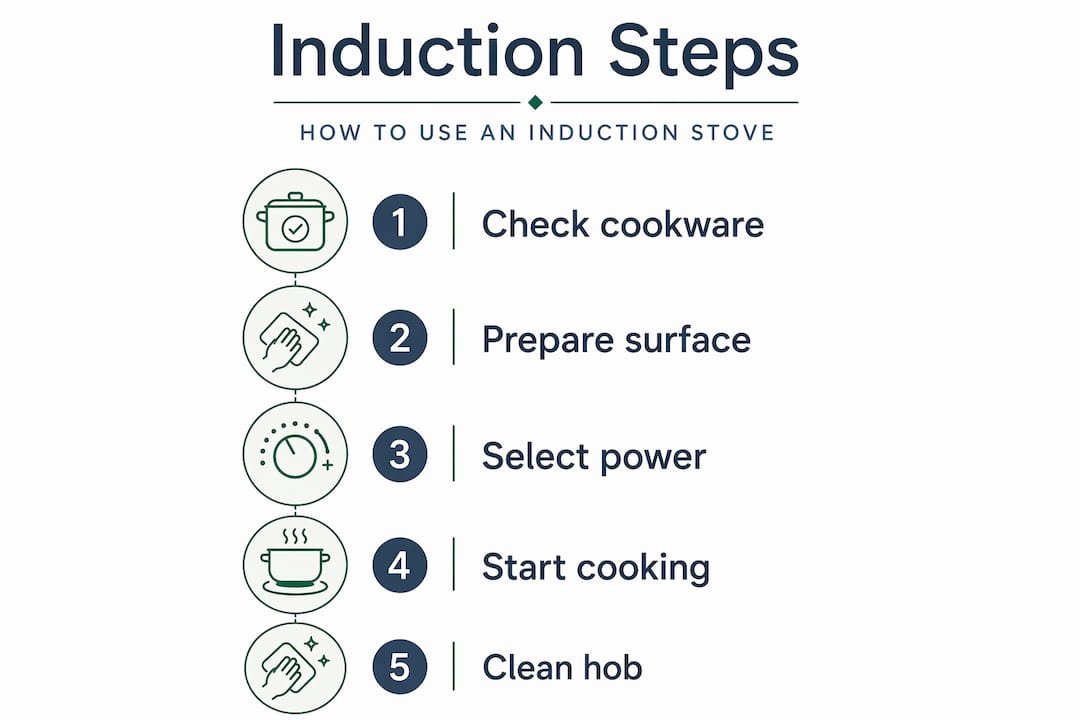
Once your cookware is sorted, the actual process is straightforward. Here is how to cook on an induction cooktop from the moment you switch it on.
-
Place your pan on the cooking zone. Centre it over the ring markings on the glass. The pan should cover most of the zone but not hang over the edges significantly.
-
Turn the hob on. Most models have a power button or touch control. Press and hold it until the display lights up.
-
Select your cooking zone. On multi-zone hobs, tap the zone you want to use. It will highlight on the display.
-
Set your power level or temperature. Induction hobs usually offer a numbered scale, typically 1 to 9 or 1 to 12, or a specific temperature in degrees. Start lower than you think you need. Induction responds almost instantly to adjustments, so you can always increase from there.
-
Wait for the pan to heat. Unlike gas, there is no visible flame, so touch the pan handle briefly or hover your hand near the pan to feel warmth. You will hear a faint hum as the magnetic field does its work.
-
Add your ingredients. For most tasks, add oil first and let it shimmer before adding food. This is the same rule as any other hob.
-
Adjust power as needed. For boiling water, use a high setting. For simmering, drop to a low setting once it reaches temperature. For searing, use a high setting and preheat the pan for a minute or two first. Induction heats water two to three times faster than gas, so adjust your timings accordingly.
-
Turn the hob off when done. Remove the pan and switch the zone off. Most hobs also have an auto-off function if the pan is removed.
Pro Tip: For searing meat, preheat the dry pan for 90 seconds on a high power setting before adding oil. Carbon steel and cast iron hold heat brilliantly at this point, giving you a crust that a lower-temperature pan simply cannot produce. Learn more about using carbon steel on induction for the best searing results.
Adapting your techniques
Boiling, frying, and simmering all work the same way as on gas, just faster. Stir-frying is worth a mention because the technique changes slightly. On gas, you move the wok up and around the flame. On induction, you need to keep the base in contact with the zone to maintain heat transfer. Use a flat-bottomed pan rather than a traditional round-bottomed wok, and keep it on the surface as much as possible.
Common mistakes and how to fix them
Most problems on an induction hob come down to one of three things: the wrong pan, the wrong size, or a setting error. Knowing what to look for saves a lot of frustration.
-
The hob does not heat at all. This usually means the pan is not compatible, or it is too small for the zone. A pan smaller than the cooking zone may not trigger the sensor, which the hob reads as no pan present. Try a larger pan or a different zone.
-
The pan heats unevenly. A warped base is the culprit here. Run your hand across the base when cold. If it rocks on a flat surface, it will not transfer heat consistently on induction.
-
An error code appears on the display. Most hobs show an “E” code or similar when they detect an issue. Check the manual for your specific model, but common causes are an incompatible pan, overheating, or a ventilation blockage underneath the unit.
-
The hob turns off on its own. Many induction hobs have a safety cut-off timer. Check the settings and adjust the timer if needed.
-
Food is burning on the outside but raw inside. The power level is too high. Because induction is so responsive, it is easy to overcook on settings you would consider moderate on gas. Drop the power by two levels and cook more slowly.
Cleaning the glass surface after each use keeps the hob in good condition. Because the glass surface stays cool around the cooking zone, spills do not bake on. A damp cloth and a gentle wipe is usually all you need. Avoid abrasive pads, which can scratch the glass.
What to expect when you get it right
Once you get comfortable with the settings and your cookware, induction cooking genuinely changes how you work in the kitchen. The speed alone is noticeable. Water boils quickly, sauces reduce in far less time, and you spend less time standing over a hob waiting.
Temperature control is where induction really stands out. Because the pan is heated directly rather than the air around it, you get precise and consistent results that are hard to replicate on gas. Delicate tasks like melting chocolate or making a custard become much more manageable.
There are meaningful safety benefits too. With no open flame, the risk of accidental burns from brushing against the hob drops considerably, which matters if you cook with children nearby. Induction also eliminates combustion-related indoor air pollution that gas stoves produce. If you have ever noticed your kitchen feeling stuffy after cooking, that is worth thinking about.
Practically speaking, the cool surrounding surface of the hob means you can rest a spoon or a small bowl right next to the active zone without it getting hot. That is a small thing, but it changes how you organise yourself while cooking.
My honest take on making the switch
I have watched a lot of home cooks get frustrated with induction in the first week, then become completely converted by week three. The learning curve is real, but it is short.
The biggest mistake I see is treating induction like gas. People crank the power to the highest setting because that is what they used to do on a gas ring, and then wonder why everything scorches. Induction at level 7 is not the same as gas on full blast. Start lower than feels natural. You can always turn it up.
The second thing I would say is to invest in the right pan before you invest in technique. A good carbon steel or cast iron pan will behave predictably on induction every single time. A thin, warped, or incompatible pan will give you grief regardless of how carefully you cook. Get the cookware selection right first, and everything else clicks into place much faster.
Induction cooking is quieter, cleaner, and more precise than gas. Once you have adjusted your instincts for it, most cooks find they do not want to go back.
— Davide
The right pan makes induction cooking far easier
If you are ready to get the most out of your induction hob, the pan you use matters more than almost anything else. At Brass-steel, we make carbon steel sauté pans forged from a single piece of steel, with no rivets and no coatings. They are fully induction compatible, heat evenly from the first minute, and build a natural nonstick seasoning over time. The 27 cm and 30 cm carbon steel pans handle everything from a weeknight sauté to a high-heat sear with equal confidence. If you want a pan that works with your induction hob rather than against it, and that will still be in your kitchen in twenty years, this is where to start. Browse the full range at Brass-steel and see what quality induction cookware actually feels like.
FAQ
What pans work on an induction stove?
Only pans with a magnetic base work on induction. Carbon steel, cast iron, and magnetic stainless steel are all compatible. Use the magnet test: a firm pull on the base means the pan will work.
How do I know if my induction hob is working?
Place a compatible pan on the cooking zone, turn the hob on, and select a power level. You should hear a faint hum and the pan will warm up within seconds. If nothing happens, check that the pan is large enough to cover the zone sensor.
Why is my induction hob not heating my pan?
The most common reason is that the pan is too small for the cooking zone, so the sensor does not detect it. Try a larger pan or move to a smaller zone on the hob.
Is cooking on induction the same as gas?
The technique is similar but the heat response is much faster. Reduce power levels compared to what you would use on gas, especially for tasks like frying and sautéing, and adjust your timing to account for the speed difference.
Is an induction stove safe to use?
Yes. Because there is no open flame, the fire risk is lower than gas. The glass surface around the cooking zone stays cool to the touch, and induction produces no combustion emissions, making it better for indoor air quality.