

Best pan types for restaurant kitchens: A chef's guide
TL;DR:
- Carbon steel pans are favored by professionals for their responsiveness, quick heating, and natural nonstick surface.
- They require proper maintenance like immediate drying and light seasoning to prevent rust and maintain performance.
- Choose stainless steel or cast iron when working with acids or needing steady, slow heat retention instead of responsiveness.
The pan you reach for first tells a lot about how you cook. In a professional kitchen, that choice is rarely sentimental — it is strategic. Every service puts pans under extreme pressure: sustained high heat, rapid temperature shifts, heavy use across dozens of covers, and the constant demand for consistent results. Choosing the wrong pan type costs you time, finish quality, and sometimes an entire dish. This guide cuts through the noise to give you a clear, experience-led breakdown of pan materials, honest comparisons, and a focused case for why carbon steel has earned its place on the professional stove.
Table of Contents
- Essential criteria for pan selection in restaurant kitchens
- Key restaurant pan types: Carbon steel, stainless steel, and cast iron
- Why carbon steel pans excel in professional kitchens
- When to choose stainless steel or cast iron instead
- Why carbon steel is the unsung hero — but only if you know its quirks
- Upgrade your kitchen: Discover premium carbon steel solutions
- Frequently asked questions
Key Takeaways
| Point | Details |
|---|---|
| Carbon steel advantages | Carbon steel offers lightness, fast heat response, and naturally develops a nonstick surface ideal for chefs. |
| Material fit matters | The best pan depends on your menu, kitchen demands, and willingness to maintain seasoning. |
| Brands chefs trust | Matfer Bourgeat, Mauviel, and de Buyer set the standard for carbon steel performance. |
| Care is crucial | Proper seasoning and cleaning routines unlock the long-term benefits of carbon steel in busy kitchens. |
Essential criteria for pan selection in restaurant kitchens
Before comparing materials, you need a firm set of criteria. Not all kitchens are alike — a fine dining operation searing duck breasts has different demands from a busy brasserie turning out omelettes every four minutes. That said, every serious kitchen shares a common baseline.
Weight and agility sit at the top. A pan you can lift, toss, and flip one-handed across a full service is worth its weight in gold. Arm fatigue is real, and a pan that is too heavy slows you down when the pass is filling up.
Heat responsiveness is equally critical. You need a pan that reacts quickly when you reduce the flame, not one that keeps scorching your protein thirty seconds after you have moved it off the burner. This is why carbon steel performance is so frequently praised — the material’s thermal properties allow rapid, precise adjustment.
Here are the core criteria professional chefs weigh when selecting pans:
- Heat distribution: Even surface temperature prevents hot spots and uneven cooking.
- Responsiveness: How quickly the pan reacts to temperature changes on the hob.
- Weight: Directly affects speed, control, and chef endurance during long services.
- Durability: Professional pans must withstand daily battering, high heat, and rough cleaning.
- Nonstick properties: Whether natural (seasoned) or engineered, this shapes what you can cook and how you can clean.
- Reactivity: Reactive metals interact with acidic ingredients, affecting flavour and appearance.
- Maintenance burden: In a busy kitchen, pans that demand complex upkeep become a liability.
- Cooktop compatibility: Induction is now standard in many European kitchens — compatibility is non-negotiable.
As professional chefs confirm, carbon steel pans are favoured for their lighter weight versus cast iron, natural nonstick patina built through seasoning, high-heat searing capability, and remarkable versatility.
Pro Tip: Always match the pan to the dish. Using a heavy cast iron pan when you need to toss vegetables wastes time and tires out your team. Matching tool to task is the first habit of a precise cook.
Key restaurant pan types: Carbon steel, stainless steel, and cast iron
Having established what chefs value, let’s examine the main contenders in the restaurant kitchen pan lineup.
Carbon steel
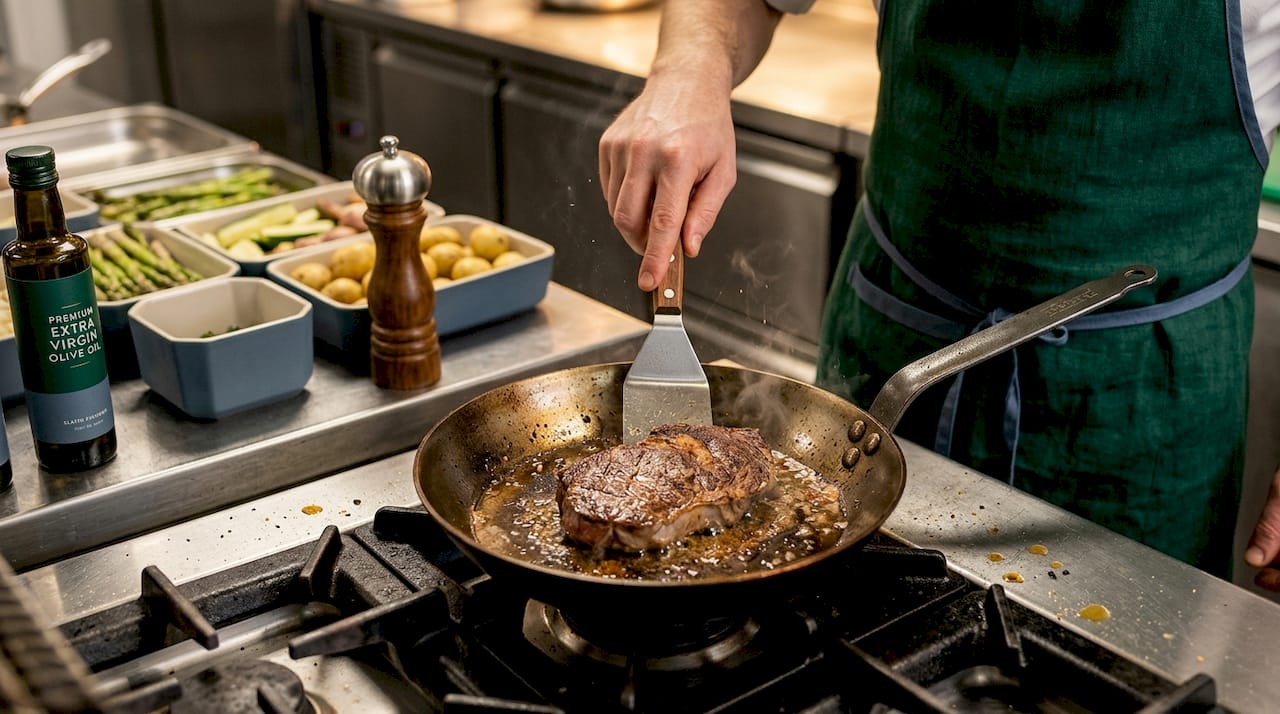
Carbon steel is essentially iron alloyed with a lower carbon content than cast iron, which makes it lighter and more responsive. It requires seasoning to build its naturally nonstick surface, but once that patina is established, it handles searing, sautéing, and even delicate work like eggs or crêpes beautifully.
Strengths: Fast preheating, superb sear quality, natural nonstick once seasoned, lighter than cast iron, works across all cooktops including induction.
Weaknesses: Reactive to acidic ingredients (wine reductions, tomato sauces), requires maintenance, seasoning takes time to establish.
Best for: Steaks, fish fillets, eggs, crêpes, vegetables, chicken thighs.
Stainless steel
Stainless steel is the reliable workhorse of most professional kitchens. Non-reactive, easy to clean, and durable, it suits a huge range of dishes. However, it is not naturally nonstick and benefits from cladding (layers of aluminium or copper core) for better heat distribution.
Strengths: Non-reactive, low maintenance, dishwasher-safe, excellent for fond development (the browned bits used for sauces).
Weaknesses: Poor natural nonstick, prone to hot spots in cheaper single-layer versions, not as responsive at high heat.
Best for: Pan sauces, braising, poaching, stocks, anything acidic.
Cast iron
Cast iron retains heat like nothing else. Once up to temperature, it holds it steadily — ideal for dishes that need consistent, deep surface heat. It is also oven-safe to very high temperatures.
Strengths: Exceptional heat retention, naturally nonstick once well-seasoned, very durable.
Weaknesses: Heavy (often 3 to 6 kg), slow to heat, slow to cool, can crack under thermal shock, requires seasoning upkeep.
Best for: Griddling, searing large cuts, cornbread, slow oven dishes.
| Criterion | Carbon steel | Stainless steel | Cast iron |
|---|---|---|---|
| Heat-up speed | Fast | Moderate | Slow |
| Heat responsiveness | Excellent | Good | Poor |
| Weight | Light to moderate | Moderate | Heavy |
| Natural nonstick | Yes (seasoned) | No | Yes (seasoned) |
| Acid compatibility | Reactive | Non-reactive | Reactive |
| Maintenance | Moderate | Low | Moderate |
| Induction compatible | Yes | Yes | Yes |
“Carbon steel is lighter and more responsive than cast iron, but requires maintenance; it excels at high-heat searing compared to stainless, which is lower maintenance but produces an inferior sear.” — Chefs’ pan preferences
As
For a detailed side-by-side breakdown, explore carbon steel vs stainless steel and cast iron vs carbon steel in our guides.
Why carbon steel pans excel in professional kitchens
Now let’s focus on why carbon steel is so beloved among professional chefs across Europe.
The case starts with performance data. Testing from Serious Eats shows that leading carbon steel pans from Matfer Bourgeat, Mauviel, and de Buyer excel in even heating, develop reliable nonstick surfaces after seasoning, and perform across tasks ranging from eggs and crêpes to high-heat chicken searing. These are not niche use cases. These are the everyday demands of a working kitchen.
Why professional kitchens choose carbon steel:
- Speed: Preheats faster than cast iron and retains a strong sear temperature once at heat.
- Manoeuvrability: Light enough to toss and flip with one hand across a full service shift.
- Versatility: Moves seamlessly from hob to oven, handles delicate proteins and robust sears alike.
- Natural nonstick: No synthetic coatings to chip or degrade. The patina improves with every use.
- PTFE-free and PFOA-free: No toxic coating risks, even at very high temperatures. Critical in professional settings where health and safety compliance matters.
- Single-piece construction: Quality carbon steel pans forged from one piece have no rivets or welds to trap food or fail under stress.
- Longevity: A well-maintained carbon steel pan can last decades, making it cost-effective over the long term despite the initial investment.
Heat benchmark tests show carbon steel outperforms aluminium and copper in sear retention during sustained cooking tests, while single-piece forged construction prevents the warping that can plague cheaper stamped pans under extreme heat.
| Material | Sear quality | Warping risk | Weight | Patina possible |
|---|---|---|---|---|
| Carbon steel | Excellent | Low (forged) | Light/moderate | Yes |
| Stainless steel | Good | Low | Moderate | No |
| Cast iron | Excellent | Very low | Heavy | Yes |
| Aluminium (coated) | Moderate | Moderate | Light | No |
Pro Tip: To maximise your carbon steel pan’s nonstick and searing capability, always preheat it gradually before adding oil. A cold pan hit with high heat risks uneven expansion. Once the pan is hot and a drop of water beads and dances on the surface, you are ready. Add oil, allow it to shimmer, then introduce your protein. This sequence builds a better sear and protects your seasoning.
Explore the best carbon steel pans for chef settings to see how leading options compare, or read our chef pan choices guide for a broader professional context.
When to choose stainless steel or cast iron instead
While carbon steel dominates in many situations, there are scenarios where another pan type takes the lead.
-
Acidic-heavy menus: If your station regularly produces tomato-based sauces, wine reductions, or dishes featuring citrus and vinegar, a reactive carbon steel surface will strip your seasoning and potentially impart metallic flavour. Stainless steel is the correct tool here. As heat and reactivity research shows, stainless steel handles acid without interaction, making it far better suited to non-reactive cooking tasks where flavour purity is paramount.
-
Kitchens prioritising minimal upkeep: Smaller operations or kitchens where trained care is inconsistent may struggle with carbon steel maintenance. Stainless steel tolerates harsher cleaning, dishwasher cycles, and neglect far better. If your team does not have the bandwidth to season and hand-dry pans correctly after every service, stainless is more forgiving — even if it sacrifices some searing quality. For a fuller picture of where each material fits, see our comparison of stainless steel pans and cast iron vs stainless.
-
High-mass, slow-cook applications: Cast iron’s weakness is also its strength. It heats slowly, yes — but once at temperature, it holds heat with remarkable stability. For griddle work, thick-cut steaks needing consistent surface contact, cornbread, or any application where sustained, even surface heat matters more than responsiveness, cast iron wins. A carbon steel pan will cool faster when a cold cut is placed on it; cast iron barely notices.
Rely on carbon steel for searing, sautéing, and agile cooking. Reach for stainless when your dish contains acid. Choose cast iron when mass and steady heat matter more than speed. No single pan type wins every situation.
Why carbon steel is the unsung hero — but only if you know its quirks
Now that you have seen the practical tradeoffs, here is a candid perspective drawn from European kitchen floors.
Carbon steel is genuinely one of the most capable materials a professional chef can work with. It is not trendy marketing — the physics back it up and so does the collective experience of generations of French, Italian, and now Polish kitchen professionals. But it has a reputation problem, and that reputation comes from one source: people who use it incorrectly.
The most common failure is maintenance neglect. A carbon steel pan that is not dried immediately after washing will rust within hours in a humid kitchen. One that is soaked in a sink — as often happens in understaffed kitchens — can develop surface rust that sets back weeks of seasoning work. The solution is not to avoid carbon steel. The solution is discipline and a good carbon steel care routine built into your kitchen’s closing procedures.
The second common mistake is over-oiling during seasoning. Thick oil layers turn sticky, not nonstick. The correct approach is a near-invisible coat of high-smoke-point oil, wiped almost entirely off before baking. It sounds counterintuitive — you are essentially seasoning with almost no oil — but that thin polymerised layer is what creates the slick, durable surface that gets better with every use.
For novice cooks or kitchens new to carbon steel, the learning curve is real. We do not think that makes it the wrong choice — it makes it the right choice for people committed to understanding their tools. A stainless pan that tolerates neglect may also be a pan that never reaches its full potential. Carbon steel demands respect, and it rewards it with performance that simply cannot be replicated by synthetic coatings or thicker, heavier alternatives.
Our honest view: carbon steel is the pan for chefs who cook with intention. If you are building a kitchen around performance, longevity, and a genuine connection to your tools, carbon steel belongs at the centre of your batterie de cuisine.
Upgrade your kitchen: Discover premium carbon steel solutions
Armed with this knowledge, you are ready to outfit your restaurant or home kitchen with tools worthy of your ambitions.
At Brass & Steel, we manufacture single-piece forged carbon steel pans in Jarocin, Poland, designed specifically for the demands of professional and serious home cooking. Our 27 cm carbon steel sauté pan at €99 and 30 cm carbon steel sauté pan at €119 offer 3 mm and 4 mm thickness options, covering everything from everyday searing to large-batch restaurant cooking. Free from PTFE, PFOA, and synthetic coatings, and compatible with induction cooktops, our pans are built to perform harder and last longer than anything mass-produced. Explore our full range and chef-driven guides at brass-steel.com.
Frequently asked questions
Why do professional chefs use carbon steel pans instead of nonstick or aluminium in restaurants?
Carbon steel pans provide better high-heat searing, develop a natural nonstick patina through seasoning, and offer far greater durability for heavy professional use than standard nonstick or aluminium alternatives.
Is carbon steel better than stainless steel for all dishes?
Carbon steel excels at searing and high-heat cooking but is reactive to acids, while stainless steel performs better for acidic sauces and dishes requiring even heat distribution without reactivity concerns.
What is the main upkeep challenge with carbon steel pans?
Seasoning maintenance and immediate drying after washing are essential to prevent rust, which is more demanding than with stainless or nonstick alternatives — but the performance return justifies the effort.
Which brands of carbon steel pans perform best in chef settings?
Testing confirms that Matfer Bourgeat, Mauviel, and de Buyer are highly rated for even heat distribution and consistent nonstick patina after proper seasoning in professional kitchen environments.
Recommended
- What pans do chefs use: expert guide to carbon steel in 2026 – Brass & Steel
- 7 Different Types of Frying Pans Every Chef Should Know – Brass & Steel
- 7 Essential Kinds of Frying Pan Every Chef Should Know – Brass & Steel
- 7 Essential Professional Cookware Types for Every Chef – Brass & Steel
- Choosing Non-Slip Kitchen Mats: Safer Commercial Spaces – Mats4U USA