What is commercial-grade cookware: a professional guide

TL;DR:
- Commercial-grade cookware is designed for professional foodservice environments, offering superior durability, heat resistance, and sanitation. It is made from materials like stainless steel, cast iron, carbon steel, or aluminum, with construction standards such as thicker gauges and multi-layer bases to withstand high temperatures and repeated washing. The key differences from home cookware include higher temperature tolerance, heavier construction, NSF certification, and handle design focused on hygiene and longevity.
Commercial-grade cookware is defined as pots, pans, and bakeware engineered specifically to meet the intensive demands of professional foodservice environments, where durability, heat resistance, and consistent performance are non-negotiable. The term “commercial-grade” is widely used in culinary circles, though the recognised industry term is professional cookware or foodservice cookware. Both refer to the same category: kitchen tools built to outlast home-grade equivalents by years, sometimes decades. If you cook seriously, whether in a restaurant or at home, understanding what separates these two categories will change how you shop and how you cook.
What is commercial-grade cookware made from?
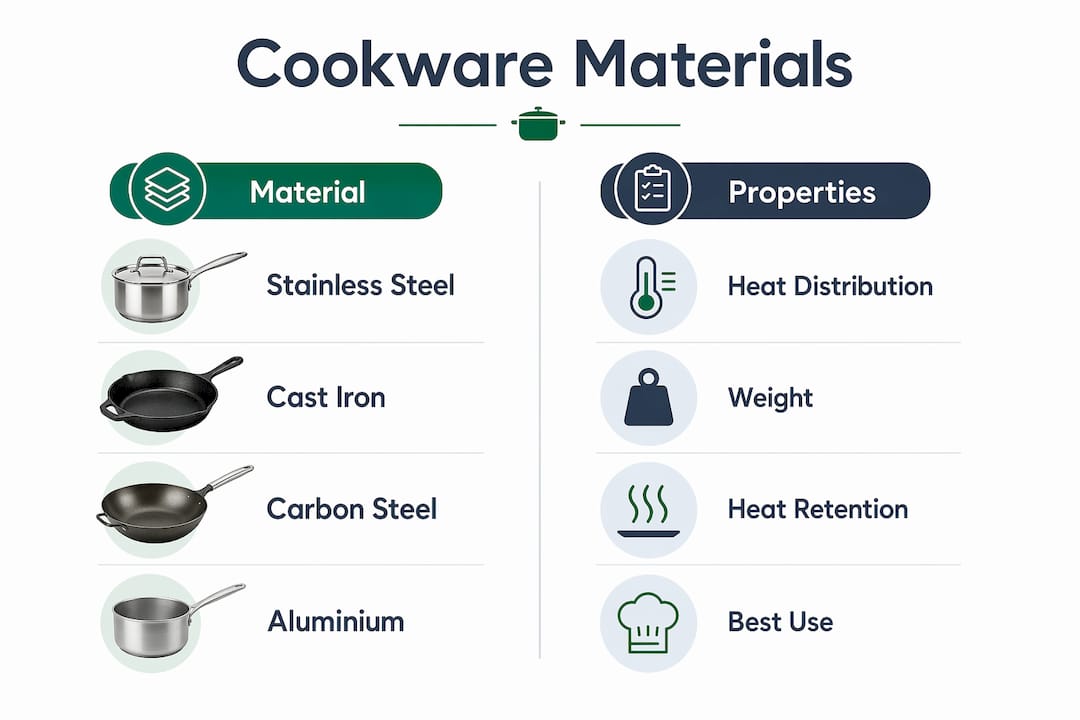
Commercial-grade cookware is designed for professional foodservice, withstanding high-volume use, heavy-duty washing, and temperature extremes. The materials used are the single biggest factor in whether a piece of cookware earns that classification. Four materials dominate the professional kitchen: stainless steel, cast iron, carbon steel, and aluminium. Each serves a different purpose, and choosing the wrong one for your cooking style is an expensive mistake.

Stainless steel is the most common material in commercial kitchens. Grade 304 stainless steel (also called 18/10, referring to its chromium and nickel content) is non-reactive, corrosion-resistant, and built for repeated sanitation cycles. Grade 201 stainless is cheaper but corrodes faster under commercial dishwasher conditions. The difference matters enormously in a professional setting.
The construction method matters as much as the material itself. Tri-ply construction combines stainless steel, aluminium, and stainless steel layers for excellent heat distribution and durability in commercial settings. A 4 mm aluminium clad bottom promotes uniform heating and prevents hot spots. This is why professional cookware produces more consistent results than single-layer home pans.
Carbon steel sits between cast iron and stainless in terms of weight and heat retention. It heats faster than cast iron, responds quickly to temperature changes, and builds a natural nonstick patina through seasoning. Brass-steel’s carbon steel sauté pans, forged from a single piece of steel, are a strong example of this category applied at a professional standard.
Cast iron offers unmatched heat retention, making it ideal for searing and oven-to-table cooking. It is heavy and slow to heat, but once at temperature it holds it steadily. Aluminium heats fastest of all and is lightweight, which is why it appears in commercial stock pots and bakeware where speed and volume matter more than retention.
| Material | Heat distribution | Heat retention | Weight | Best use |
|---|---|---|---|---|
| Stainless steel (tri-ply) | Excellent | Good | Medium | Sautéing, sauces, general use |
| Carbon steel | Good | Very good | Medium | Searing, frying, high-heat cooking |
| Cast iron | Moderate | Excellent | Heavy | Searing, braising, oven use |
| Aluminium | Excellent | Low | Light | Stock pots, bakeware, rapid heating |
Pro Tip: When buying commercial-grade stainless steel, check the grade stamped on the base. 18/10 (304) is the professional standard. If it says 18/0 or 201, it is not built for long-term commercial use.
How does commercial cookware differ from home cookware?
The difference between home and commercial cookware is not just price. It is engineering. Commercial cookware can endure sustained oven temperatures of 500°F and above, whereas standard nonstick pots and pans are typically limited to 350 to 400°F. That gap is critical for any cooking that involves broiling, high-heat searing, or moving pans between a commercial burner and a professional oven.
Thickness is another dividing line. Home-grade pans often use thinner gauge materials to reduce cost and weight. Commercial pans use heavier gauge steel or aluminium, which resists warping under repeated thermal cycling. A home pan warped by a single high-heat session on a gas burner is a familiar frustration. A commercial pan is built so that never happens.
Commercial cookware must tolerate commercial dishwasher cycles and thermal shock for sanitation and durability. NSF certification (from the National Sanitation Foundation) is the benchmark here. NSF-certified cookware has been tested to withstand repeated high-temperature washing without degrading. Home cookware carries no such requirement.
Handle design also differs significantly. Professional cookware often uses rivetless or welded handles to eliminate the crevices where bacteria accumulate. Home cookware frequently uses riveted handles, which are harder to clean thoroughly. For a serious cook, this is not a hygiene pedantry. It is a practical difference in how long a pan stays sanitary and structurally sound.
| Feature | Commercial-grade | Home-grade |
|---|---|---|
| Oven temperature tolerance | 500°F+ sustained | 350 to 400°F typical |
| Material gauge | Heavy (3 to 4 mm+) | Light to medium (1 to 2.5 mm) |
| Dishwasher compatibility | NSF-certified cycles | Hand wash often recommended |
| Handle construction | Rivetless or welded | Riveted common |
| Price premium | 50 to 100% higher than consumer grade | Baseline |
Pro Tip: Do not assume a higher price tag means commercial-grade quality. Check for NSF certification, gauge thickness, and handle construction. These are the actual indicators, not the marketing language on the box.
What are the main types of commercial cookware?
Commercial cookware materials include stainless steel, cast iron, carbon steel, and aluminium, each suited for specific tasks and heat properties. The type of cookware you need depends entirely on what you cook and how you cook it. Here is how the main categories break down in a professional context.
Frying and sauté pans are the workhorses of any professional kitchen. Commercial frying pans are built for continuous heavy use across 12-hour shifts, with thick gauge materials, reinforced handles, and NSF certification. They need rapid heat response and compatibility with high-output commercial burners. Carbon steel and stainless steel are the dominant materials here.
Stock pots and sauce pots handle large-volume boiling, simmering, and reducing. They prioritise capacity and even heat distribution over rapid response. Heavy-gauge aluminium or stainless steel with a thick base is standard. A well-made stock pot holds temperature steadily across hours of use without scorching the base.
Bakeware in a commercial context includes sheet pans, hotel pans, and roasting trays. These need to withstand repeated oven cycling without warping. Heavy-gauge aluminium is the most common material, though stainless steel hotel pans are used where corrosion resistance matters more than heat conductivity.
For serious home cooks, the most useful categories to invest in are:
- A carbon steel or stainless tri-ply sauté pan for high-heat stovetop work
- A heavy-gauge stock pot for soups, pasta, and stocks
- A cast iron or carbon steel pan for searing and oven finishing
- A quality sheet pan for roasting and baking
You can find a detailed breakdown of professional cookware types for serious cooks on the Brass-steel blog, which covers each category with specific use cases.
How to choose and maintain commercial-grade cookware
Cookware selection should consider actual kitchen workflows, volume, and menu to choose appropriate materials and construction. Before you spend money, answer three questions: What cooking methods do you use most? What heat source do you cook on? How often will the cookware be used and washed?
Follow this process when evaluating any piece of commercial-grade cookware:
- Check the gauge. For pans, look for 3 mm or thicker. Thinner than that and you are buying home-grade regardless of what the label says.
- Verify the construction. Tri-ply or multi-ply bases outperform single-layer pans for heat distribution. Multi-layer construction is engineered for balanced heat distribution and non-reactive cooking surfaces, which is what professional throughput demands.
- Confirm heat source compatibility. Carbon steel and stainless steel work on all hob types including induction. Cast iron does too. Aluminium without a steel base does not work on induction.
- Look for NSF certification if you are buying for a professional kitchen. For home use, it is a quality signal rather than a legal requirement.
- Assess handle design. Rivetless handles are easier to clean and more hygienic. Welded handles on carbon steel pans, like those from Brass-steel, eliminate the weak points that riveted handles create over time.
For maintenance, the rules differ by material. Stainless steel tolerates dishwashers but benefits from hand washing to preserve its finish. Carbon steel requires seasoning and should never be soaked. Cast iron needs drying immediately after washing and a light coat of oil after each use. Avoiding sudden temperature changes, such as plunging a hot pan into cold water, prevents warping across all materials.
Pro Tip: When evaluating warranties, a commercial-grade manufacturer will typically offer a lifetime or multi-year warranty on the pan body. A short warranty on a supposedly professional product is a red flag worth taking seriously.
Key takeaways
Commercial-grade cookware is defined by material gauge, construction quality, temperature tolerance, and sanitation standards, not by price or marketing claims alone.
| Point | Details |
|---|---|
| Material determines performance | Carbon steel, stainless tri-ply, cast iron, and aluminium each suit different cooking tasks and heat sources. |
| Construction quality is measurable | Look for 3 mm or thicker gauge, multi-ply bases, and rivetless or welded handles as concrete quality indicators. |
| Temperature tolerance sets the standard | Commercial cookware sustains 500°F and above; home-grade nonstick typically fails above 400°F. |
| NSF certification signals professional build | NSF-certified cookware is tested for repeated sanitation cycles, a standard home cookware does not meet. |
| Price premium reflects operational value | Commercial cookware costs 50 to 100% more than consumer equivalents, but the lifespan and performance justify the investment. |
Why I think most cooks misread the commercial-grade label
Most people buying “commercial-grade” cookware are actually buying marketing. The label appears on products ranging from genuine professional tools to lightly reinforced home pans with a higher price tag. After years of cooking with and evaluating professional cookware, the clearest lesson I have learned is this: the spec sheet never lies, but the packaging often does.
The biggest misconception I encounter is that commercial-grade means nonstick. Many commercial users require cookware that endures high oven temperatures and broiling, well beyond nonstick limits. PTFE-coated nonstick pans degrade above 260°C. A real commercial kitchen does not run on nonstick. It runs on seasoned carbon steel, stainless tri-ply, and cast iron.
The second mistake I see is buying by brand rather than by specification. A well-known brand name does not guarantee commercial-grade construction. A pan forged from a single piece of 4 mm carbon steel, with no rivets and no coatings, is a professional tool regardless of who made it. That is the standard worth chasing.
My honest advice: learn to read the spec sheet before you read the price. Gauge, ply construction, handle attachment method, and temperature rating tell you everything. The rest is noise.
— Davide
Brass-steel carbon steel pans: built for serious cooking
Brass-steel designs and manufactures carbon steel sauté pans forged from a single piece of steel, with no rivets, no coatings, and no compromises on heat performance. The 30 cm pan at 4 mm thickness is built for exactly the kind of high-heat, high-frequency cooking this article describes. It works on every hob type including induction, builds a natural nonstick patina through seasoning, and is free from PTFE and PFOA. If you are ready to cook with a pan that meets a genuine professional standard, explore the full carbon steel pan range at Brass-steel. You can also read the professional cookware guide on the Brass-steel blog for deeper guidance on choosing the right pan for your kitchen.
FAQ
What is the commercial cookware definition?
Commercial-grade cookware refers to pots, pans, and bakeware designed for professional foodservice use, built to withstand high-volume cooking, repeated sanitation cycles, and sustained high temperatures. The recognised industry terms are professional cookware or foodservice cookware.
What makes cookware commercial-grade?
The key factors are material gauge (3 mm or thicker), multi-ply or heavy-gauge construction, temperature tolerance above 500°F, NSF certification, and handle design that meets hygiene standards. Price alone does not determine the classification.
What is the difference between home and commercial cookware?
Commercial cookware uses heavier gauge materials, tolerates higher oven temperatures, and is built for NSF-certified sanitation cycles. Home cookware is lighter, typically limited to 350 to 400°F, and is not designed for the thermal cycling demands of a professional kitchen.
Is carbon steel considered commercial-grade cookware?
Carbon steel is widely used in professional kitchens and qualifies as commercial-grade when manufactured to the correct gauge and construction standard. A 3 to 4 mm carbon steel pan with a welded or single-piece handle meets the durability and heat performance criteria of professional cookware.
What are the benefits of commercial cookware for home cooks?
Commercial cookware offers superior heat retention, longer lifespan, and better performance at high temperatures compared to standard home cookware. For serious home cooks who sear, braise, or cook frequently, the investment pays back in consistency and durability over time.